

Topical relevance is one of the most consequential quality factors when assessing a PBN placement page. A link placed on a page that shares genuine subject-matter alignment with your target site carries a different contextual signal than one placed on a page with no thematic connection. Understanding how to evaluate that alignment — across the placement page itself, the surrounding domain, and the linking context — helps you make better decisions about which placements are worth pursuing and which are unlikely to contribute meaningfully to your campaign.
Key Takeaways
- Topical relevance in a PBN placement should be assessed at three levels: the placement page itself, the broader domain, and the immediate linking context within the content.
- Domain history and archived content are strong indicators of whether a site has sustained topical focus over time, not just at the moment of placement.
- Anchor text, surrounding paragraph content, and internal linking patterns all contribute to how a search engine may interpret the contextual relationship between the linking page and your target URL.
- Third-party authority metrics such as DR, DA, and TF are useful screening tools but do not measure topical relevance directly and should not be used as a substitute for content-level review.
- A placement page with strong topical alignment and a coherent content structure is generally more useful than a high-metric page with thin or off-topic content.
Why Topical Relevance Matters for PBN Placements
Search engines use a range of signals to assess the quality and context of a backlink. One of those signals is the thematic relationship between the linking page and the page being linked to. When a PBN placement page covers subject matter that is closely related to your target site’s niche, the link exists within a coherent topical context. This contextual alignment may contribute to how the link is interpreted, though the precise weighting of topical relevance as an individual ranking factor is not publicly documented by Google or other major search engines.
From a practical standpoint, topical relevance also affects the plausibility of the placement. A link from a page about home renovation pointing to a financial services site has no natural editorial logic. Even if the linking domain has strong authority metrics, the absence of subject-matter alignment weakens the contextual case for the link. Conversely, a placement on a page that discusses closely related topics — even if the domain’s authority metrics are moderate — may carry more interpretable signal because the thematic connection is coherent.
For PBN campaigns specifically, topical relevance is a quality dimension that distinguishes well-constructed placements from volume-focused ones. Networks that prioritize subject-matter alignment across their placement inventory tend to produce placements that are harder to dismiss on contextual grounds alone.
Assessing Topical Relevance at the Page Level
The placement page itself is the most direct unit of analysis. Start by reading the page content and asking whether the primary subject matter is genuinely related to your target site’s niche. This is not a binary check — relevance exists on a spectrum. A page about personal finance is broadly relevant to a site selling accounting software, but a page specifically about small business bookkeeping is more precisely relevant. The closer the subject-matter match, the stronger the contextual signal.
Look at the page’s main heading, subheadings, and body content. The topic should be established clearly in the opening section and developed consistently throughout. Pages that introduce a relevant topic in the title but drift into unrelated content partway through present a weaker contextual case. Consistency of subject matter across the full page is a meaningful quality indicator.
Evaluate the depth and specificity of the content. A placement page that covers a topic with genuine detail — explaining concepts, addressing related questions, and using appropriate terminology — signals that the page was created with topical intent rather than as a thin vehicle for link placement. Thin content, keyword-stuffed paragraphs, or content that reads as auto-generated are warning signs regardless of the domain’s authority metrics.
Check whether the page uses semantically related terms and entities that belong naturally to the topic. For example, a page about search engine optimization should naturally reference concepts like crawling, indexing, anchor text, and organic traffic. The presence of a coherent semantic field around the main topic suggests that the content was written with genuine subject-matter knowledge rather than assembled to approximate relevance superficially.
Evaluating the Domain’s Topical History
A single placement page does not exist in isolation. The domain hosting that page has its own topical history, and that history is a meaningful part of the relevance assessment. A domain that has consistently covered a specific niche over several years presents a different contextual profile than one that was recently repurposed from an unrelated topic.
Use the Wayback Machine or a similar web archive tool to review the domain’s historical content. Look at snapshots from different periods to understand what topics the site covered before it became part of a network. If the archived content aligns with the current placement topic and your target niche, that historical consistency strengthens the topical case. If the archived content shows a completely different subject area — or if the domain was previously a parking page, a directory, or a site in an unrelated industry — that gap is worth noting when assessing placement quality.
Review the domain’s current content inventory beyond the placement page. If the site publishes multiple pages on related topics, the placement page exists within a coherent topical cluster. If the placement page is the only piece of content on a relevant topic while the rest of the site covers unrelated subjects, the topical context is thinner than it appears from the placement page alone.
Backlink profile analysis using tools such as Ahrefs, Semrush, or Majestic can also reveal the domain’s topical associations. Examine the anchor text distribution of the domain’s inbound links and the types of sites linking to it. A domain that has historically attracted links from topically related sources has a more coherent niche profile than one whose inbound links come from a scattered range of unrelated industries.
Reviewing the Linking Context Within the Content
Beyond the page topic and domain history, the specific paragraph or section where your link will appear is a critical relevance factor. The sentences immediately surrounding the link — often called the linking context or link neighborhood — shape how the anchor text and destination URL are interpreted in relation to the surrounding content.
Assess whether the paragraph introducing the link discusses a topic that is directly relevant to your target page. If your target page covers a specific product, service, or informational topic, the surrounding text should address that subject or a closely related one. A link embedded in a paragraph about a genuinely related concept is contextually stronger than one inserted into a generic sentence that could accommodate any anchor text without changing the paragraph’s meaning.
Evaluate the anchor text itself in relation to the surrounding content. The anchor should read naturally within the sentence and should reflect a term or phrase that a reader would plausibly follow to learn more about the linked topic. Forced anchor text — where the linked phrase feels disconnected from the surrounding sentence — reduces the contextual coherence of the placement regardless of the page’s overall relevance.
Check whether the content around the link uses related terminology and addresses the same subject area as your target page. If the surrounding paragraph uses vocabulary and concepts that belong to your niche, the link exists within a semantically coherent context. If the paragraph is generic or only loosely connected to your target topic, the contextual signal is weaker even if the page-level topic appears relevant.
Using SEO Tools to Support Relevance Assessment
Several SEO tools provide data points that can support — though not replace — a manual topical relevance review. Understanding what each tool measures and what it does not measure helps you use these resources accurately.
Ahrefs and Semrush both provide organic keyword data for domains and individual pages. Reviewing the keywords a placement page ranks for, or has historically ranked for, gives you a data-driven view of the topics search engines associate with that page. If the ranking keywords align with your target niche, that is a useful corroborating signal. If the page ranks for keywords in an unrelated category, that discrepancy is worth investigating before accepting the placement.
Majestic’s Topical Trust Flow categories offer a domain-level view of topical associations based on the link profile. A domain with a strong Topical Trust Flow score in a category relevant to your niche has attracted links from topically related sources, which may indicate genuine subject-matter focus. However, Topical Trust Flow reflects the domain’s link profile rather than its content directly, so it should be used alongside content-level review rather than as a standalone relevance measure.
Domain Rating from Ahrefs, Domain Authority from Moz, and Trust Flow from Majestic are authority metrics, not topical relevance scores. A high DR or DA value tells you about the strength of a domain’s link profile relative to other domains; it does not confirm that the domain’s content is relevant to your niche. Treating authority metrics as a proxy for topical relevance is a common assessment error that can lead to accepting placements that are contextually weak despite appearing strong on a metrics dashboard.

Identifying Topical Mismatch and Common Relevance Problems
Recognizing the signs of poor topical alignment helps you filter out placements that are unlikely to serve your campaign well. Several patterns appear frequently in lower-quality PBN placements and are worth checking for systematically.
- Domain repurposing without content alignment: A domain that previously covered one niche has been redirected to a new topic without updating the content inventory. The placement page may appear relevant, but the surrounding site content and historical footprint belong to a different subject area.
- Thin or templated placement pages: The page nominally covers a relevant topic but contains minimal original content, relies on generic filler text, or uses a structure that is clearly replicated across many pages on the same domain.
- Keyword-adjacent but not topically aligned content: The page uses terms that appear in your niche but does not actually address the subject matter in a meaningful way. For example, a page that mentions a keyword in passing within a list of unrelated topics is not genuinely relevant to that keyword’s subject area.
- Inconsistent internal linking: The placement page links to other pages on the domain that cover entirely different topics, suggesting the site lacks a coherent topical structure and the placement page is an isolated content piece rather than part of a thematic cluster.
- Anchor text that does not fit the surrounding content: The paragraph containing the link reads naturally without the anchor, and the linked phrase feels inserted rather than integral to the sentence. This suggests the content was written first and the link was added afterward without adjusting the surrounding context.
Practical Steps for a Topical Relevance Review
A structured review process makes topical relevance assessment more consistent and repeatable, particularly when evaluating multiple placements across a campaign. The following sequence covers the main evaluation points without requiring advanced technical SEO knowledge.
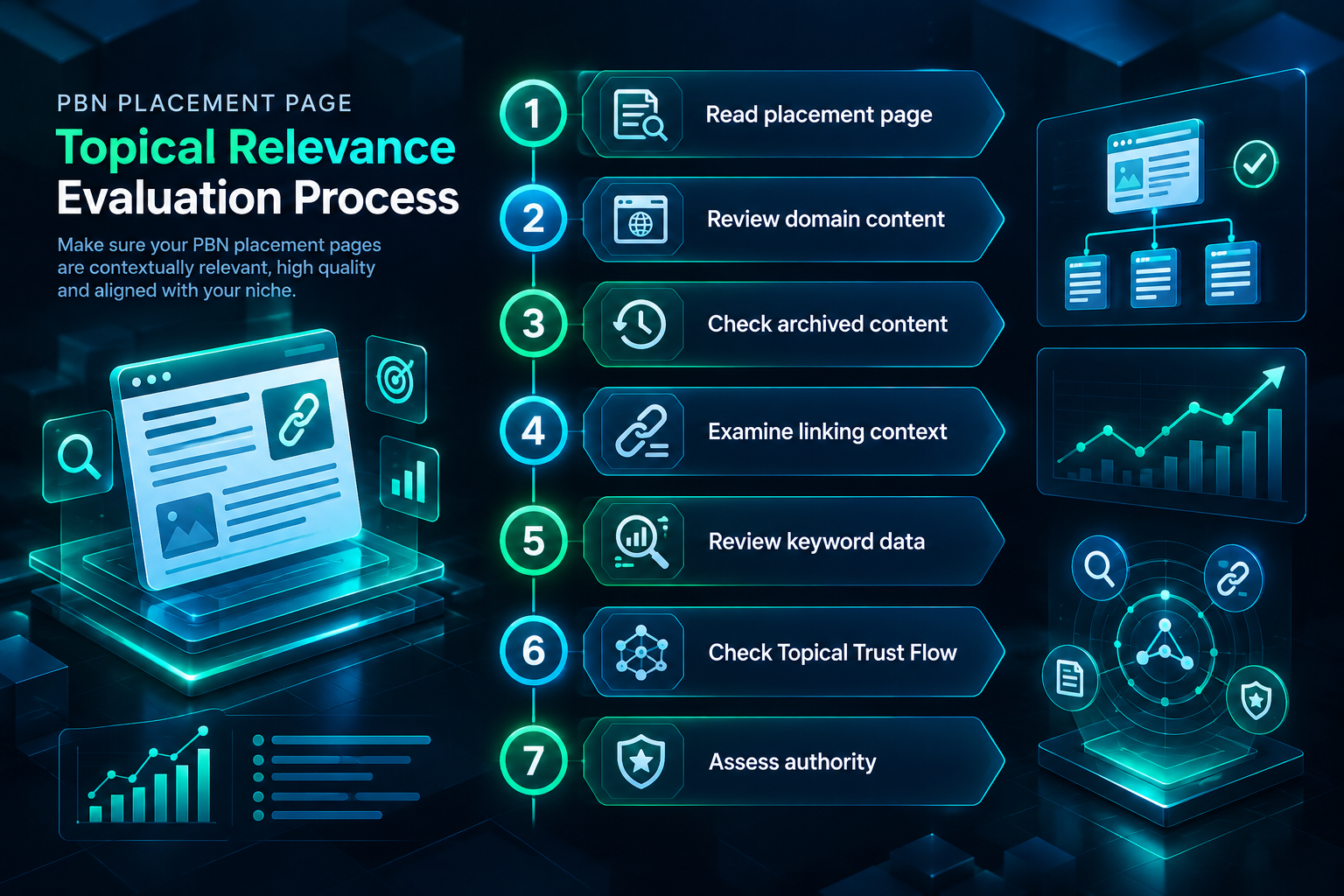
- Read the placement page in full. Assess whether the primary topic is clearly established, consistently developed, and genuinely related to your target niche. Note whether the content uses appropriate terminology and addresses the subject with meaningful depth.
- Review the domain’s content inventory. Browse the site’s other published pages to understand whether the placement page exists within a coherent topical cluster or as an isolated piece on an otherwise unrelated site.
- Check the domain’s archived content. Use a web archive tool to review historical snapshots and confirm whether the domain has maintained consistent topical focus over time or has been repurposed from a different niche.
- Examine the linking context. Read the specific paragraph where your link will appear and assess whether the surrounding content is directly relevant to your target page’s topic and whether the anchor text fits naturally within the sentence.
- Review organic keyword data. Use an SEO tool to check which keywords the placement page ranks for or has ranked for historically. Confirm that these keywords belong to a subject area related to your niche.
- Check Topical Trust Flow categories if available. Use Majestic’s category data as a supplementary signal to understand the domain’s topical associations based on its inbound link profile.
- Assess authority metrics in context. Note DR, DA, or TF values as part of the overall picture, but do not use them as a substitute for the content-level and contextual checks above.
How Topical Relevance Fits Into Broader Placement Quality Assessment
Topical relevance is one dimension of placement quality, not the only one. A complete assessment of a PBN placement page also considers the domain’s link profile health, indexing status, content freshness, technical setup, and the overall structure of the network. Topical relevance that is strong on the page level but undermined by a weak or manipulated link profile, deindexed pages, or obvious footprint issues presents a different risk profile than a placement where all quality dimensions are coherent.
When working with a PBN link provider, ask specifically about how topical relevance is managed across the network’s placement inventory. Providers who can explain their content strategy, domain selection criteria, and placement matching process give you more information to assess placement quality than those who present only authority metrics. Understanding whether placements are matched to your niche based on content review or simply assigned based on available inventory is a meaningful distinction when evaluating a provider’s approach.
Topical relevance also interacts with anchor text strategy. A contextually relevant placement page creates a more natural environment for a keyword-rich anchor text than a page with weak topical alignment. When the surrounding content, the anchor text, and the target page all address the same subject area, the link exists within a coherent semantic context that is more interpretable than a placement where only the anchor text signals relevance while the surrounding content does not.
Frequently Asked Questions
Does topical relevance matter more than domain authority metrics for PBN placements?
Topical relevance and authority metrics address different aspects of placement quality. Authority metrics such as DR, DA, and TF reflect the strength of a domain’s link profile, while topical relevance reflects the subject-matter alignment between the placement page and your target site. Both dimensions are useful, and a placement that scores well on both is generally preferable to one that is strong on only one dimension. Treating authority metrics as a substitute for topical relevance assessment is a common evaluation gap.
How closely related does a PBN placement page need to be to my target niche?
There is no universally defined threshold for topical closeness. In practice, a placement page that covers the same broad industry as your target site is a baseline requirement, while a page that addresses the same specific topic or subtopic represents stronger alignment. The appropriate level of specificity depends on your niche, the competitiveness of your target keywords, and the overall quality of your backlink profile. Closer subject-matter alignment is generally preferable when you have the option to select among multiple placements.
Can I use Topical Trust Flow as the primary relevance check?
Topical Trust Flow from Majestic provides a useful domain-level signal based on the topical associations of a domain’s inbound link profile. It is a helpful supplementary data point but should not replace a manual content review. Topical Trust Flow reflects where a domain’s links come from, not necessarily what the domain’s content covers in detail. Use it alongside page-level content assessment and organic keyword data for a more complete picture.
What should I do if a placement page has strong metrics but weak topical relevance?
A high-metric page with weak topical relevance presents a contextual mismatch that may limit the placement’s interpretable signal. Whether to accept such a placement depends on your campaign goals, the availability of better-matched alternatives, and the overall composition of your backlink profile. If topically relevant placements are available at comparable quality levels, they are generally preferable. If the placement is part of a diversified campaign where other links provide strong topical context, the decision involves more trade-offs.
How does the linking context within a page affect relevance assessment?
The paragraph or section immediately surrounding your link is a meaningful unit of relevance assessment. Even on a broadly relevant page, a link embedded in a paragraph that addresses a closely related subtopic carries stronger contextual signal than one inserted into a generic or loosely connected section. Reviewing the specific linking context — not just the page topic — is an important step in a thorough placement assessment.
Does the age of a domain affect its topical relevance assessment?
Domain age is not a direct measure of topical relevance, but it is relevant to the historical consistency check. A domain that has covered a specific niche for several years has a longer track record of topical focus than one that was recently registered or repurposed. Reviewing archived content from different periods helps you assess whether the domain’s topical profile is genuinely established or recently constructed to appear relevant.
Choosing PBN Placements With Genuine Topical Alignment
Evaluating topical relevance is a practical skill that improves the quality of your placement decisions. The assessment involves reading placement pages carefully, reviewing domain history, examining the linking context, and using SEO tool data as a supporting layer rather than a primary filter. No single metric or tool captures topical relevance completely, which is why a structured manual review remains the most reliable approach.
For campaigns where topical alignment is a priority, working with a provider who can explain their placement matching process and content strategy gives you more confidence in the placements you receive. At PBN Backlinks Service, placement quality and subject-matter alignment are part of how we approach network management. If you want to discuss your niche, review placement options, or assess how topical relevance fits into your broader link-building strategy, we are available to help you evaluate your requirements before committing to a campaign.