

Over-optimized anchor text in a PBN campaign is one of the more common and correctable issues SEO practitioners encounter. When too many backlinks point to a page using the same exact-match or keyword-heavy phrase, the anchor distribution can look unnatural compared to what a page would typically earn organically. Correcting this does not require dismantling a campaign — it requires understanding how anchor profiles work, identifying where the imbalance sits, and making targeted adjustments to future placements and, where possible, existing ones.
Key Takeaways
- Over-optimized anchor text means a disproportionate share of backlinks use exact-match or keyword-rich phrases rather than a natural mix of branded, generic, and partial-match anchors.
- Diagnosing the problem requires pulling your full anchor text report from a backlink analysis tool and comparing the distribution against realistic benchmarks for your niche and page type.
- Correction focuses on diluting the over-represented anchor types by adding varied placements, and where the network allows it, requesting anchor edits on existing links.
- Future PBN placements should follow a planned anchor distribution from the start to prevent the same imbalance from recurring.
- The threshold at which anchor concentration becomes a material concern is not publicly defined by search engines, so assessment should be proportionate and based on the full backlink profile rather than isolated link counts.
What Over-Optimized Anchor Text Actually Means
Anchor text is the clickable, visible text of a hyperlink. In a healthy backlink profile, anchor text tends to vary: some links use a brand name, some use a URL, some use generic phrases like “click here” or “read more”, and some use partial or related keyword phrases. A smaller proportion might use an exact-match keyword — the precise phrase a page is targeting in search. This variation reflects how links are naturally distributed when different websites independently reference a page for different reasons.
Over-optimization occurs when the anchor distribution skews heavily toward exact-match or keyword-rich phrases. In a PBN context, this can happen when every placement is ordered with the same target keyword as the anchor, or when a campaign is built quickly without a planned anchor strategy. The result is a backlink profile where, for example, 60–80% of referring domains use the same phrase, while branded and generic anchors are underrepresented. Whether and how search engines respond to this pattern is not publicly documented with a specific threshold, but an unnatural-looking anchor distribution is a recognized quality signal that experienced SEOs monitor.
It is worth distinguishing between a profile that looks concentrated and one that has triggered a documented response. An imbalanced anchor profile is a condition to address proactively — not automatically evidence of a penalty. The appropriate response is a measured correction, not a wholesale removal of existing links.
Diagnosing the Anchor Text Distribution
Before making any changes, pull a complete anchor text report for the target page. Tools such as Ahrefs, Semrush, or Majestic can generate a breakdown of anchor text across all referring domains pointing to a specific URL. The report should show each anchor phrase, the number of referring domains using it, and the percentage share of the total profile.
When reviewing the report, group anchors into categories rather than evaluating each phrase individually:
- Exact-match anchors: the precise keyword phrase the page targets, with no variation.
- Partial-match anchors: phrases that include the target keyword alongside other words.
- Branded anchors: the website or business name, with or without a keyword.
- Naked URL anchors: the full or partial URL used as anchor text.
- Generic anchors: phrases like “here”, “this page”, “visit”, or “source”.
- Topically related anchors: relevant phrases that describe the page’s subject without using the exact keyword.
Once grouped, assess which category is over-represented. In most over-optimized PBN profiles, exact-match anchors account for a disproportionate share. The specific percentage that constitutes a problem varies by niche, competition level, and the overall profile size — there is no universal published threshold. What matters is whether the distribution looks plausible for a page that has earned links from independent sources over time.
Also note the total number of referring domains. A profile with five referring domains where three use the same exact-match anchor presents a different picture than a profile with 200 referring domains where 40 use the same phrase. Proportions matter more than raw counts, and the broader competitive context — what anchor distributions look like for competing pages — provides useful calibration.
Correcting Existing PBN Anchor Text
Once the over-represented anchor category is identified, the first correction option is to request anchor text changes on existing PBN placements. Whether this is possible depends on the network and provider. Managed PBN services often allow anchor edits as part of ongoing placement maintenance; self-managed networks give full control over this. If anchor edits are available, prioritize changing the anchors that contribute most to the concentration — typically the exact-match phrases on the highest-authority placements.
When requesting or making anchor changes, replace over-used exact-match phrases with alternatives from the underrepresented categories: partial-match phrases that include the keyword alongside a modifier, topically related phrases that describe the page’s subject, or branded anchors that reference the site name. Avoid replacing one over-represented anchor type with another. The goal is to spread the distribution more evenly, not to shift the concentration from one phrase to a different one.

Not every PBN placement will allow anchor edits, particularly if the link is embedded in published content that the site owner does not want to revise. In those cases, the practical correction path is dilution through new placements rather than modification of existing ones.
Diluting the Profile with New Placements
Dilution is the most reliable correction method when existing anchors cannot be changed. By adding new PBN placements — or other contextual backlinks — that use varied anchor text, the proportion of exact-match anchors in the overall profile decreases. This does not remove the existing links; it changes their relative weight within the full distribution.
To dilute effectively, calculate how many new placements are needed to bring the exact-match share to a more balanced level. For example, if 10 out of 15 referring domains currently use an exact-match anchor, adding 10 new placements with branded, generic, or partial-match anchors would reduce the exact-match share from roughly 67% to around 38% — a meaningful shift. The target distribution will depend on the niche and competitive context, but a profile where no single anchor category dominates heavily is generally more defensible.
When planning new placements for dilution purposes, prioritize anchor variety over keyword targeting. This is a deliberate short-term trade-off: the new links contribute to profile health rather than direct keyword reinforcement. Over time, as the distribution normalizes, future placements can return to a planned mix that includes some exact-match and partial-match anchors alongside the varied types.
Contextual placement quality still matters during dilution. Links placed on topically relevant pages within the network, embedded naturally within useful content, carry more weight than links dropped into unrelated or thin pages. A dilution strategy built on low-quality placements may address the anchor distribution issue while introducing other quality concerns.
Building a Planned Anchor Text Strategy Going Forward
Correcting an existing imbalance is only part of the solution. Without a planned anchor strategy for future placements, the same concentration can rebuild over time. A planned strategy defines, before any placement is ordered, what proportion of links should use each anchor category.
A practical approach is to maintain a simple anchor text log — a spreadsheet or document that records every PBN placement, the anchor used, the target URL, and the placement date. Before ordering each new placement, check the current distribution and assign an anchor type that moves the profile toward the intended balance. This prevents the gradual drift toward exact-match concentration that often causes the problem in the first place.
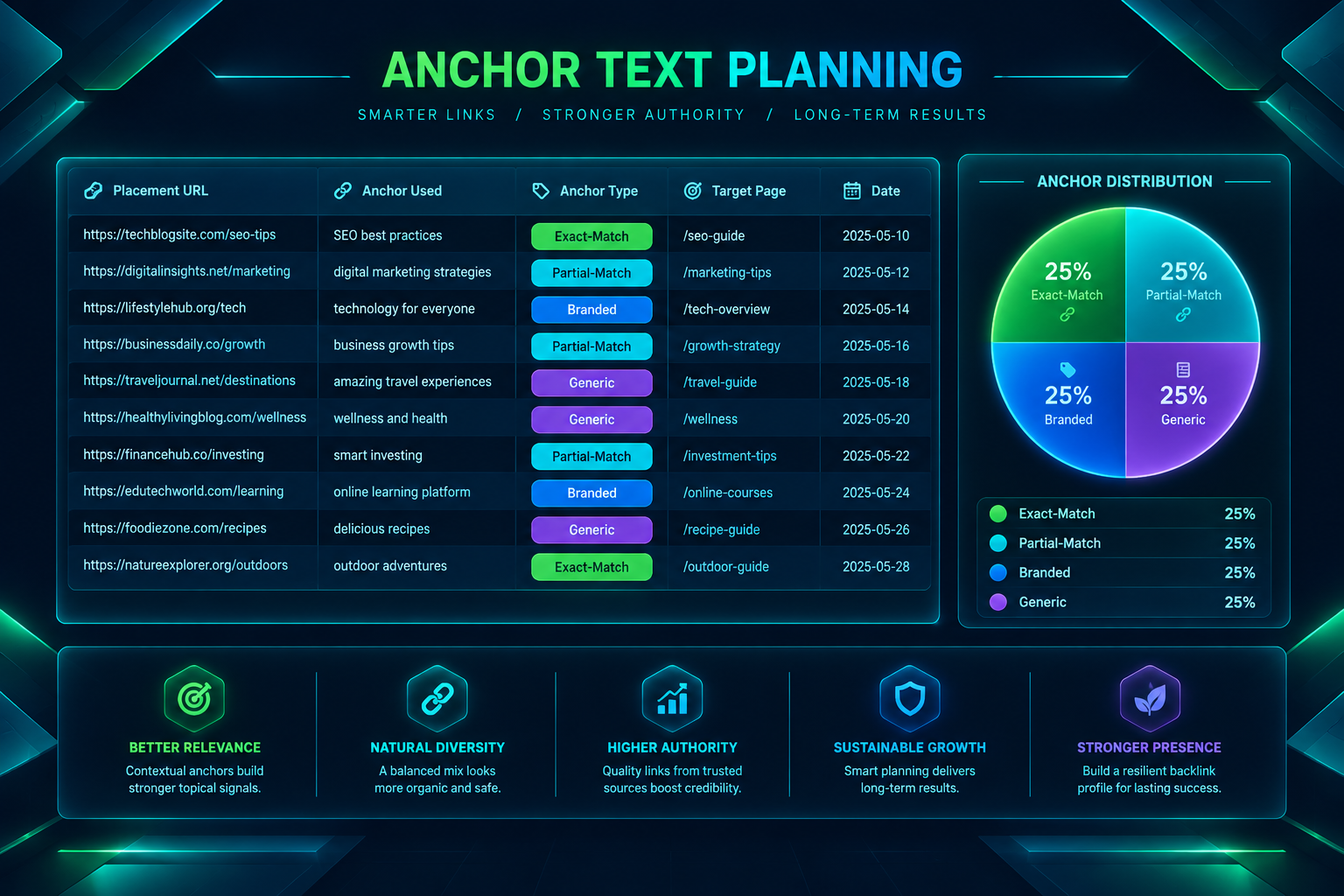
The specific proportions in a planned strategy should reflect the niche, the page type, and the competitive landscape. Pages in highly competitive niches where top-ranking competitors have diverse, high-volume backlink profiles may tolerate a different anchor mix than pages in lower-competition niches with smaller overall profiles. Reviewing the anchor distributions of pages that currently rank well for the target keyword provides a useful reference point, though it should be treated as a benchmark rather than a formula to copy exactly.
Partial-match anchors — phrases that include the target keyword alongside a modifier such as a location, a qualifier, or a related term — are often underused in PBN campaigns. They contribute keyword relevance without the concentration risk of exact-match repetition, and they tend to appear naturally in editorial contexts. Including a meaningful share of partial-match anchors in the planned distribution can help maintain topical relevance while keeping the profile varied.
Monitoring the Anchor Profile After Correction
After making changes — whether through anchor edits, new placements, or both — monitor the anchor distribution at regular intervals. Backlink analysis tools update their indexes at different speeds, so allow adequate time for new placements to be crawled and reflected in the report before assessing whether the correction has taken effect.
Set a recurring review schedule: monthly for active campaigns, quarterly for stable profiles. Each review should check the anchor distribution for the target page, note any new referring domains that have appeared or dropped, and confirm that the planned anchor strategy is being followed for new placements. If the exact-match share begins creeping upward again, the log makes it straightforward to identify when the drift started and which placements contributed to it.
Monitoring should also extend to ranking behavior for the target page. If rankings for the target keyword were stable before the correction and remain stable or improve afterward, that is a useful signal. If rankings change during the correction period, consider whether other factors — algorithm updates, competitor activity, technical changes to the site — may be contributing before attributing the change to the anchor adjustment. Ranking changes during a correction period are not automatically caused by the anchor work, and isolating the cause requires looking at the full picture.
Backlink index coverage varies between tools. Ahrefs, Semrush, and Majestic each crawl the web independently and may show different referring domain counts and anchor distributions for the same page. Using more than one tool for anchor analysis gives a more complete picture, particularly for profiles with a moderate number of referring domains where a single missed link could skew the percentage calculations.
When Anchor Text Correction Is and Is Not Sufficient
Anchor text correction addresses one specific quality signal within a backlink profile. It is most effective when the over-optimization is the primary concern and the underlying placements are otherwise solid — placed on topically relevant pages, embedded in useful content, on domains with credible histories and reasonable authority metrics.
If the backlink profile has additional quality issues beyond anchor concentration — such as placements on pages with thin or irrelevant content, domains with problematic histories, or a very high proportion of links from a single network — anchor correction alone may not fully address the profile’s overall quality. In those cases, the anchor work is still worthwhile, but it should be part of a broader placement quality review rather than treated as a standalone fix.
It is also worth noting that anchor text is one of many signals search engines use to evaluate a backlink profile. Page-level relevance, domain authority characteristics, link placement context, and the overall diversity of the referring domain set all contribute to how a profile is assessed. Correcting anchor text while neglecting other quality factors produces a more limited improvement than addressing the profile holistically.
For websites that have experienced a documented manual action related to link schemes, anchor text correction alone is unlikely to be sufficient for a reconsideration request. In that specific scenario, a more comprehensive backlink audit and, where appropriate, a disavowal process may be relevant — but that is a distinct situation from the more common case of a profile that looks concentrated without a confirmed enforcement action. Do not conflate the two.
Frequently Asked Questions
How do I know if my PBN anchor text is actually over-optimized?
Pull an anchor text report for the target page using a tool like Ahrefs or Semrush and group the anchors by category. If exact-match anchors account for a large majority of referring domains — particularly when branded, generic, and partial-match anchors are underrepresented — the profile is likely concentrated. Compare the distribution to pages that currently rank well for the same keyword to calibrate what a more natural profile looks like in your specific niche.
Can I just add more links with different anchors, or do I need to change existing ones?
Both approaches work, and they are often used together. Adding new placements with varied anchors dilutes the existing concentration without requiring changes to published content. Editing existing anchors is faster when the network allows it, because it directly reduces the over-represented category rather than just lowering its percentage share. If anchor edits are available, prioritize them for the highest-authority placements first.
What anchor text types should I use to replace exact-match anchors?
Partial-match anchors that include the target keyword alongside a modifier, branded anchors using the site or business name, topically related phrases that describe the page’s subject, and generic anchors like “read more” or “visit here” are all useful replacements. The goal is to spread the distribution across multiple categories rather than concentrating it in any single phrase type.
How long does it take for anchor text corrections to be reflected in backlink tools?
Backlink tools update their indexes at different speeds. New placements may appear in Ahrefs or Semrush within days to a few weeks, depending on how frequently the tool crawls the referring domain. Anchor edits on existing links may take longer to be re-crawled and updated. Allow at least four to six weeks after making changes before drawing conclusions about whether the distribution has shifted meaningfully.
Does fixing anchor text distribution guarantee a ranking improvement?
No. Anchor text distribution is one quality signal among many. Correcting an over-optimized profile removes a potential concern and brings the profile closer to a natural-looking distribution, but ranking outcomes depend on a wide range of factors including content quality, technical SEO, overall backlink profile strength, and competitive dynamics. Results vary by website, niche, and the specific conditions of the campaign.
Should I disavow my existing PBN links to fix the anchor text problem?
Disavowal is a specific tool for addressing links that may be contributing to a confirmed manual action or that are genuinely harmful to a profile. For an anchor text concentration issue without a confirmed enforcement action, disavowal is generally not the appropriate first step. Correcting the distribution through anchor edits and new placements is the more proportionate response. Disavowal removes the link’s potential value entirely, which is a significant trade-off when the underlying placements are otherwise sound.
Assessing Your PBN Anchor Strategy Before the Problem Recurs
Over-optimized anchor text in a PBN campaign is a correctable condition, not a permanent liability. The correction process — diagnosing the distribution, editing existing anchors where possible, diluting with varied new placements, and implementing a planned anchor strategy going forward — is straightforward when approached methodically. The most important shift is moving from reactive correction to proactive planning: defining the intended anchor mix before each placement is ordered, rather than assigning anchors based on the target keyword alone.
The specific anchor distribution that works best for a given page depends on the niche, the competitive landscape, the page type, and the overall profile size. There is no universal formula, and the threshold at which anchor concentration becomes a material concern is not publicly defined. What is clear is that a varied, plausible-looking anchor profile is a more durable foundation for a PBN campaign than one built entirely on exact-match repetition.
If you are managing an active PBN campaign and want to review your current anchor distribution, assess placement quality, or plan a more structured anchor strategy for upcoming link orders, the team at PBN Backlinks Service can help evaluate your profile and discuss placement options that fit your campaign goals.