

Handing over a private blog network to a new agency is a process that requires careful preparation, clear documentation, and a structured transfer of access and responsibilities. Whether you are switching link-building providers, bringing management in-house, or transitioning between SEO teams, the way you handle the handover directly affects whether the network continues to perform, remains properly maintained, and retains the domain equity and placement value you have built over time.
Key Takeaways
- A PBN handover involves transferring domain registrar access, hosting accounts, CMS credentials, content records, and backlink placement data — not just login details.
- Documenting the network’s structure, footprint management practices, and anchor text strategy before the transition protects continuity and helps the incoming agency maintain the same operational standards.
- Domain registrar transfers, DNS changes, and hosting migrations each carry their own timelines and technical risks that should be planned in advance.
- A structured overlap period, where both the outgoing and incoming teams are briefly active, reduces the risk of broken placements, lapsed renewals, or lost configuration data.
- Verifying that all placements remain live, indexed, and correctly attributed after the handover is an essential final step before closing out the transition.
Why PBN Handovers Require More Planning Than Standard Website Transfers
A private blog network is not a single website. It is a collection of individual domains, each with its own registrar account, hosting environment, CMS installation, content history, and outbound link configuration. When a standard website changes hands, the transfer typically involves one domain, one hosting account, and one CMS. A PBN handover multiplies that complexity by the number of sites in the network, and adds a layer of operational sensitivity because the network’s value depends on how it is managed, not just what it contains.
The incoming agency needs to understand not only where everything is hosted and how to access it, but also how the network has been operated. This includes the footprint management approach — how domains are distributed across hosting providers and IP ranges, how content is structured and updated, how outbound links are placed and monitored, and how anchor text has been distributed across placements. Without this operational context, a new team may inadvertently introduce patterns that reduce the network’s effectiveness or create consistency issues across the sites.
Planning the handover in advance, rather than treating it as a simple credential transfer, is what separates a smooth transition from one that results in lapsed domain renewals, broken placements, or a loss of the configuration knowledge that took time to build.
What to Document Before the Handover Begins
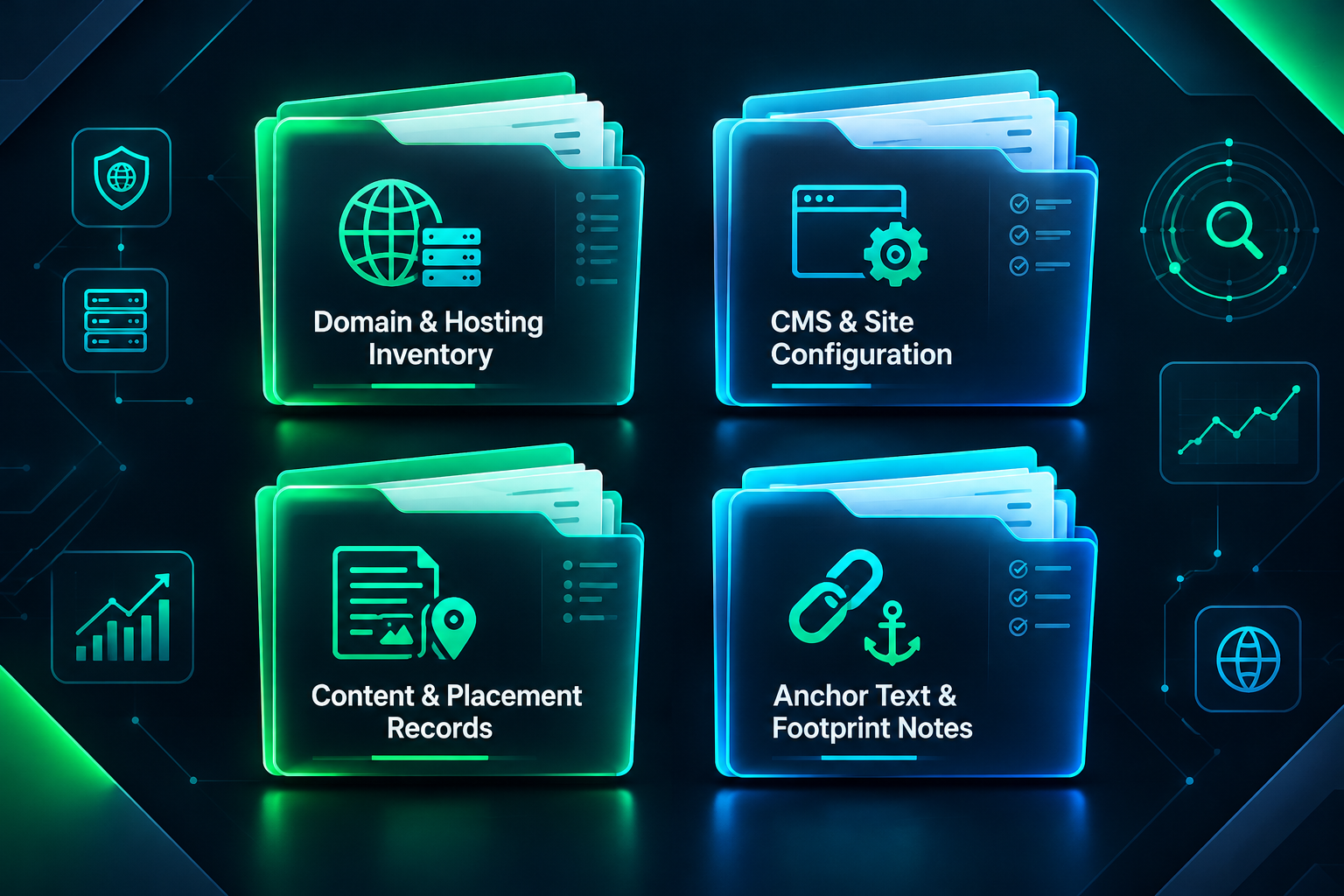
Comprehensive documentation is the foundation of a successful PBN transition. Before any access is transferred, the outgoing team should compile a complete record of the network’s assets and operational practices. This documentation serves as the incoming agency’s reference point and reduces the risk of gaps appearing during or after the transfer.
Domain and Hosting Inventory
The first document to prepare is a full inventory of every domain in the network. For each domain, this should include the registrar where it is registered, the renewal date, the nameserver configuration, the hosting provider, the server or account where the site is installed, and the IP address. If domains are distributed across multiple registrars or hosting environments as part of a footprint management strategy, that distribution should be recorded clearly so the incoming agency can maintain it rather than consolidating everything onto a single provider.
Renewal dates deserve particular attention. A lapsed domain registration during a handover can result in the domain dropping, which would remove the associated placements from the network and potentially allow the domain to be registered by a third party. Identifying any domains due for renewal within sixty to ninety days of the handover date allows the incoming agency to prioritize those renewals immediately.
CMS and Site Configuration Records
Each site in the network typically runs on a content management system, most commonly WordPress. For each installation, the outgoing team should document the admin URL, the current theme, any plugins that affect site function or appearance, and any custom configuration that affects how the site behaves. If sites use specific plugins for SEO settings, caching, or link management, those configurations should be exported or documented so the incoming agency can replicate them without guesswork.
Database credentials and file transfer protocol access details should also be included where relevant, particularly if the incoming agency will be managing hosting migrations or performing technical maintenance on the sites.
Content and Placement Records
A record of all existing content on each PBN site, including publication dates, word counts, topics, and any scheduled updates, gives the incoming agency a clear picture of the content maintenance requirements. More importantly, a complete placement log should document every outbound link that has been placed across the network: the PBN site it appears on, the target URL it points to, the anchor text used, the publication date, and the current indexing status if known.
This placement log is one of the most operationally valuable documents in the handover package. It allows the incoming agency to verify that all placements are still live, to understand the anchor text distribution that has been used across the network, and to avoid duplicating placements or creating anchor text patterns that conflict with the existing strategy.
Anchor Text Strategy and Footprint Notes
If the outgoing team has followed a deliberate anchor text strategy — balancing exact-match, partial-match, branded, and generic anchors across placements — that strategy should be documented and handed over. The incoming agency needs to understand what has already been used so that future placements can maintain a consistent and considered distribution rather than inadvertently concentrating anchor text in ways that were previously avoided.
Similarly, any footprint management decisions — such as which hosting providers are used, how many sites share a given IP range, how content topics are distributed across the network, or how outbound link ratios are managed — should be explained in writing. These operational decisions are often undocumented because they exist in the institutional knowledge of the team that built the network, but they are precisely the kind of information that a new agency needs to maintain the network effectively.
Transferring Access: Registrars, Hosting, and CMS
Once documentation is complete, the practical transfer of access can begin. This stage involves three distinct layers: domain registrar accounts, hosting environments, and CMS installations. Each layer has its own transfer process and timeline considerations.
Domain Registrar Transfers
Domains can be transferred to a new registrar or, more commonly in a PBN handover, the registrar account credentials can be updated to give the incoming agency access. If the network uses multiple registrars — which is common practice for footprint management — each registrar account needs to be addressed separately. The outgoing team should either transfer account ownership or create new sub-accounts with appropriate access levels, depending on the registrar’s account structure.
If domains are being moved to a different registrar as part of the handover, be aware that domain transfers typically take five to seven days to complete and require the domain to be unlocked and an authorization code to be provided. Domains registered within the past sixty days are generally not eligible for transfer. Planning these transfers in advance avoids situations where a domain is mid-transfer during a critical period.
Hosting Account Transfers
Hosting transfers are often the most technically involved part of a PBN handover. If the network uses multiple hosting providers across different accounts — again, a common footprint management approach — each account needs to be addressed. Options include transferring account ownership directly to the incoming agency, creating new accounts under the incoming agency’s billing details and migrating site files and databases, or providing temporary shared access during the transition period.
When migrating sites between hosting accounts, the process typically involves exporting the WordPress database, transferring site files via FTP or a migration plugin, importing the database into the new environment, and updating the site’s configuration file to reflect the new database credentials. DNS records then need to be updated to point the domain to the new hosting environment, which involves a propagation period that can take up to forty-eight hours. During this window, the site may be intermittently accessible from different locations, so timing migrations carefully — and avoiding them during periods of active link placement — reduces disruption.
CMS Credential Handover
For each WordPress installation, the outgoing team should either update the admin password and provide the new credentials, or create a new administrator account for the incoming agency and remove the outgoing team’s access once the transition is confirmed. Creating a new account rather than sharing existing credentials is generally cleaner from an access management perspective and avoids situations where the outgoing team retains unintended access after the handover is complete.
Any API keys, third-party service integrations, or plugin license keys associated with the sites should also be transferred or replaced at this stage. Plugin licenses in particular are often overlooked but may be required for automatic updates or continued functionality of tools the incoming agency will rely on.
Managing the Transition Period
A structured overlap period, where both the outgoing and incoming teams are briefly active and in communication, significantly reduces the risk of errors during the handover. The length of this overlap depends on the size of the network and the complexity of the transfer, but even a two-week period of parallel access can prevent the kinds of gaps that arise when one team hands off and immediately steps away.
During the overlap period, the incoming agency should verify access to every domain, hosting account, and CMS installation against the inventory document. Any discrepancies — missing credentials, inaccessible accounts, or undocumented sites — can be resolved while the outgoing team is still available to assist. The incoming agency should also review the placement log and confirm that all documented outbound links are currently live and pointing to the correct target URLs.
Domain renewal dates should be reviewed and any upcoming renewals actioned immediately. Hosting billing should be transferred to the incoming agency’s payment method to avoid service interruptions caused by lapsed payments on the outgoing team’s accounts.
Verifying Placement Integrity After the Handover
Once access has been fully transferred and the overlap period has ended, the incoming agency should conduct a systematic verification of the network’s placement integrity. This involves checking that every outbound link documented in the placement log is still live, that the anchor text matches the record, and that the target URL is correct and returning a valid response.
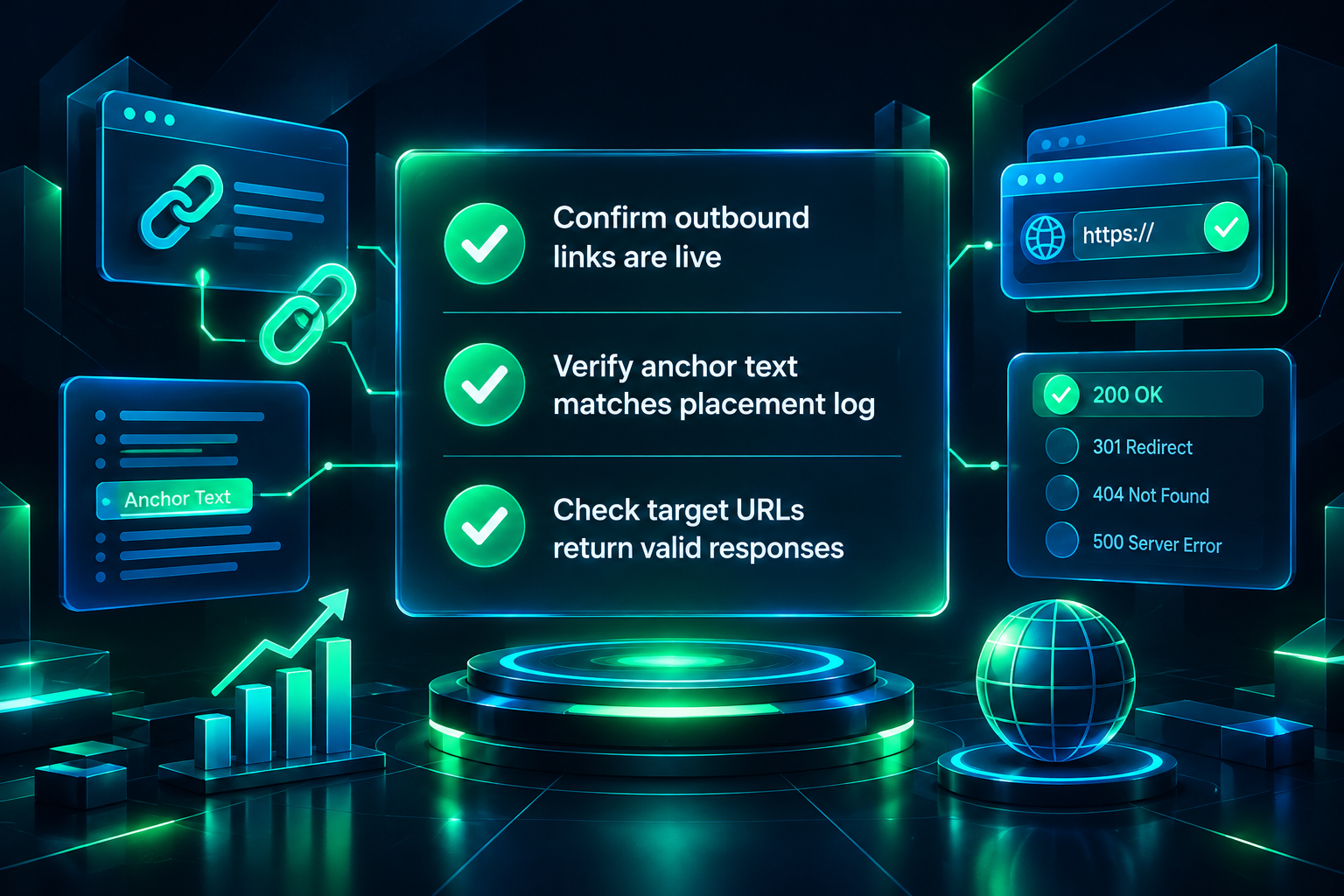
Link verification can be performed manually for smaller networks or with the assistance of tools that crawl specified URLs and report on outbound link status. If any placements are found to be missing — because a post was deleted, a page was restructured, or a site experienced a technical issue during the migration — those placements should be restored or replaced as a priority.
Indexing status is a separate consideration. A placement being live on a PBN site does not automatically confirm that the page containing the link is indexed by search engines. If the outgoing team maintained indexing records, the incoming agency should cross-reference those records and investigate any pages that appear to have dropped from the index during the transition. Hosting migrations and DNS changes can temporarily affect crawlability, so allowing a few weeks after the migration before drawing conclusions about indexing changes is advisable.
Ongoing Responsibilities the Incoming Agency Should Understand
A PBN is not a set-and-forget asset. The incoming agency should have a clear understanding of the ongoing maintenance responsibilities they are taking on, including domain renewals, hosting payments, content updates, and placement monitoring. These responsibilities should be explicitly outlined in the handover documentation rather than assumed.
Content maintenance on PBN sites — adding new posts periodically, updating existing content, and ensuring sites do not appear stale or abandoned — is an operational task that varies in frequency depending on how the network was originally built and managed. The incoming agency should understand the content cadence the outgoing team followed and decide whether to maintain it or adjust it based on their own assessment of the network’s needs.
Placement monitoring should be an ongoing process rather than a one-time verification. Links can be lost due to site restructuring, CMS updates that affect permalink structures, or content management decisions on the PBN sites themselves. A regular audit of active placements — checking that links remain live and correctly configured — is a standard part of managing a network over time.
Questions to Ask Before Completing the Handover
- Has every domain in the network been accounted for in the inventory, including any that were recently added or are pending renewal?
- Are all hosting accounts now billed to the incoming agency, and have any accounts on the outgoing team’s payment methods been migrated or closed?
- Has the placement log been verified against the live sites, and are all documented outbound links currently active?
- Does the incoming agency have a clear record of the anchor text distribution used across the network to date?
- Are there any domains in the network with known technical issues, indexing problems, or content gaps that need to be addressed?
- Has the outgoing team removed their own access from all registrar accounts, hosting environments, and CMS installations?
- Is there a documented point of contact at the outgoing team for any questions that arise in the weeks following the handover?
Frequently Asked Questions
How long does a PBN handover typically take?
The timeline depends on the size of the network and the complexity of the hosting setup. A small network of ten to twenty sites with straightforward hosting can often be transferred within one to two weeks. Larger networks with multiple registrars, diverse hosting environments, and extensive placement records may require four to six weeks to transfer completely, particularly if domain registrar transfers are involved.
Should the incoming agency rebuild any PBN sites during the handover?
Not as a default step. The handover process is primarily about transferring what exists, not rebuilding it. If the incoming agency identifies specific sites with technical problems, thin content, or configuration issues during their verification process, those can be addressed after the handover is complete and access is confirmed. Attempting to rebuild sites during the transfer itself adds unnecessary complexity.
What happens to active placements if a hosting migration causes downtime?
Brief downtime during a hosting migration is unlikely to cause permanent placement loss, but it can temporarily affect crawlability. Search engine crawlers that attempt to access a page during a migration window may encounter errors and delay re-crawling. Scheduling migrations during lower-traffic periods and using appropriate HTTP status codes during the transition can reduce the impact. After the migration, confirming that all sites are accessible and that placements are live is the priority.
Does the incoming agency need to know the original domain acquisition history?
It is useful context, particularly for domains that were acquired as expired or aged domains with existing backlink profiles. Understanding why a domain was selected — its historical topical relevance, referring domain quality, or prior content — helps the incoming agency make informed decisions about how to maintain and use it. This information should be included in the handover documentation where available.
What if some PBN sites are not indexed after the handover?
Indexing issues that predate the handover should be documented by the outgoing team and flagged to the incoming agency. Issues that arise during or after the migration should be investigated in the context of any technical changes made during the transfer — DNS propagation, hosting configuration changes, or CMS updates can all temporarily affect how search engines access and index pages. Allowing a few weeks for crawl patterns to normalize before taking corrective action is generally advisable.
Should the outgoing agency retain any access after the handover?
Retaining access after the handover is complete is generally not recommended, as it creates ambiguity about who is responsible for the network and can lead to conflicting changes. A clean handover with a defined end date for the outgoing team’s access is cleaner operationally. If a post-handover support period is agreed, it should be time-limited and clearly scoped.
Planning Your PBN Transition for Long-Term Network Value
A well-executed PBN handover preserves the domain equity, placement history, and operational knowledge that the network has accumulated. The domains, content, and link placements represent a meaningful investment, and the transition between agencies is the point at which that investment is most at risk of being disrupted through gaps in documentation, missed renewals, or lost configuration data.
Approaching the handover as a structured project — with a complete asset inventory, documented operational practices, a verified placement log, and a defined overlap period — gives the incoming agency everything they need to maintain the network without interruption. The outgoing team’s institutional knowledge, particularly around footprint management and anchor text strategy, is as important to transfer as the login credentials themselves.
If you are planning a PBN transition and want to assess the current state of your network’s placements, domain quality, or backlink strategy before handing over, PBN Backlinks Service can help you review what you have and identify any gaps worth addressing before the transfer begins.