

DMCA complaints on PBN sites are a practical operational concern that any serious private blog network operator will eventually encounter. Whether a notice arrives through your hosting provider, a domain registrar, or directly via email, knowing how to evaluate it, respond appropriately, and protect your network’s continuity is essential for maintaining the link equity and uptime your placements depend on.
Key Takeaways
- A DMCA takedown notice is a legal instrument under US copyright law, and responding to it correctly — or incorrectly — has real consequences for your PBN site’s hosting status and content availability.
- Not every DMCA complaint is valid; evaluating the notice carefully before acting is a necessary first step, not an optional one.
- Hosting providers and registrars have their own DMCA response policies, and understanding those policies in advance reduces the risk of unexpected site suspension.
- Maintaining original, properly licensed content across PBN sites is the most reliable way to reduce DMCA exposure over the long term.
- A well-handled DMCA complaint preserves site uptime, protects placed backlinks, and avoids escalation to registrar-level action that could affect domain ownership.
What a DMCA Complaint Actually Means for a PBN Site
The Digital Millennium Copyright Act (DMCA) is a US federal law that establishes a notice-and-takedown system allowing copyright holders to request the removal of infringing content from online platforms and hosting services. When a PBN site receives a DMCA complaint, it typically means a copyright holder — or an agent acting on their behalf — has identified content on that site they believe infringes their copyright. The complaint is usually directed at the hosting provider rather than the site owner directly, because the DMCA’s safe harbor provisions give hosts legal protection when they act promptly on valid notices.
For a PBN operator, the practical consequence is straightforward: if the hosting provider receives a valid DMCA notice and the site owner does not respond or comply, the host may suspend the site, remove specific content, or in some cases terminate the hosting account. Any of those outcomes interrupts the uptime of the PBN site and, by extension, the availability of the backlinks placed on it. Understanding the process before a complaint arrives is therefore a matter of network management, not just legal compliance.
It is worth noting that DMCA jurisdiction is primarily US-based. Hosting providers operating under US law are the most likely to follow the DMCA notice-and-takedown process formally. Providers based in other jurisdictions may handle copyright complaints under different legal frameworks, which can affect timelines and required responses. Knowing where your hosting provider is incorporated and what copyright complaint process they follow is a useful baseline for any PBN operator.
Common Reasons PBN Sites Receive DMCA Notices
PBN sites attract DMCA complaints for several identifiable reasons, and most of them are avoidable with careful content management. The most frequent cause is the use of images sourced from the web without verifying licensing. Stock photography, news images, and branded graphics are among the most actively monitored categories, and automated copyright enforcement tools scan the web continuously for unauthorized use. A PBN site that pulls images from search results or repurposes content from other websites without checking licensing terms is a predictable target.
A second common source is republished or scraped text content. Some PBN operators use content spinning tools or republish articles from other sites to populate their networks quickly. If that content is protected by copyright — and most original web content is — the original publisher or a rights management service acting on their behalf may file a DMCA notice. This is particularly relevant for PBN sites built around expired domains that previously hosted content, where old cached or archived material may have been inadvertently retained or republished.
A third category involves embedded media: videos, audio files, or other media assets embedded from third-party sources without authorization. Even embedding rather than hosting a file directly can attract a complaint in some circumstances, depending on the rights holder’s enforcement approach.
Understanding which content categories carry the highest DMCA risk helps PBN operators make better sourcing decisions before complaints arise, rather than managing them reactively.
Evaluating the Notice Before You Respond
Not every DMCA complaint is legally valid, and responding to an invalid notice as though it were legitimate can create unnecessary disruption. Before taking any action, evaluate the notice against the formal requirements of a valid DMCA takedown request. Under US law, a properly formed DMCA notice must identify the copyrighted work claimed to be infringed, identify the allegedly infringing material and its location, include a statement that the complainant has a good-faith belief that the use is unauthorized, include a statement that the information in the notice is accurate, and be signed — physically or electronically — by the copyright owner or their authorized agent.
A notice that lacks these elements may not be legally enforceable, though your hosting provider may still act on it depending on their internal policies. If a notice is incomplete or appears to be a competitor using the DMCA process to remove content rather than a genuine copyright claim, that distinction matters for how you respond. Automated DMCA notices sent in bulk by rights management services are common and are not always accurate; they can misidentify content, flag licensed material, or target content that falls under fair use.
If you are uncertain whether a notice is valid, consulting a legal professional familiar with copyright law before responding is a reasonable step, particularly if the complaint involves a significant volume of content or threatens account-level action. This is not a situation where guessing is advisable.
How to Respond to a Valid DMCA Complaint
When a DMCA notice is valid — meaning the content is genuinely infringing and you do not have a license or fair use defense — the appropriate response is to remove or disable access to the infringing content promptly. Most hosting providers specify a response window in their DMCA policies, and acting within that window is important for maintaining your hosting account in good standing. Delaying a response to a valid notice rarely produces a better outcome and increases the risk of account suspension.
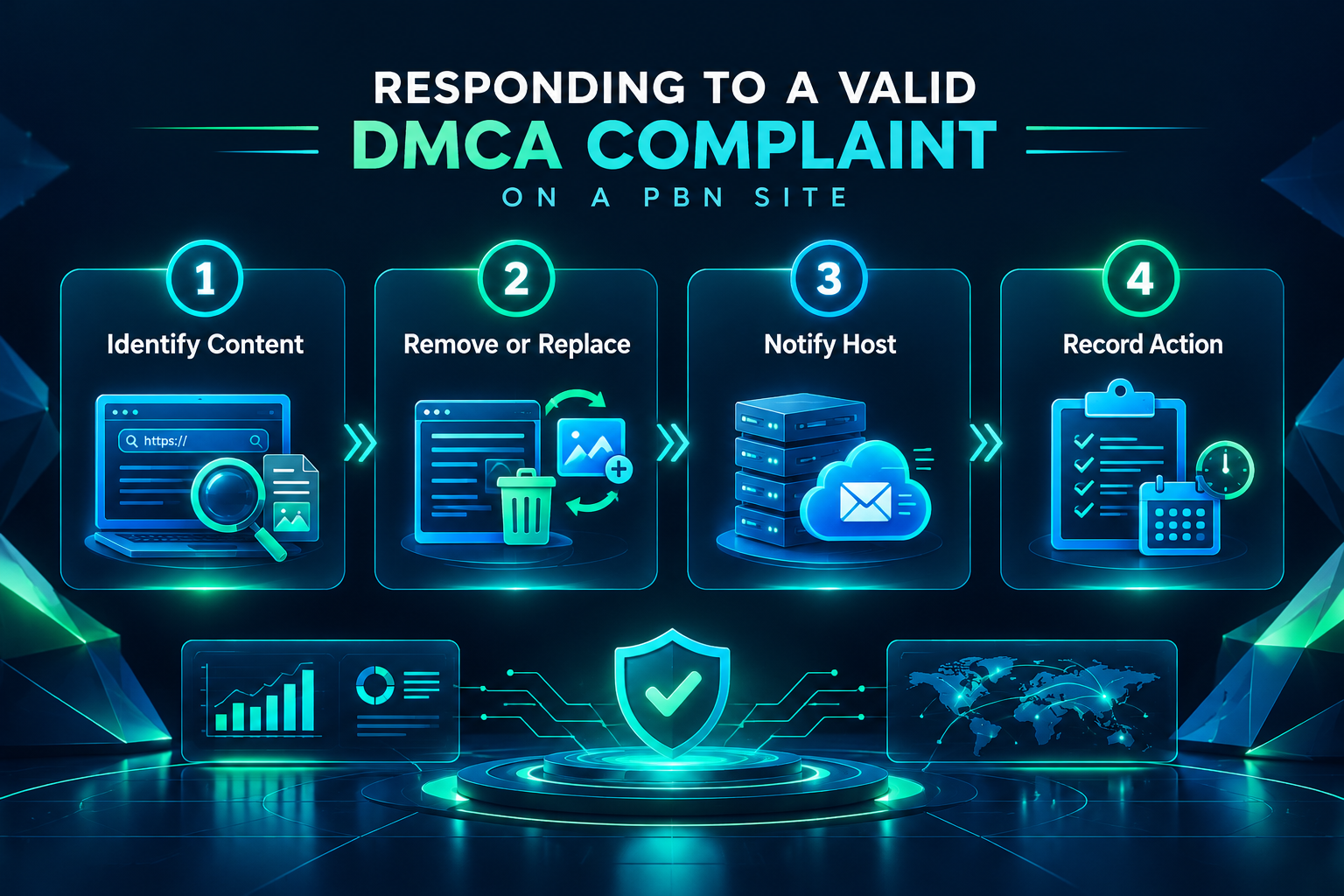
The removal process typically involves identifying the specific URL or file named in the notice, removing or replacing the content, and notifying your hosting provider that the content has been addressed. Some hosts have a formal acknowledgment process; others simply require that the content be removed and the notice be retained for your records. Keeping a record of every DMCA notice received, the date of receipt, the action taken, and the date of that action is good operational practice for any PBN network.
If the infringing content is an image, replacing it with a properly licensed alternative — from a Creative Commons source, a paid stock library, or an original image — resolves the immediate complaint and reduces the likelihood of a repeat notice for the same asset. If the content is text, rewriting or replacing it with original material is the appropriate step. The goal is to resolve the specific complaint while maintaining the site’s content quality and the contextual relevance of any backlinks placed on that page.
Filing a DMCA Counter-Notice When the Complaint Is Unjustified
If you believe a DMCA notice is invalid — because the content is original, properly licensed, or qualifies as fair use — you have the right to file a counter-notice under the DMCA. A counter-notice formally disputes the takedown request and, if properly filed, requires the hosting provider to restore the content within a specified period unless the original complainant initiates legal action.
A valid counter-notice must include your contact information, identification of the removed content and its location before removal, a statement under penalty of perjury that you have a good-faith belief the content was removed as a result of mistake or misidentification, and your consent to jurisdiction in the relevant federal district court. Filing a counter-notice is a legal act, and the statement of good faith carries legal weight. If you are not confident the content is non-infringing, filing a counter-notice is not appropriate.
For PBN operators, the practical calculus around counter-notices involves weighing the value of the specific content against the time and potential legal exposure involved in disputing the claim. In many cases, replacing the content is faster and less disruptive than pursuing a counter-notice process, particularly for image-related complaints. However, if a competitor or bad-faith actor is using DMCA notices to systematically target your network, documenting the pattern and seeking legal advice is a more appropriate response than simply complying with each notice.
Working with Hosting Providers and Registrars
The hosting provider’s DMCA policy is the most immediate operational factor when a complaint arrives. Providers vary significantly in how they handle notices: some forward the notice to the site owner and allow a response period before taking action; others remove content immediately upon receiving a notice and notify the site owner afterward. Knowing your provider’s process before a complaint arrives allows you to respond within the required window rather than discovering the policy under pressure.
For PBN networks, hosting diversity is already a common operational consideration for footprint management. That same diversity also means different DMCA response timelines and processes across different providers. Maintaining a record of each provider’s DMCA contact process, response window, and escalation policy is a practical step that reduces disruption when a notice arrives.
Registrar-level DMCA complaints are less common than hosting-level notices but can be more disruptive because they may affect domain availability rather than just content. Some registrars will place a domain on hold or transfer lock in response to a complaint while the matter is investigated. Understanding your registrar’s complaint handling process and ensuring your domain contact information is accurate and monitored reduces the risk of missing a registrar-level notice.
If a hosting provider or registrar takes action on a notice before you have had the opportunity to respond, contacting their abuse or legal team directly with documentation of your response — or your counter-notice, if applicable — is the appropriate next step. Most providers have a formal reinstatement process for content that was removed in response to a notice that has since been resolved.
Protecting PBN Sites from Future DMCA Exposure
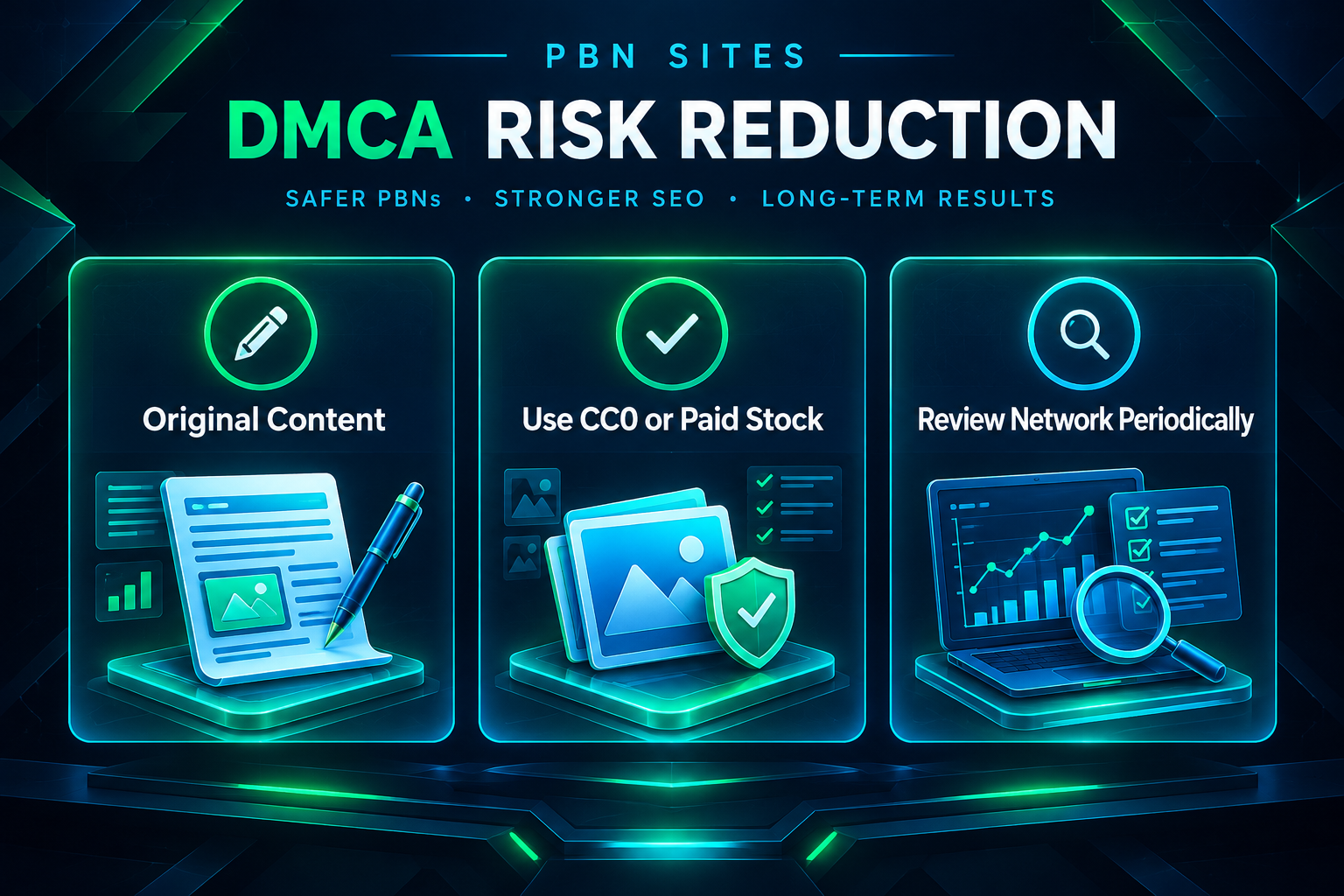
Reducing DMCA exposure across a PBN network is primarily a content sourcing and management issue. The most reliable approach is to use original content written specifically for each site, combined with images sourced from properly licensed libraries or created specifically for the network. Creative Commons Zero (CC0) image sources, paid stock libraries with clear commercial licensing, and original photography or graphics all reduce the risk of image-based complaints significantly.
For PBN sites built on expired or aged domains, reviewing the content that was previously hosted on the domain before republishing or repurposing it is an important step. Archived content from a previous site owner may include licensed images, syndicated articles, or other material that the new owner does not have the right to republish. A review of the Wayback Machine archive and any cached content associated with the domain helps identify potential issues before they become complaints.
Content audits across an active PBN network — periodically reviewing the images, text, and embedded media on each site — help identify potential DMCA risks before a notice arrives. This is particularly relevant for networks that have grown over time and may include content added by different writers or sourced through different processes. Establishing clear content sourcing guidelines for anyone contributing to the network reduces the likelihood of infringing material being published in the first place.
Monitoring tools that track DMCA notices sent to your hosting providers, or services that alert you when content from your sites appears in DMCA databases, can provide early warning of complaints before they escalate to account-level action. Some hosting providers also offer notification systems that alert account holders when a complaint is received.
DMCA Complaints and PBN Link Equity
From a link-building perspective, the primary concern with a DMCA complaint on a PBN site is the potential disruption to placed backlinks. If a hosting provider suspends a site or removes content in response to a complaint, the backlinks on that site become temporarily or permanently unavailable. The extent to which that affects the target site’s rankings depends on a range of factors including the number of links affected, the authority of the PBN site, and the overall backlink profile of the target site.
A single site going offline temporarily due to a DMCA dispute is unlikely to produce a measurable ranking change for a target site with a diverse backlink profile. However, if a complaint leads to account termination or domain suspension, the impact is more significant and potentially longer-lasting. This is one reason why maintaining clean, properly licensed content across PBN sites is not just a legal consideration but a practical link-building one: sites with original content and clear licensing are less likely to face DMCA disruption, and therefore more likely to maintain consistent uptime and link availability.
When evaluating PBN placements or assessing the quality of a network, content originality and licensing practices are worth considering alongside the more commonly discussed factors such as domain authority metrics, topical relevance, and hosting diversity. A PBN site with well-sourced, original content is a more stable placement than one populated with scraped or unlicensed material, regardless of its domain metrics.
Frequently Asked Questions
What should I do first when I receive a DMCA notice on a PBN site?
Read the notice carefully and verify that it meets the formal requirements of a valid DMCA takedown request. Check whether the content identified is genuinely infringing, licensed, or potentially covered by fair use before deciding whether to remove the content, replace it, or file a counter-notice. Acting without evaluating the notice first can lead to unnecessary content removal or, conversely, to missing a legitimate complaint within the hosting provider’s response window.
Can I ignore a DMCA notice if I think it is invalid?
Ignoring a DMCA notice is not advisable even if you believe it is invalid. Your hosting provider may act on the notice regardless of its legal validity, and failing to respond can result in content removal or account suspension. If you believe the notice is invalid, the appropriate response is to file a formal counter-notice rather than to ignore the complaint.
Does a DMCA complaint affect my domain or just the content?
Most DMCA complaints are directed at hosting providers and result in content-level action — removal of specific files or pages — rather than domain-level action. However, repeated complaints or complaints that escalate to the registrar level can affect domain availability. Registrar-level action is less common but more disruptive, so monitoring for registrar-directed notices is worthwhile for active PBN operators.
How do DMCA complaints affect the backlinks placed on a PBN site?
If a DMCA complaint results in a page being taken down or a site being suspended, the backlinks on that page or site become unavailable for the duration of the disruption. A temporary outage is unlikely to produce a significant ranking change for a target site with a diverse backlink profile, but a permanent suspension or domain termination has a more lasting effect on link availability.
What content types are most likely to trigger DMCA complaints on PBN sites?
Images sourced from the web without licensing verification are the most common trigger, followed by republished or scraped text content and embedded media. Automated rights enforcement tools actively scan the web for unauthorized image use, making unlicensed images a particularly frequent source of complaints on sites that do not use original or properly licensed visuals.
Is it worth using a DMCA-ignored hosting provider for PBN sites?
Some hosting providers market themselves as DMCA-ignored, meaning they do not process DMCA takedown requests. While this may reduce the risk of content removal in response to a complaint, it does not eliminate copyright liability for the site owner, and such providers often operate in jurisdictions with different legal frameworks. The decision involves trade-offs around hosting reliability, provider reputation, and the legal environment of the jurisdiction involved. It is a factor some PBN operators consider as part of their hosting strategy, but it is not a substitute for using properly licensed content.
Managing DMCA Complaints as Part of PBN Network Operations
Handling DMCA complaints effectively is a practical operational skill for anyone running a private blog network, not a rare edge case. The combination of content sourcing practices, hosting provider knowledge, and a clear response process determines whether a complaint becomes a minor administrative task or a significant disruption to network uptime and link availability.
The most important factors are evaluating each notice carefully before acting, responding within the hosting provider’s required window, maintaining records of all complaints and responses, and using original or properly licensed content to reduce future exposure. For PBN sites built on expired or aged domains, reviewing archived content before republishing is a step that prevents many complaints before they occur.
From a link-building standpoint, a PBN network that maintains clean content practices is a more reliable source of consistent link equity than one that accumulates DMCA risk through unlicensed or scraped material. If you are assessing the quality of PBN placements or evaluating a network for your campaign, content originality and licensing practices are worth including in your due diligence alongside domain metrics and topical relevance. For guidance on placement quality, network assessment, or building a backlink strategy suited to your site’s goals, PBN Backlinks Service can help you evaluate your options.