

When a website changes hands, the backlink profile is rarely examined with the same rigor as revenue figures or traffic trends. Yet for sites that rely on a private blog network to maintain rankings, the ongoing cost of that network is a material operating expense that directly affects both the site’s profitability and its risk profile. Ignoring PBN costs during a valuation can lead buyers to overpay and sellers to underprice, while misrepresenting the true economics of the asset.
Key Takeaways
- PBN operating costs — including domain renewals, hosting, content, and maintenance — are recurring expenses that reduce net profit and therefore affect the valuation multiple applied to a website.
- Buyers should request a full breakdown of PBN-related expenditure and assess whether those placements are genuinely driving rankings before factoring them into a purchase price.
- Sellers who have invested in a well-maintained private blog network can present that investment as a documented SEO asset, provided they can demonstrate link quality and ranking contribution.
- Link dependency risk — the possibility that rankings decline if PBN maintenance stops — is a legitimate valuation discount factor that both parties should negotiate transparently.
- Accurate PBN cost accounting requires separating one-time domain acquisition costs from ongoing annual expenses, then normalizing those figures into the monthly profit calculation used for valuation multiples.
Why PBN Costs Belong in a Website Valuation
Website valuations in the content and affiliate publishing space are most commonly expressed as a multiple of monthly net profit, typically calculated over a trailing twelve-month period. The multiple applied — often ranging from 30x to 50x monthly profit for established sites, though this varies considerably by marketplace, niche, and growth trajectory — is sensitive to the accuracy of the underlying profit figure. If a seller is running a private blog network to support their rankings but has not recorded those costs as business expenses, the reported profit is overstated. A buyer who accepts that figure at face value will apply the agreed multiple to an inflated number and pay more than the site’s true economics justify.
PBN operating costs are not hypothetical. A network of even ten to twenty domains involves annual renewal fees, hosting or server costs, periodic content updates to keep pages indexed and relevant, and occasional domain acquisition costs when a placement site needs to be replaced. For larger networks supporting competitive affiliate or lead-generation sites, these costs can run to several hundred or several thousand dollars per year. Normalizing those costs into the monthly profit figure — dividing annual PBN expenditure by twelve and subtracting it from monthly revenue — is the standard approach to ensuring the valuation reflects the actual cost of maintaining the site’s current ranking position.
Breaking Down PBN Operating Costs
Accurately accounting for PBN costs requires separating different categories of expenditure, because they have different timing, predictability, and relevance to a buyer’s ongoing obligations.
Domain Acquisition Costs
Expired or aged domains purchased for a private blog network represent a one-time capital cost at the time of acquisition. These costs can range from a modest registration fee for a recently dropped domain to several hundred or even several thousand dollars for a premium auction domain with a strong referring domain profile and established topical history. For valuation purposes, domain acquisition costs are sometimes treated as capital expenditure rather than operating expenditure, meaning they may be amortized over an assumed useful life rather than expensed in full in the month of purchase. How a buyer and seller agree to treat these costs depends on the age of the acquisition and whether the domains are still actively contributing links. Domains acquired within the trailing twelve-month valuation window are most likely to be scrutinized, since they represent recent cash outflows that may not yet have produced measurable ranking benefit.
Domain Renewal Fees
Annual domain renewal fees are straightforward recurring costs. A network of twenty domains at standard renewal rates of eight to fifteen dollars per domain per year represents a predictable annual expense. These fees should be included in the operating cost normalization without adjustment, since they recur regardless of whether the site is growing or stable. If a seller has been absorbing renewal costs personally without recording them as business expenses, a buyer’s due diligence process should identify this gap by reviewing the domain registration records and cross-referencing them against the profit and loss statement.
Hosting and Server Costs
PBN hosting strategy varies considerably. Some operators use individual shared hosting accounts across multiple providers to reduce footprint, while others use cloud-based virtual private servers or managed WordPress hosting. The cost structure differs accordingly. Shared hosting accounts may cost five to fifteen dollars per month each, while a VPS setup supporting multiple sites may cost twenty to eighty dollars per month depending on configuration. For valuation purposes, the total monthly hosting cost attributable to the PBN — not to the money site itself — should be identified and included in the operating cost calculation. If hosting costs are bundled with the main site’s hosting in the seller’s accounts, the buyer should request an itemized breakdown or a reasonable estimate based on the network’s size and configuration.
Content and Maintenance Costs
A private blog network requires periodic content to remain indexed and to maintain the contextual relevance of its outbound links. Content costs depend on the frequency of updates, the length and quality of articles, and whether the seller writes content personally or outsources it. If the seller writes PBN content themselves, the cost may not appear in the financial records, but it represents a time cost that a buyer would need to either replicate personally or outsource. For valuation purposes, if the seller’s personal labor is not already accounted for in the profit calculation, the buyer should estimate a realistic outsourced content cost and include it in the normalized expense figure. Ongoing maintenance — updating plugins, renewing SSL certificates, monitoring for deindexation — also represents a recurring time or financial cost that should be acknowledged even if it is difficult to quantify precisely.
Link Placement Service Fees
Some website owners do not build or maintain their own private blog network. Instead, they purchase PBN backlink placements from a managed service on a recurring basis. In this model, the monthly or annual cost of the backlink package is a direct operating expense that appears clearly in the business’s payment records. These costs are the most straightforward to include in a valuation normalization, since they are documented, recurring, and directly attributable to the site’s link-building activity. A buyer reviewing a site that relies on purchased PBN placements should confirm whether those placements are on a subscription or one-time basis, since the ongoing cost obligation differs significantly between the two models.
How PBN Costs Affect the Valuation Multiple
The valuation multiple applied to a website reflects not only its current profitability but also the perceived stability, scalability, and risk profile of that profitability. PBN-supported rankings introduce two distinct considerations that can influence the multiple a buyer is willing to pay: cost normalization and link dependency risk.
Cost Normalization and Its Effect on Profit
Once all PBN operating costs are correctly normalized into the monthly profit figure, the adjusted profit may be meaningfully lower than the seller’s reported figure. If a site generates $3,000 per month in revenue with $500 in reported expenses but the seller has not recorded $200 per month in PBN-related costs, the true monthly profit is $2,300 rather than $2,500. At a 40x multiple, that difference represents an $8,000 discrepancy in the purchase price. For higher-revenue sites with larger networks, the gap can be substantially greater. Buyers who perform thorough due diligence on backlink-related costs protect themselves from this common valuation error.
Link Dependency Risk as a Valuation Discount Factor
Beyond cost normalization, a buyer must assess what happens to the site’s rankings and revenue if PBN maintenance stops or if the network’s placements lose effectiveness over time. This is sometimes called link dependency risk. A site whose top-ranking pages are supported primarily by PBN backlinks, with limited organic link acquisition or brand authority, carries a higher dependency on continued PBN investment than a site with a diverse backlink profile. Buyers may apply a lower multiple to a site with high link dependency, reflecting the ongoing cost obligation and the uncertainty about ranking stability if that investment is reduced or discontinued. The appropriate discount is not fixed and depends on the quality of the PBN placements, the competitiveness of the niche, the site’s content quality, and the availability of alternative ranking signals.
It is worth noting that link dependency is not unique to PBN-supported sites. Sites that rely heavily on a single traffic source, a single affiliate program, or a single content format carry analogous concentration risks. The relevant question for a buyer is not whether PBN links are present, but whether the site’s rankings are sufficiently robust and the ongoing cost of maintaining them is accurately reflected in the valuation.
Assessing PBN Link Quality During Due Diligence
Not all PBN placements contribute equally to a site’s rankings, and a buyer should not assume that the existence of a private blog network automatically justifies a premium or automatically warrants a discount. The quality of the network’s domains, the relevance of the placement context, and the measurable ranking contribution of the links are all factors that affect how the PBN investment should be treated in the valuation.
During due diligence, a buyer can use backlink analysis tools such as Ahrefs, Semrush, or Majestic to review the referring domain profile of the site’s key ranking pages. Metrics such as Domain Rating (Ahrefs), Domain Authority (Moz), Trust Flow (Majestic), and referring domain counts are proprietary tool metrics and are not Google ranking scores, but they provide a useful starting point for assessing the relative strength of the backlink profile. A buyer should look at whether the PBN domains have meaningful referring domain histories, whether the anchor text distribution appears natural and varied, and whether the placement pages contain relevant contextual content rather than thin or templated material.
A seller who can demonstrate that their PBN placements come from domains with genuine topical history, varied anchor text, and contextually relevant content is in a stronger position to present the network as a documented SEO asset rather than a liability. Conversely, a network of low-metric domains with thin content and aggressive exact-match anchor text may represent a risk factor that a buyer should price into the negotiation.
Presenting PBN Investment as a Documented SEO Asset
Sellers who have invested meaningfully in a private blog network often undervalue that investment during a sale because they are uncertain how a buyer will perceive it. A well-maintained network with quality domains, relevant content, and demonstrable ranking contribution is a genuine SEO asset that has required capital and ongoing operational effort to build. Presenting it accurately — with documentation of costs, domain metrics, placement context, and ranking correlation — gives a buyer the information they need to assess the investment rather than discount it reflexively.
A seller preparing for a website sale should compile a PBN asset summary that includes the number of placement domains, their approximate domain metrics, the annual cost of maintaining the network, the target pages receiving links, and any observable correlation between the network’s placements and the site’s ranking positions. This documentation does not need to reveal the specific domain URLs if the seller wishes to protect the network’s integrity, but it should give a buyer enough information to assess the network’s scale, cost, and quality tier. Some sellers choose to include the PBN domains as part of the sale, which changes the cost structure for the buyer and may justify a higher purchase price if the domains have genuine standalone value.
Including PBN Costs in a Seller’s Discretionary Earnings Calculation
In website brokerage and acquisition contexts, the profit figure used for valuation is sometimes expressed as Seller’s Discretionary Earnings (SDE), which adjusts reported profit for owner-specific expenses, one-time costs, and non-cash items. PBN costs that the seller has absorbed personally — such as domain renewals paid from a personal account or content written by the seller without a recorded cost — should be added back to the SDE calculation if they represent costs that a new owner would need to incur to maintain the site’s current performance. This add-back approach ensures that the SDE figure reflects the true economic cost of running the site, not just the costs that happened to be recorded in the business’s accounts.
Conversely, if a seller has been recording PBN costs as business expenses, those costs are already reflected in the reported profit and should not be added back. The goal of the SDE normalization is accuracy, not the inflation or deflation of the profit figure. A buyer’s accountant or broker reviewing the financials should be able to trace every PBN-related cost to either the profit and loss statement or the SDE add-back schedule, with no material costs unaccounted for in either direction.
Negotiating PBN-Related Terms in a Website Sale
When a website sale involves a significant PBN investment, the purchase agreement may need to address several PBN-specific considerations beyond the headline price. These include whether the PBN domains are included in the sale, whether the seller will maintain the network during a transition period, and whether the buyer has the technical capability to manage the network after the handover.
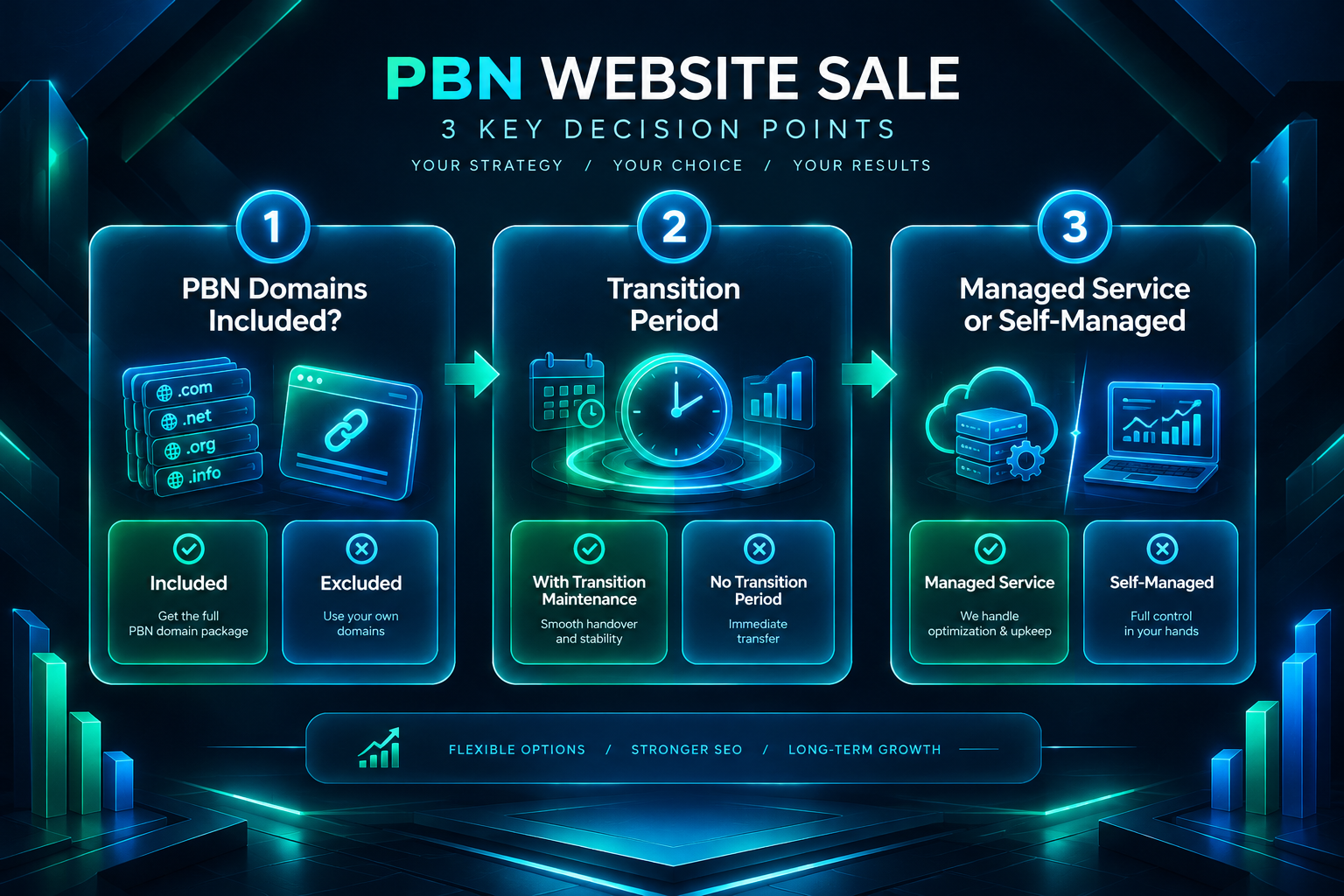
If the PBN domains are included in the sale, the buyer is acquiring both the money site and the supporting infrastructure. In this case, the domain acquisition costs already incurred by the seller may be partially reflected in the purchase price, and the buyer’s ongoing costs will be limited to renewals, hosting, and content rather than new domain acquisition. If the PBN domains are not included — for example, because the seller operates the network across multiple sites and does not wish to sell it — the buyer should negotiate a transition arrangement that ensures continued link placements for a defined period, or should factor the cost of sourcing replacement placements into their post-acquisition budget.
Some buyers prefer to purchase PBN placements from a managed service rather than inheriting and operating a private network themselves. In this scenario, the buyer’s ongoing link-building cost is the service fee for continued placements, which is a predictable and outsourced expense rather than an operational responsibility. This preference should be reflected in the valuation discussion, since the buyer’s cost structure after acquisition may differ from the seller’s.
Frequently Asked Questions
Should PBN domain acquisition costs be expensed or capitalized in a website valuation?
Domain acquisition costs are typically treated as capital expenditure and may be amortized over an assumed useful life rather than expensed in full in the month of purchase. For valuation purposes, domains acquired within the trailing twelve-month window are most relevant, since they represent recent cash outflows. Buyers and sellers should agree on a consistent treatment and apply it uniformly across all domains in the network.
How do I find out if a site I am buying relies on PBN links?
Backlink analysis tools such as Ahrefs, Semrush, and Majestic can help identify referring domains with characteristics common to private blog networks, such as limited organic traffic, thin content, or a high ratio of outbound links relative to inbound links. A thorough due diligence process should also include a direct conversation with the seller about their link-building history and a review of any link-building invoices or domain registration records.
Does a PBN-supported site always receive a lower valuation multiple?
Not automatically. The multiple depends on the quality of the network, the accuracy of the cost normalization, the site’s overall backlink diversity, and the buyer’s assessment of link dependency risk. A well-documented, high-quality PBN with demonstrable ranking contribution and reasonable ongoing costs may support a competitive multiple. A low-quality network with high costs and uncertain ranking contribution is more likely to attract a discount.
What happens to rankings if a buyer stops maintaining the PBN after purchase?
The outcome depends on how dependent the site’s key ranking pages are on PBN placements relative to other ranking signals. Sites with strong content, brand authority, and a diverse backlink profile may maintain rankings if PBN maintenance is reduced. Sites with high link dependency on a single network may see ranking changes over time if that network is not maintained. This uncertainty is a legitimate risk factor that buyers should assess before agreeing to a purchase price.
Can I include the value of PBN domains separately from the website valuation?
Yes. If the PBN domains have genuine standalone value — strong referring domain profiles, topical history, and reusable link equity — they can be valued separately from the money site and included as a distinct line item in the sale. This approach is more common in larger transactions where the network has been built with significant capital investment and could plausibly be used to support other sites.
How should I handle PBN costs that the seller paid personally and never recorded as business expenses?
These costs should be identified during due diligence and added to the SDE normalization as an expense add-back. The adjusted profit figure should reflect what a new owner would realistically need to spend to maintain the site’s current performance, including any PBN-related costs that the seller absorbed personally. Failing to account for these costs results in an overstated profit figure and a higher-than-justified purchase price.
Accounting for PBN Investment When Buying or Selling a Website
Incorporating PBN operating costs into a website valuation is fundamentally an exercise in accurate profit normalization. The goal is to ensure that the monthly net profit figure used to calculate the purchase price reflects the true cost of maintaining the site’s current ranking position, including every recurring expense associated with the private blog network that supports it. Domain renewals, hosting, content, and placement service fees are all legitimate operating costs that belong in the calculation, regardless of whether they have been formally recorded in the seller’s accounts.
Beyond cost normalization, the quality and dependency profile of the PBN placements are relevant to the multiple a buyer is willing to pay. A well-maintained network with quality domains, relevant contextual placements, and documented ranking contribution is a more defensible SEO asset than a low-quality network with uncertain effectiveness. Sellers who can present their PBN investment with clear documentation — costs, domain metrics, placement context, and ranking correlation — are better positioned to negotiate a fair price than those who leave the buyer to guess at the network’s value and risk profile.
If you are preparing a website for sale and want to ensure your PBN investment is accurately represented, or if you are evaluating an acquisition and need to assess the quality and cost structure of an existing link-building strategy, reviewing your backlink requirements with an experienced provider is a practical starting point. PBN Backlinks Service can help you assess placement quality, understand ongoing cost obligations, and evaluate whether a site’s PBN-supported rankings are built on a foundation worth paying for.