

Isolating the ranking contribution of PBN backlinks in a live SEO environment is one of the more demanding methodological challenges in link-building research. Search engines process hundreds of signals simultaneously, organic traffic fluctuates for reasons unrelated to links, and most websites cannot be frozen in a controlled state while a test runs. Despite these constraints, a structured experimental approach can produce meaningful evidence about whether a specific set of PBN placements is contributing to ranking movement — provided the test is designed carefully before the first link is placed.
Key Takeaways
- True isolation of PBN link effects requires controlling for on-page changes, technical SEO events, algorithm updates, and competing link acquisition during the test window.
- A valid SEO experiment needs a clearly defined hypothesis, a stable baseline measurement period, and a pre-agreed measurement window before any links are placed.
- Segmenting test pages from control pages — and keeping both groups unchanged during the test — is the most practical way to reduce confounding variables on a live website.
- Ranking movement alone is insufficient evidence; corroborating signals such as crawl frequency, indexing speed, and organic click data strengthen the interpretation.
- Results from a single test are directional, not definitive; replication across different pages, niches, and competitive environments improves confidence in the findings.
Why Isolating PBN Link Effects Is Difficult
A search engine’s ranking algorithm evaluates a page against dozens of interacting signals: content relevance, internal link structure, page experience metrics, historical authority of the domain, the full backlink profile, and behavioral signals from searchers, among others. When a ranking change follows a PBN link placement, attributing that change to the link rather than to a concurrent algorithm update, a competitor’s ranking drop, a seasonal query shift, or a technical change on the target site requires deliberate experimental controls. Without those controls, the observation is a correlation, not a causal finding.
PBN backlinks add a further layer of complexity because their effects depend on factors that vary between placements: the topical relevance of the linking domain, the quality and depth of the surrounding content, the anchor text used, the crawl and indexing status of the linking page, and the existing authority profile of the target page. A test that treats all PBN placements as interchangeable will produce ambiguous results even if the methodology is otherwise sound. Defining the specific type of placement being tested — for example, a contextual link from a topically relevant aged domain to a commercial inner page — is a prerequisite for a meaningful experiment.
Defining the Experimental Hypothesis
Every useful SEO experiment begins with a falsifiable hypothesis. For a PBN link test, a well-formed hypothesis might read: “Adding two contextual PBN backlinks with partial-match anchor text to Page X, while keeping all other on-page and off-page variables constant, will produce a measurable improvement in average ranking position for the target keyword cluster within a defined measurement window.” This formulation specifies the treatment (the PBN links), the conditions (anchor type, page, link count), the expected direction of change (improvement), and the measurement scope (keyword cluster, time window).
A vague hypothesis such as “PBN links improve rankings” cannot be tested meaningfully because it does not define what counts as a result, over what time frame, or under what conditions. Precision at the hypothesis stage also forces the experimenter to decide in advance what outcome would constitute a negative or null result — a discipline that prevents post-hoc rationalization of ambiguous data.
Selecting and Segmenting Test Pages
The most practical isolation method available on a live website is a page-level split: designate a set of pages as the treatment group (pages that will receive PBN links) and a comparable set as the control group (pages that will receive no new links during the test). Both groups should be similar in terms of current ranking position, search volume of target keywords, content depth, internal link equity, and existing backlink profile composition.
Similarity between groups reduces the risk that any observed difference in ranking movement is explained by a pre-existing advantage in one group rather than by the link treatment. If the website has a large enough page inventory, matching pages by keyword difficulty and current position range — for example, pages ranking between positions 8 and 20 for keywords with 500 to 2,000 monthly searches — creates a more defensible comparison than selecting pages arbitrarily.
During the test window, the control group pages must not receive new backlinks, significant content edits, or changes to internal linking. The treatment group pages should receive only the planned PBN placements and no other link-building activity. Any deviation from this protocol introduces a confounding variable that weakens the causal interpretation of the results.
Establishing a Stable Baseline
Ranking data is inherently noisy. A page’s position for a given keyword can fluctuate by several positions from day to day without any change to the page or its backlink profile, due to personalization, data center variation, and query interpretation shifts. Measuring from a single pre-test data point produces a baseline that may not represent the page’s true average position.
A reliable baseline requires tracking target keywords daily for a minimum of four to six weeks before any links are placed. This period should be free of significant on-page edits, new internal links to the test pages, and any other link acquisition. The baseline measurement should record average position, ranking volatility (the standard deviation of daily positions), organic click-through rate from Google Search Console data where available, and crawl frequency if the website’s log files or a crawl monitoring tool can provide it.
A stable baseline also reveals whether a page is already trending upward or downward before the test begins. A page in a natural upward trend may continue improving regardless of any link placement, making it a poor candidate for a PBN link test unless the trend is accounted for in the analysis.
Controlling for Confounding Variables
Confounding variables are the primary threat to a valid causal interpretation of SEO test results. The most common confounders in a PBN link experiment include the following.
- Algorithm updates: A broad core update or a link-spam algorithm refresh during the test window can move rankings across the entire website, masking or amplifying the effect of the PBN links. Monitoring Google’s confirmed update announcements and cross-referencing them with ranking movement dates is essential for interpreting results. If a confirmed update occurs during the test window, the results for that period should be treated with additional caution.
- Competitor activity: A competitor gaining or losing significant backlinks, publishing new content, or experiencing a technical issue can shift the ranking landscape for the target keywords independently of anything done to the test pages. Tracking the top three to five competing pages for each target keyword throughout the test provides context for interpreting ranking changes.
- Seasonal query demand: Some keyword clusters experience predictable seasonal fluctuations in search volume and competition. A ranking improvement that coincides with a seasonal demand increase may reflect higher query volume rather than a link-driven authority gain. Comparing year-over-year data from Google Search Console can help distinguish seasonal patterns from link-driven movement.
- Technical SEO changes: A site migration, a Core Web Vitals improvement, a change to the robots.txt file, or an update to the website’s internal linking structure can affect rankings independently of any backlink activity. Freezing technical changes on the test and control pages during the experiment is important; if a site-wide technical change is unavoidable, document it and factor it into the analysis.
- Content changes: Even minor edits to a page’s title tag, meta description, or body content can influence rankings. Test and control pages should remain editorially unchanged during the measurement window.
Designing the Link Treatment
The PBN link treatment should be defined precisely before placement begins. Key parameters to document include the number of links, the domains from which they will be placed, the anchor text for each link, the target URL, the placement context (the surrounding paragraph topic and the page’s overall subject), and the planned placement date. Recording these parameters creates a treatment log that supports later analysis and replication.
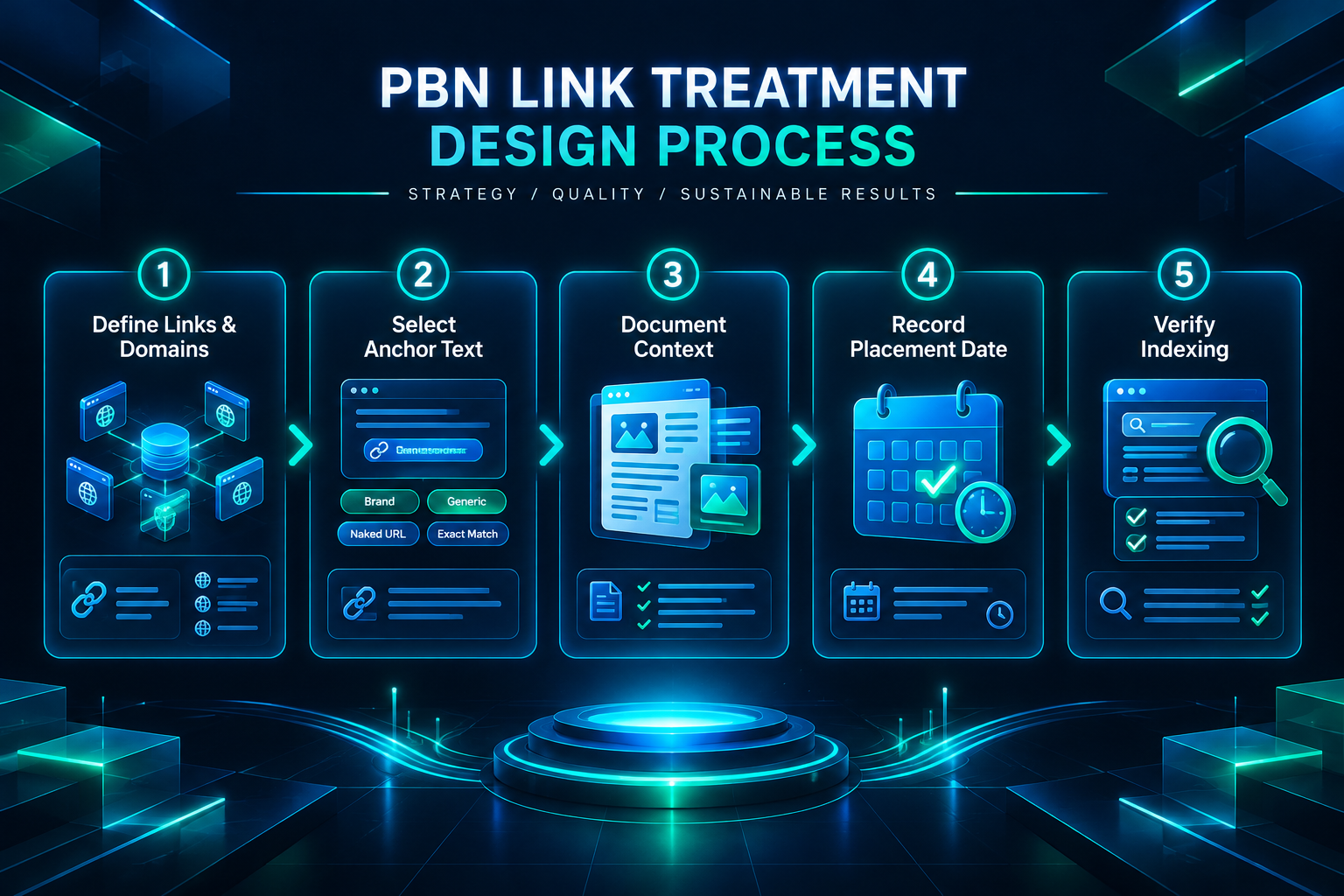
Anchor text selection deserves particular attention in a test design. Using a single anchor type across all test placements — for example, all partial-match anchors — makes it easier to attribute any observed effect to that anchor strategy. Mixing exact-match, partial-match, branded, and naked URL anchors across a small number of test links makes it difficult to determine which anchor type, if any, contributed to a ranking change. If the goal is to test anchor text strategy specifically, a separate experiment with a controlled anchor variable is more informative than a mixed treatment.
The linking domains should be documented with their key characteristics at the time of placement: topical category, estimated domain authority using a consistent third-party metric such as Ahrefs Domain Rating or Majestic Trust Flow, referring domain count, and indexing status of the specific linking page. These characteristics allow the experimenter to describe the treatment accurately and to assess whether the result generalizes to similar or different domain profiles.
Setting the Measurement Window
The measurement window — the period after link placement during which ranking changes are attributed to the treatment — must be defined before the test begins, not after results are observed. Choosing the window retrospectively based on when a favorable movement occurred is a form of data manipulation that invalidates the causal interpretation.
PBN links, like other backlinks, require time to be crawled, indexed, and processed by the search engine before any ranking effect can be observed. The crawl and indexing lag for a linking page varies depending on the domain’s crawl budget, the freshness of the content, and the search engine’s current processing load. In practice, a minimum of two to four weeks after confirmed indexing of the linking page is a reasonable starting point for expecting any measurable ranking movement, though the timeline varies considerably across websites and competitive environments.
A measurement window of eight to twelve weeks after confirmed link indexing is commonly used in structured SEO experiments because it allows enough time for the ranking signal to stabilize while remaining short enough to limit the accumulation of uncontrolled confounders. Shorter windows risk measuring noise rather than signal; longer windows increase the probability that an unrelated event explains the observed change.
Verifying Link Indexing Before Measuring Results
A PBN link that has not been indexed by the search engine cannot contribute a ranking signal, regardless of the quality of the linking domain. Measuring ranking changes before confirming that the linking page is indexed introduces a systematic error: the test may record a null result not because the link had no effect, but because the link had not yet been processed.
Indexing verification can be performed by searching for the exact URL of the linking page using a site: query in the search engine being tested, or by checking whether the page appears in a crawl tool’s index coverage data. Some SEO practitioners also use Google Search Console’s URL Inspection tool to request indexing of the linking page, though this applies only to pages within the verified property. For PBN linking pages that are external to the target site, direct URL inspection is not available through Search Console, so a site: query or a third-party index checker is the practical alternative.
If a linking page remains unindexed after a reasonable waiting period, the test should note this as a treatment failure for that specific link and exclude it from the primary analysis, or treat it as a separate condition to analyze independently.
Measuring and Interpreting Results
The primary outcome metric for a PBN link test is average ranking position for the target keyword cluster, measured daily and averaged over the post-treatment window. Comparing the average position in the post-treatment window to the average position in the baseline window, while applying the same comparison to the control group, produces a difference-in-differences estimate: the ranking change in the treatment group minus the ranking change in the control group. If the control group also improved during the test window, that improvement likely reflects a factor affecting the whole website or the competitive landscape rather than the link treatment.
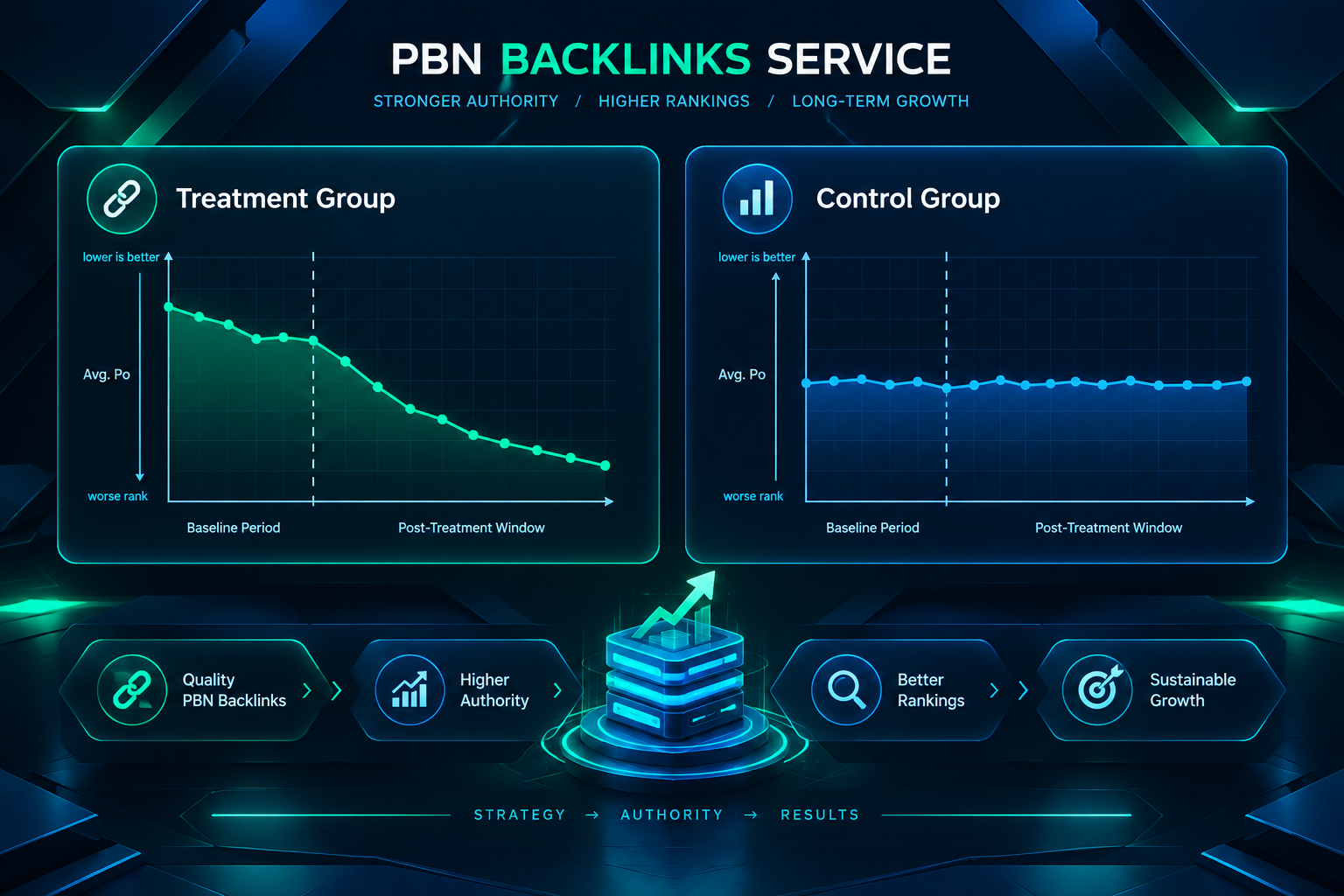
Secondary metrics that strengthen the interpretation include organic click-through rate from Google Search Console (an improvement in CTR at a stable impression count suggests a genuine ranking gain rather than a query volume shift), crawl frequency of the target pages (increased crawl activity after link placement can indicate that the search engine is re-evaluating the page’s authority), and the ranking positions of the specific competing pages for the target keywords (if competitors dropped while the test page rose, the gain may reflect competitor weakness rather than link strength).
A statistically meaningful result in an SEO experiment is difficult to define precisely because ranking data does not follow a simple statistical distribution and sample sizes are typically small. Rather than applying formal significance tests, most SEO experimenters assess practical significance: is the observed ranking improvement large enough to produce a meaningful change in organic traffic, and is it consistent across multiple keywords in the target cluster rather than isolated to one or two queries? A movement from position 14 to position 9 across five related keywords is more convincing evidence of a link effect than a movement from position 14 to position 13 on a single keyword.
Documenting and Replicating the Experiment
A single SEO experiment, however carefully designed, produces directional evidence rather than definitive proof. The result may reflect the specific characteristics of the test page, the linking domains used, the competitive environment at the time of the test, or an undetected confounding variable. Replicating the experiment across different pages on the same website, and eventually across different websites and niches, builds a more reliable picture of when and how PBN link placements contribute to ranking movement.
Documentation is the foundation of replication. A complete experiment record should include the hypothesis, the baseline data for both treatment and control groups, the treatment log (link details, placement dates, anchor text, domain characteristics), the indexing verification dates, the measurement window definition, the outcome data, and a written interpretation that distinguishes the observed result from alternative explanations. This record allows the experiment to be repeated under similar conditions and compared against future tests with different link types, anchor strategies, or domain profiles.
Sharing documented experiments within a team or with a link-building provider also creates a feedback loop: if a particular type of PBN placement consistently produces measurable ranking movement in a specific niche and competitive range, that pattern informs future campaign decisions more reliably than anecdotal observation.
Practical Limitations of SEO Experimentation
Even a well-designed PBN link experiment operates under constraints that limit the certainty of its conclusions. Search engines do not publish their ranking algorithms, so the mechanism by which a link contributes to a ranking change cannot be directly observed — only inferred from the correlation between placement and movement. The processing of a link by a search engine may be delayed, partial, or weighted differently depending on factors that are not publicly documented, including the search engine’s current assessment of the linking domain’s quality and the target page’s existing authority profile.
Small page samples — which are common in most website-level experiments — limit the statistical power of the comparison. A website with only ten pages suitable for testing cannot produce the same confidence in a result as a large content site with hundreds of comparable pages. Acknowledging this limitation in the interpretation prevents overconfidence in a result that may not generalize beyond the specific test conditions.
It is also worth noting that the absence of a measurable ranking change within the test window does not necessarily mean the PBN links had no effect. The links may not yet have been fully processed, the target page may require additional authority signals before a ranking threshold is crossed, or the competitive environment for the target keywords may have become more difficult during the test period. A null result should be interpreted in light of these possibilities rather than treated as definitive evidence that PBN links are ineffective for the website in question.
Frequently Asked Questions
How many pages do I need for a valid PBN link test?
There is no fixed minimum, but a treatment group of at least five to ten pages with a matched control group of similar size produces more reliable results than a single-page test. Larger samples reduce the influence of page-specific factors on the overall result. If the website has limited suitable pages, running the experiment in sequential rounds — testing one set of pages, then another — can build cumulative evidence over time.
Should I use the same anchor text for every test link?
Standardizing anchor text within a single experiment makes it easier to attribute any observed effect to a specific anchor strategy. If you want to compare anchor types, design separate experiments for each type rather than mixing them in one test. Mixing anchor strategies in a small test makes it difficult to determine which variable drove the result.
How do I account for a Google algorithm update that occurs during my test?
Document the update date and cross-reference it with your ranking data. If a confirmed broad core update or link-spam update occurs during the measurement window, treat the results for that period with additional caution. Where possible, extend the measurement window beyond the update’s stabilization period and compare the post-update trajectory of the treatment and control groups separately.
Can I run a PBN link test on a new website with no existing backlinks?
A new website with no existing backlink profile and limited ranking history makes baseline measurement difficult because there is no stable ranking position to measure from. Tests on established pages with a documented ranking history produce more interpretable results. If testing on a newer site, allow sufficient time for the site to achieve some baseline indexing and ranking stability before placing test links.
How do I verify that a PBN linking page has been indexed?
Use a site: query for the exact URL of the linking page in the search engine you are testing. If the page appears in the results, it is indexed. Third-party index-checking tools can also provide this information. Do not begin measuring ranking outcomes until indexing is confirmed, as an unindexed linking page cannot contribute a ranking signal.
What should I do if my test produces a null result?
A null result — no measurable ranking change in the treatment group relative to the control group — should be analyzed in context. Check whether the linking pages were indexed, whether the measurement window was long enough, and whether any confounding events occurred during the test. A null result under well-controlled conditions is informative: it may suggest that the specific link type, domain profile, or anchor strategy tested did not produce a detectable effect for that page and keyword cluster, which is useful data for refining future campaign decisions.
Designing PBN Link Tests That Produce Actionable Findings
Isolating PBN backlink effects in an SEO experiment is achievable with disciplined methodology, but it requires accepting that the results will be directional rather than definitive. The most actionable experiments are those with a precise hypothesis, a stable and well-documented baseline, a clearly defined treatment, matched control pages, and a pre-agreed measurement window. Confounding variables cannot be eliminated entirely in a live website environment, but they can be identified, documented, and accounted for in the interpretation.
The value of running structured PBN link tests extends beyond any single result. A documented series of experiments across different page types, anchor strategies, and domain profiles builds an evidence base that informs link-building decisions with greater confidence than anecdotal observation or industry generalizations. Understanding which placement characteristics correlate with measurable ranking movement in a specific niche and competitive range allows for more targeted and efficient use of PBN link placements in future campaigns.
If you are planning a PBN link campaign and want to structure it in a way that allows meaningful performance measurement, PBN Backlinks Service can discuss placement options, domain characteristics, and anchor text approaches that align with a testable campaign design. Reviewing your backlink profile and target pages before placement helps ensure that the links are placed in conditions where their contribution can be assessed as clearly as the live SEO environment allows.