

Running a private blog network across multiple languages introduces a distinct set of operational challenges that go well beyond simply translating content. Each language version of a PBN site needs to function as a credible, topically relevant web property in its own right, with appropriate hosting signals, native-quality content, and a coherent internal structure. This guide covers the practical decisions involved in building and maintaining multilingual PBN operations, from domain selection and CMS configuration through to content production, link placement, and ongoing quality control.
Key Takeaways
- Multilingual PBN sites require native-quality content in each target language to maintain topical credibility and placement value.
- Hosting geography, server location, and ccTLD or subdomain structure all affect how a site reads to both users and crawlers in a given language market.
- Content management systems such as WordPress support multilingual configurations through plugins, but each setup choice carries footprint implications worth evaluating.
- Link placement context matters more in multilingual networks because anchor text, surrounding copy, and page relevance must align in the target language.
- Ongoing quality control, including content audits and crawl monitoring, is more demanding across a multilingual network than a single-language one.
Why Language Matters in a Private Blog Network
A PBN site’s placement value depends heavily on how convincingly it presents as a real, useful web property within its niche. When a site targets a non-English language market, that credibility requirement extends to every visible element: the content, the navigation labels, the metadata, the comment sections if present, and the anchor text used in outbound links. A German-language PBN site with machine-translated copy or English-language internal links immediately signals low editorial investment, which can reduce the perceived quality of any placement it hosts. For SEO campaigns targeting Spanish, French, German, Portuguese, Japanese, or other language markets, the multilingual dimension of a PBN is not a cosmetic concern — it is a core quality factor.
Beyond content quality, language also intersects with technical signals. Search engines use a combination of language detection, hreflang attributes, server location, top-level domain, and content signals to understand which market a page serves. A PBN site that mixes languages, uses incorrect hreflang markup, or hosts content in a language inconsistent with its domain history may struggle to rank in the target market and may deliver weaker placement value to the linked destination. Getting the language architecture right from the start reduces maintenance overhead and supports more consistent link performance over time.
Domain Selection for Multilingual PBN Sites
Domain choice is the first structural decision in a multilingual PBN operation. Country-code top-level domains (ccTLDs) such as .de, .fr, .es, or .com.br carry a geographic signal that can reinforce a site’s relevance to a specific language market. Expired ccTLD domains with an existing backlink profile in the target language are particularly useful because they may carry historical topical authority relevant to the market being targeted. When evaluating an expired domain for a multilingual PBN site, the same quality checks that apply to any PBN domain apply here — referring domain quality, anchor text distribution, archived content relevance, and indexing history — but with the additional requirement that the domain’s history should be consistent with the target language and geography.
Generic TLDs such as .com or .net can also serve multilingual PBN sites, particularly when the network targets multiple language markets from a single domain using subdirectory or subdomain structures. However, this approach requires more careful hreflang implementation and content separation to avoid language mixing. For most multilingual PBN operations, using separate domains per language market is simpler to manage and produces cleaner topical signals, even if it increases the total number of domains to maintain.
Aged domains with a documented history in the target language are preferable to newly registered domains when available. A domain that previously hosted a French cooking blog, for example, carries contextual relevance that a blank-slate domain does not. That said, domain age alone does not determine placement value; the quality of the referring backlink profile and the relevance of the archived content to the current PBN site’s topic are more meaningful indicators of suitability.
Hosting and Server Location Considerations
Server location is a practical signal in multilingual PBN management. Hosting a German-language PBN site on servers physically located in Germany or a neighboring European country aligns the IP geography with the language and target market. While server location is not a dominant ranking factor, it contributes to the overall coherence of the site’s geographic signals and may affect crawl behavior from regional search engine bots. For markets where regional search engines such as Baidu or Yandex are relevant, server location and domain choice carry additional weight beyond what Google’s infrastructure typically requires.
From a footprint management perspective, multilingual PBN sites benefit from hosting diversity. Using the same hosting provider, IP block, or server cluster across all sites in a network — regardless of language — creates a shared infrastructure signal that can connect otherwise unrelated properties. Distributing multilingual PBN sites across different hosting providers, ideally with servers in or near the target language market, reduces the likelihood of a shared infrastructure footprint. This is a standard PBN management principle that becomes more operationally complex when applied across multiple language markets, since it requires managing relationships with hosting providers in different regions.
Content delivery networks (CDNs) such as Cloudflare can be used to serve multilingual PBN sites, but the configuration should reflect the target market. Using a CDN with edge nodes in the target region can improve page load times for local visitors and may support geographic targeting signals. CDN configuration should be consistent with the site’s stated language and geographic focus rather than defaulting to a single global configuration applied uniformly across the network.
CMS Setup and Multilingual Plugin Considerations
WordPress is the most widely used CMS for PBN sites, and it supports multilingual configurations through several plugin approaches. The two most common methods are running separate WordPress installations per language site, or using a multilingual plugin such as WPML or Polylang on a single installation to manage multiple language versions. For PBN operations, separate installations per language site are generally preferable because they produce cleaner separation between properties, reduce the risk of a single technical issue affecting multiple sites, and make it easier to customize each site’s appearance and structure independently.
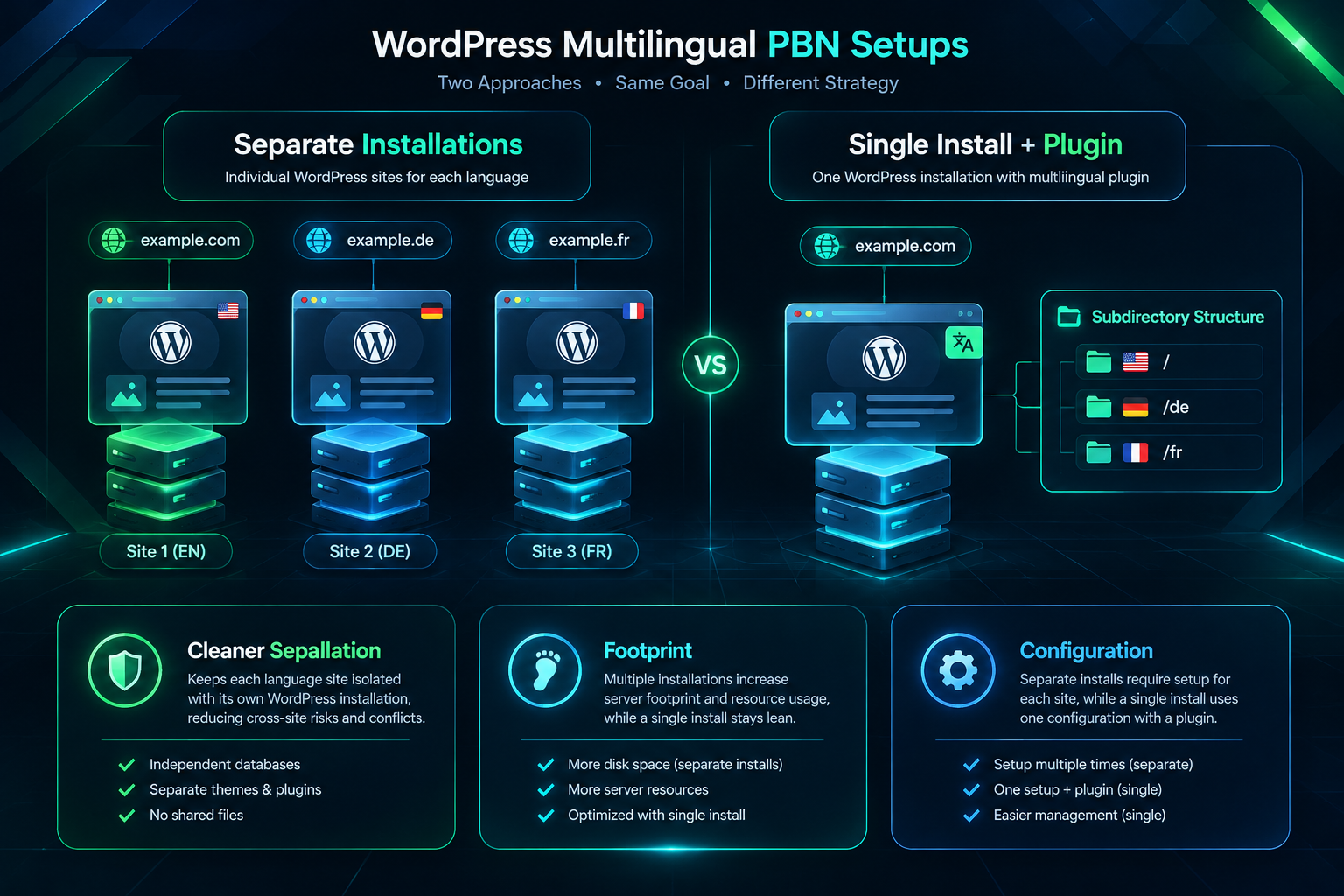
When using a single WordPress installation with a multilingual plugin to serve multiple language versions of a PBN site, the plugin’s hreflang output, URL structure, and language switcher implementation all require careful configuration. Incorrect hreflang tags — for example, pointing to the wrong language version or omitting the x-default tag — can create indexing confusion and reduce the site’s effectiveness as a placement host. Each language version should have its own distinct URL structure, whether through subdirectories such as /de/ and /fr/ or through separate subdomains, rather than relying on URL parameters or cookies to serve different language content from the same URL.
Theme selection also matters in a multilingual context. A theme that hard-codes English-language labels, uses English placeholder text in widget areas, or does not support right-to-left text rendering for languages such as Arabic or Hebrew will undermine the site’s credibility in those markets. Choosing a theme with full internationalization support and testing it thoroughly in each target language before publishing placements is a worthwhile investment in long-term site quality.
Content Production for Multilingual PBN Sites
Content quality is the most operationally demanding aspect of multilingual PBN management. Native-quality writing in each target language is the standard to aim for, because machine-translated or poorly localized content is detectable by both human readers and automated systems. For a PBN site to function as a credible placement host in a given language market, its content should read naturally to a native speaker of that language, use appropriate idiomatic expressions, and reflect the conventions of the local publishing environment in that niche.
Sourcing native-language content at scale requires either working with freelance writers who are native speakers of each target language, using content agencies with multilingual capabilities, or — with careful quality control — using AI-assisted drafting followed by native-speaker editing. Each approach has different cost and quality trade-offs. Freelance native writers typically produce the most natural output but require more coordination across multiple language markets. AI-assisted drafting can reduce per-word costs but requires thorough editing to remove translation artifacts, unnatural phrasing, and factual errors that may be more common in less-resourced language models.
Content topics for each multilingual PBN site should be consistent with the site’s stated niche and relevant to the target language market. A Spanish-language site in the finance niche should cover topics that Spanish-speaking audiences in the target geography actually search for, using local terminology and referencing locally relevant examples where appropriate. Generic content that could apply to any market, simply translated into the target language, is less convincing than content that demonstrates genuine familiarity with the local context.
Publishing cadence should be realistic for the number of language sites being maintained. A network of ten language-specific PBN sites each requiring regular content updates demands significantly more production capacity than a single-language network of the same size. Planning content production schedules per language site, rather than treating all sites as a single content pool, helps maintain consistent quality and avoids the common problem of some language sites becoming stale while others are actively updated.
Anchor Text and Link Placement in Multilingual Contexts
Anchor text strategy in a multilingual PBN requires attention to language consistency. The anchor text used in a placement on a German-language PBN site should be in German, or at minimum should be a natural fit for a German-language editorial context. Using English-language anchor text in a German-language article is unusual enough to stand out as an editorial anomaly, particularly for branded or generic anchors. Exact-match keyword anchors in the target language should be used with the same care applied in any PBN campaign — varied, contextually appropriate, and proportionate to the overall anchor profile of the destination site.
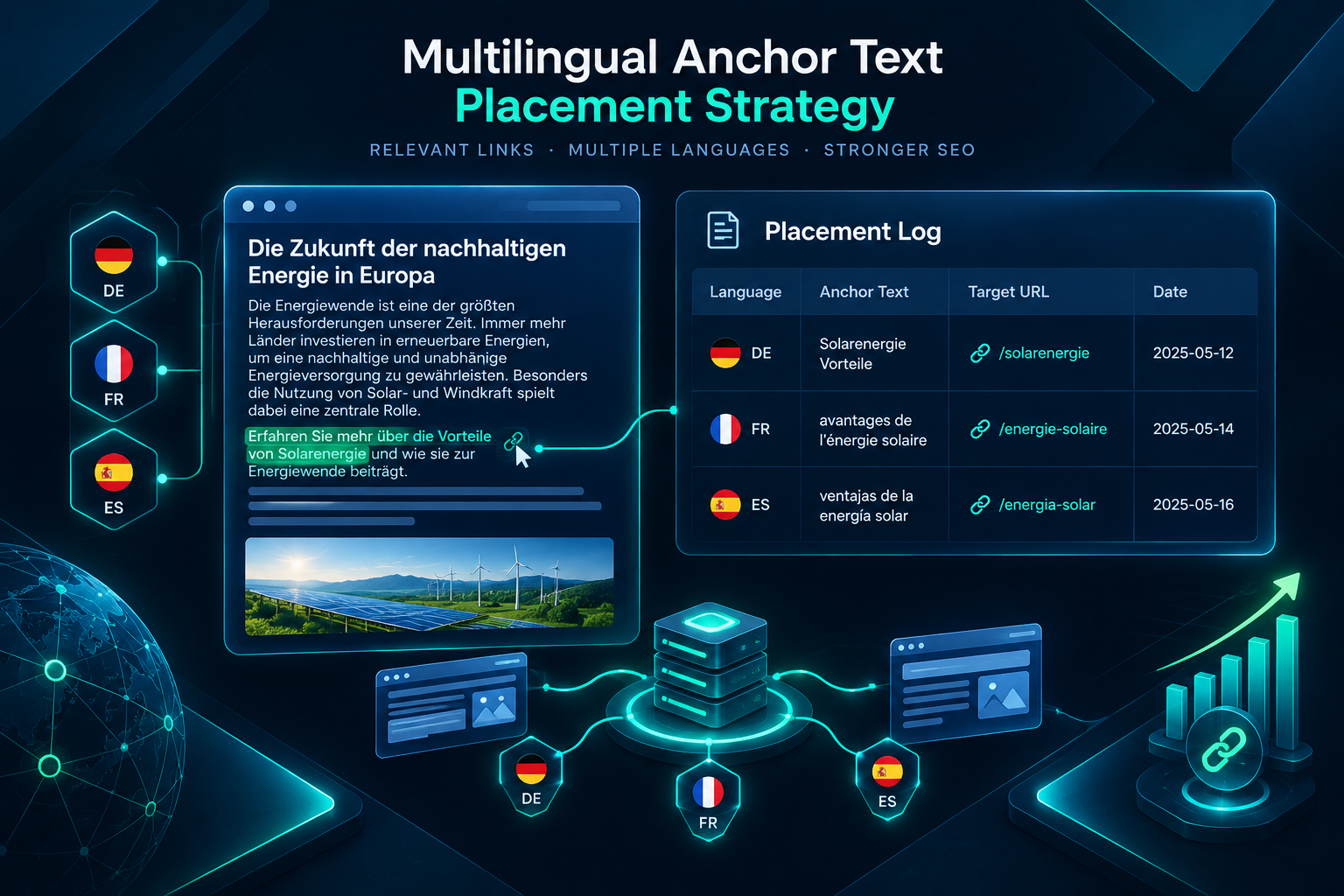
The surrounding content of a placement — the paragraph or section in which the link appears — should be topically relevant to both the PBN site’s niche and the destination page being linked. In a multilingual context, this means the placement context must be written in the target language with the same quality standard as the rest of the site’s content. A link embedded in a poorly written or obviously translated paragraph loses contextual credibility regardless of the domain’s authority metrics. Reviewing placement context in the target language, ideally with input from a native speaker, is a practical quality control step that is easy to overlook when managing a large multilingual network.
For campaigns targeting multiple language markets simultaneously, maintaining a placement log that records the language, anchor text, target URL, and publication date for each placement helps track anchor diversity and avoid over-concentration of similar anchors across the network. This is standard practice in any PBN campaign but becomes more important when placements span multiple languages, since the same destination URL may be receiving links with anchors in several different languages.
Technical SEO Configuration for Multilingual PBN Sites
Several technical SEO elements require specific attention in a multilingual PBN setup. Hreflang implementation, as noted above, is important when a single domain serves multiple language versions. Each language version should declare its own hreflang tag and reference all other language versions, including an x-default fallback. Errors in hreflang implementation — such as non-reciprocal tags or incorrect language codes — can cause search engines to misidentify the intended audience for each page.
XML sitemaps should be configured per language site or per language section, and should be submitted through the appropriate webmaster tools account for the target market. Google Search Console supports property sets and allows separate verification for different URL structures, which is useful for monitoring crawl coverage and indexing status across a multilingual network. Bing Webmaster Tools offers similar functionality and is worth configuring for markets where Bing has meaningful search share.
Canonical tags should be used carefully in multilingual configurations. Each language version of a page should have a self-referencing canonical tag pointing to its own URL, not to the primary language version. Using the primary language URL as the canonical for all language versions effectively tells search engines to ignore the non-primary versions, which defeats the purpose of maintaining separate language sites.
Page speed and Core Web Vitals performance should be monitored per language site, since different hosting environments and content configurations may produce different performance profiles. A multilingual PBN site that loads slowly in its target market provides a worse user experience and may be crawled less frequently, both of which can affect its value as a placement host.
Quality Control and Ongoing Maintenance
Maintaining quality across a multilingual PBN network is an ongoing operational commitment. Content audits should be conducted periodically for each language site to identify pages that have become outdated, thin, or inconsistent with the site’s stated niche. In a multilingual context, content audits require reviewers who can assess quality in each target language, which adds coordination overhead compared to a single-language network.
Crawl monitoring using tools such as Screaming Frog can identify technical issues such as broken links, missing metadata, redirect chains, and duplicate content across each language site. Running crawls per site rather than across the entire network at once makes it easier to isolate and address issues without disrupting other properties. Indexing status should be checked regularly through Search Console or equivalent tools to confirm that placement pages are being crawled and indexed in the target market.
Domain renewal and registration management becomes more complex across a multilingual network, particularly when using ccTLDs from multiple countries, each with different registrar requirements, renewal periods, and administrative contacts. Maintaining a centralized domain management record that tracks renewal dates, registrar details, and hosting configurations for each language site reduces the risk of accidental domain expiry, which would remove all placements hosted on that site.
Placement verification — confirming that published links remain live, correctly formatted, and pointing to the intended destination — should be part of the routine maintenance schedule for each language site. Link monitoring tools can automate much of this process, but the output should be reviewed by someone familiar with the target language to catch issues such as anchor text being altered during content edits or links being removed from updated pages.
Scaling a Multilingual PBN Operation
Scaling a multilingual PBN network efficiently requires systematizing the processes described above rather than managing each site entirely manually. Standard operating procedures for domain acquisition, hosting setup, CMS configuration, content briefing, placement publication, and quality review reduce the per-site overhead as the network grows. Documenting these procedures in each target language, or at minimum ensuring that team members responsible for each language market understand the relevant steps, prevents quality inconsistencies as the operation expands.
Prioritizing language markets based on campaign demand is a practical scaling approach. Rather than building out all target language sites simultaneously, developing the highest-demand language markets first allows the operation to generate placement value while the remaining markets are being built. This staged approach also allows quality standards to be refined based on early experience before being applied to additional language sites.
Working with a PBN backlinks provider that has existing multilingual network capacity can significantly reduce the operational burden of building and maintaining language-specific sites from scratch. Evaluating a provider’s multilingual capabilities — including the languages covered, the content quality standards applied, the hosting diversity across language markets, and the placement verification process — is an important step before committing to a multilingual link-building campaign through an external service.
Frequently Asked Questions
Do PBN sites in different languages need separate hosting?
Separate hosting is not strictly required, but using distinct hosting environments for different language sites reduces shared infrastructure signals across the network. For language markets where geographic server location is a meaningful signal — such as markets served by regional search engines — hosting in or near the target country is worth prioritizing.
Can I use the same WordPress theme across all language sites in a PBN?
Using the same theme across multiple sites in a network is a recognized footprint consideration. If the same theme is used, customizing the appearance, color scheme, typography, and layout for each site reduces visual similarity. Choosing themes that support full internationalization is important for non-Latin script languages.
How do I handle anchor text when the target keyword is in a different language than the PBN site?
Anchor text should generally match the language of the PBN site hosting the placement. If the destination page targets a keyword in a different language, the anchor used on the PBN site should be a natural equivalent in the PBN site’s language rather than a direct copy of the foreign-language keyword. This maintains editorial coherence in the placement context.
Is machine translation acceptable for multilingual PBN content?
Machine translation without native-speaker editing typically produces content that reads unnaturally to fluent speakers of the target language. For PBN sites where content quality directly affects placement credibility, native-speaker review and editing of any machine-translated or AI-assisted content is a practical minimum standard.
How often should multilingual PBN sites be updated with new content?
There is no fixed publishing frequency that applies universally. Sites that appear active and regularly updated are generally more credible as placement hosts than sites with a single page of content. A realistic schedule that can be maintained consistently — even if that means publishing less frequently — is preferable to an ambitious schedule that leads to content gaps or quality shortcuts.
What should I check when buying an expired domain for a non-English PBN site?
In addition to standard domain quality checks — referring domain quality, anchor text distribution, spam history, and indexing status — verify that the domain’s archived content and backlink profile are consistent with the target language and geographic market. A domain with a strong backlink profile in English may carry less relevant authority for a French-language PBN site than a domain with a smaller but language-consistent profile.
Building a Multilingual PBN That Delivers Consistent Placement Value
Managing PBN sites across multiple languages is operationally more demanding than running a single-language network, but the underlying quality principles remain the same: credible content, coherent site structure, relevant topical context, and careful placement execution. The language dimension adds requirements around native-quality writing, appropriate hosting geography, correct hreflang and canonical configuration, and language-consistent anchor text — all of which require deliberate planning rather than ad hoc adaptation of a single-language workflow.
For SEO campaigns targeting non-English markets, the quality of the multilingual PBN sites hosting placements directly affects the value those placements deliver. A well-maintained German-language PBN site with native content, appropriate hosting, and a relevant backlink profile is a meaningfully different placement environment than a translated version of an English site with no local context. Investing in that quality difference — whether by building language-specific sites carefully or by working with a provider whose multilingual network meets those standards — is the practical foundation of effective multilingual link building.
If you are planning a link-building campaign that spans multiple language markets, reviewing your domain selection criteria, content production capacity, and placement verification process for each target language before scaling is a worthwhile step. PBN Backlinks Service can help assess multilingual campaign requirements and discuss placement options suited to your target markets and SEO goals.