

Losing a PBN link can produce a measurable ranking change, no change at all, or a gradual shift that takes weeks to become visible in your data. Before drawing conclusions, it helps to understand what signals to monitor, how to isolate the link loss from other ranking factors, and what the observed change actually tells you about the link’s contribution to your campaign.
Key Takeaways
- A ranking change after losing a PBN link is not automatically caused by that link loss — other factors must be ruled out before attributing the shift.
- Useful measurement requires baseline data collected before the link was removed, not just a snapshot taken after the fact.
- Google Search Console, rank-tracking tools, and backlink monitors each capture different parts of the picture and work best used together.
- The time between link removal and a measurable ranking response can range from days to several weeks, depending on crawl frequency and the link’s prior contribution.
- A link that produced no measurable ranking change when lost may still have contributed to overall profile diversity or topical relevance signals.
Why Measuring Link Loss Is More Complex Than It Looks
Ranking positions are influenced by dozens of interacting signals simultaneously. When a PBN backlink disappears from your profile, the ranking effect — if any — is rarely immediate or isolated. Google’s crawlers must first discover that the link is gone, the index must update, and any ranking adjustment must propagate through the algorithm before it becomes visible in your tracking data. That sequence can take anywhere from a few days to several weeks, which means a ranking drop observed on the day of link removal is almost certainly caused by something else.
The core measurement challenge is attribution. Your target page may have lost a ranking position because of the PBN link removal, a broad algorithm update, a competitor acquiring new links, a change in your own internal linking, a content update on the target page, or a technical issue such as a crawl block or page-speed regression. Without a structured approach to ruling out these alternative causes, any conclusion about the link’s contribution will be unreliable.
This is why measurement should begin before a link is lost, not after. If you have no baseline data — keyword positions, organic traffic, crawl frequency, and backlink profile state — you are working backward from an incomplete picture. Establishing monitoring habits across your PBN-supported pages gives you the reference points needed to assess any future change accurately.
Setting Up a Measurement Baseline
A reliable baseline for measuring PBN link impact covers four data layers: keyword rankings for the target page, organic traffic to that page, the backlink profile state at the time the link was active, and any concurrent on-page or technical changes. Each layer helps you isolate the link’s contribution from other variables.
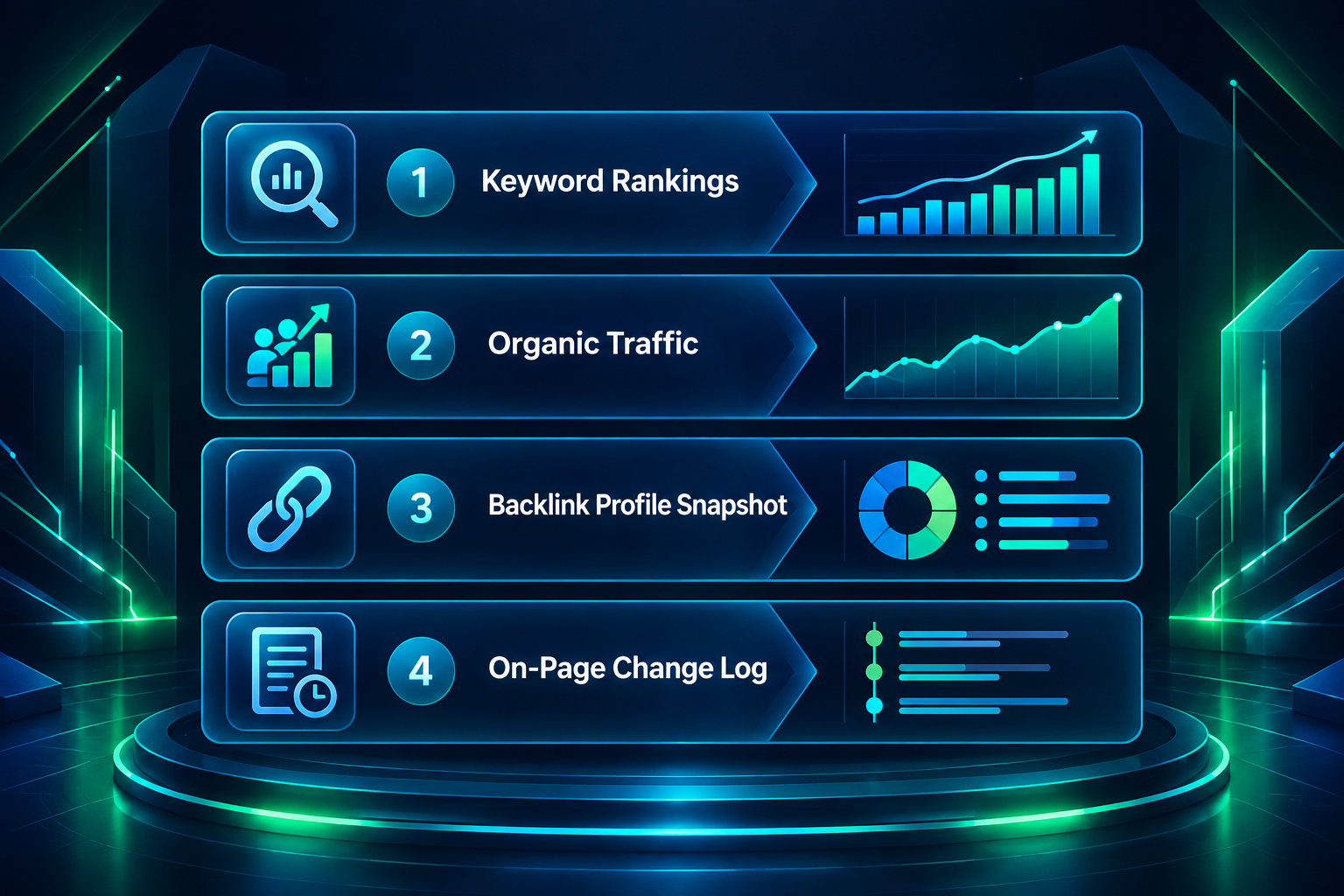
For keyword rankings, record positions for the primary target keyword and a set of semantically related terms. Rank-tracking tools such as Semrush, Ahrefs, or dedicated rank trackers allow you to export daily or weekly position snapshots. Tracking a cluster of related keywords rather than a single phrase gives you a more complete picture of the page’s overall visibility, because a link that contributes to topical authority may lift several related terms, not just the exact-match target.
For organic traffic, Google Search Console provides impression and click data at the page level, broken down by query. This data is particularly useful because it reflects actual search-engine behavior rather than a tool’s estimated position. Export the page’s performance data covering at least 90 days before the link was active and the period during which it was live. A 90-day window is generally sufficient to smooth out normal weekly fluctuations and seasonal patterns.
For the backlink profile, tools such as Ahrefs or Majestic allow you to export a snapshot of referring domains, anchor text distribution, and link attributes at a specific point in time. Record this snapshot while the PBN link is active so you have a clear record of the profile state that corresponded to the ranking positions you observed.
Finally, log any on-page changes, technical updates, or other link-building activity that occurred during the measurement period. If you added new links from other sources, updated the page’s content, or changed internal linking while the PBN link was active, those variables need to be accounted for when you assess the effect of losing the link.
Detecting the Link Loss Itself
Before you can measure the effect of losing a PBN link, you need to confirm that the link has actually been removed from Google’s active index, not just from the live page. A link can disappear from a page but remain in Google’s index for days or weeks if the page has not been recrawled. Conversely, a link may still appear in a third-party backlink tool’s database long after Google has deindexed it, because commercial crawlers and Google operate on different schedules.
The most reliable way to confirm that Google has processed the link removal is to monitor your Google Search Console link report. The links listed there reflect what Google has crawled and attributed to your site. A drop in the referring domain count or the disappearance of a specific anchor from the top anchor text list can indicate that the link has been processed. However, Search Console’s link data is not updated in real time and may lag by days or weeks.
Third-party backlink monitors such as Ahrefs, Semrush, or Majestic track link status based on their own crawl schedules. These tools are useful for detecting when a link disappears from the live page, but they do not confirm when Google processed the removal. Use them to identify the approximate date of link loss, then cross-reference with Search Console data and rank-tracking records to establish a timeline.
Setting up automated backlink alerts in a monitoring tool is a practical way to catch link losses quickly. Most major backlink platforms allow you to configure email or dashboard notifications when a referring domain is lost. Receiving this alert promptly gives you a clear starting point for your measurement window.
Tracking Ranking Changes After the Link Is Gone
Once you have confirmed the approximate date of link removal and have a baseline in place, the next step is to monitor keyword positions over the following four to eight weeks. This window is necessary because ranking responses to link changes are rarely instantaneous. Google’s algorithm processes link signals over time, and a position change caused by link loss may not become statistically distinguishable from normal ranking fluctuation for several weeks.
When reviewing ranking data, look for a sustained directional shift rather than a single-day movement. Normal ranking volatility means that a page may move up or down by one to three positions on any given day without any underlying cause. A meaningful signal is a consistent downward trend across multiple consecutive tracking periods, affecting both the primary keyword and related terms, that began within a plausible time window after the link was removed.
Compare the ranking trend for the target page against other pages on the same domain that did not lose a link during the same period. If those pages also declined, the cause is more likely a sitewide factor — an algorithm update, a technical issue, or a broad competitor shift — rather than the specific link loss. If only the target page declined while other pages held steady, the link loss becomes a more plausible contributing factor.
Also compare against competitor pages targeting the same keyword. If competitors gained positions during the same period, that competitive movement may explain part or all of your ranking change independently of the link loss. Rank-tracking tools that include competitor position data make this comparison straightforward.
Using Google Search Console to Assess Traffic Impact
Google Search Console’s performance report provides the most direct evidence of how a ranking change has affected organic visibility. After the link loss, compare the page’s impressions and clicks for the four-week period following the removal against the equivalent period before the link was active and during the period when it was live.
A meaningful traffic impact from a link loss will typically appear as a reduction in impressions for the target keyword cluster, followed by a reduction in clicks. If impressions remain stable but clicks decline, the cause is more likely a change in click-through rate — perhaps a competitor’s title or meta description became more compelling — rather than a ranking drop caused by the link loss.
The Search Console performance report also allows you to filter by specific queries and pages. Use this to isolate the target page’s data from the rest of the domain, and to identify whether the impression decline is concentrated on the primary keyword or spread across a broader set of related queries. A broad impression decline across many related queries suggests a more significant authority or topical relevance signal was lost, while a narrow decline on a single keyword may indicate a more limited contribution from the link.
One important limitation of Search Console data is that it reflects the last 16 months of performance and is sampled for high-traffic properties. For lower-traffic pages, the data may not provide statistically reliable conclusions about small ranking movements. In those cases, rank-tracking tool data and backlink profile analysis become proportionally more important.
Isolating the Link’s Contribution from Other Ranking Factors
Attribution is the hardest part of measuring PBN link impact. Even with a solid baseline and careful monitoring, you cannot directly observe Google’s internal link weighting for a specific URL. What you can do is apply a structured elimination process to assess how likely the link loss is to have caused the observed ranking change.
Start by checking whether any Google algorithm updates were announced or detected during the measurement window. Tools such as Semrush Sensor, MozCast, or community-reported volatility data can help you identify periods of elevated ranking volatility across the broader search landscape. If a confirmed broad core update or spam update was released within the measurement window, that update is a plausible alternative explanation for any ranking change, and the link loss cannot be identified as the primary cause without additional evidence.
Next, review whether any changes were made to the target page itself — content edits, title tag changes, schema markup additions, or internal link modifications — during the measurement period. On-page changes can produce ranking movements that are unrelated to the backlink profile. Similarly, check whether the page’s crawl coverage changed, for example through a robots.txt update, a noindex tag, or a canonical tag adjustment.
Review the broader backlink profile for the target page. If other links were gained or lost during the same period, the net change in the profile may be more relevant than the single PBN link removal. A page that lost one PBN link but gained two new referring domains from other sources may show no net ranking change, which does not mean the PBN link had no value — it means the profile change was partially offset.
Finally, assess the relative weight of the lost link within the overall profile. A PBN link from a domain with strong topical relevance, a clean referring domain history, and a well-placed contextual anchor may have contributed more measurably than a link from a domain with a thin profile or low topical alignment. The link’s characteristics at the time it was active — domain authority metrics, anchor text, placement context, and topical relevance — are relevant to estimating how much weight it may have carried.
Interpreting the Results: What Different Outcomes Mean
After completing the measurement process, you will typically observe one of three outcomes: a measurable ranking decline, no detectable change, or an ambiguous result that cannot be attributed with confidence.
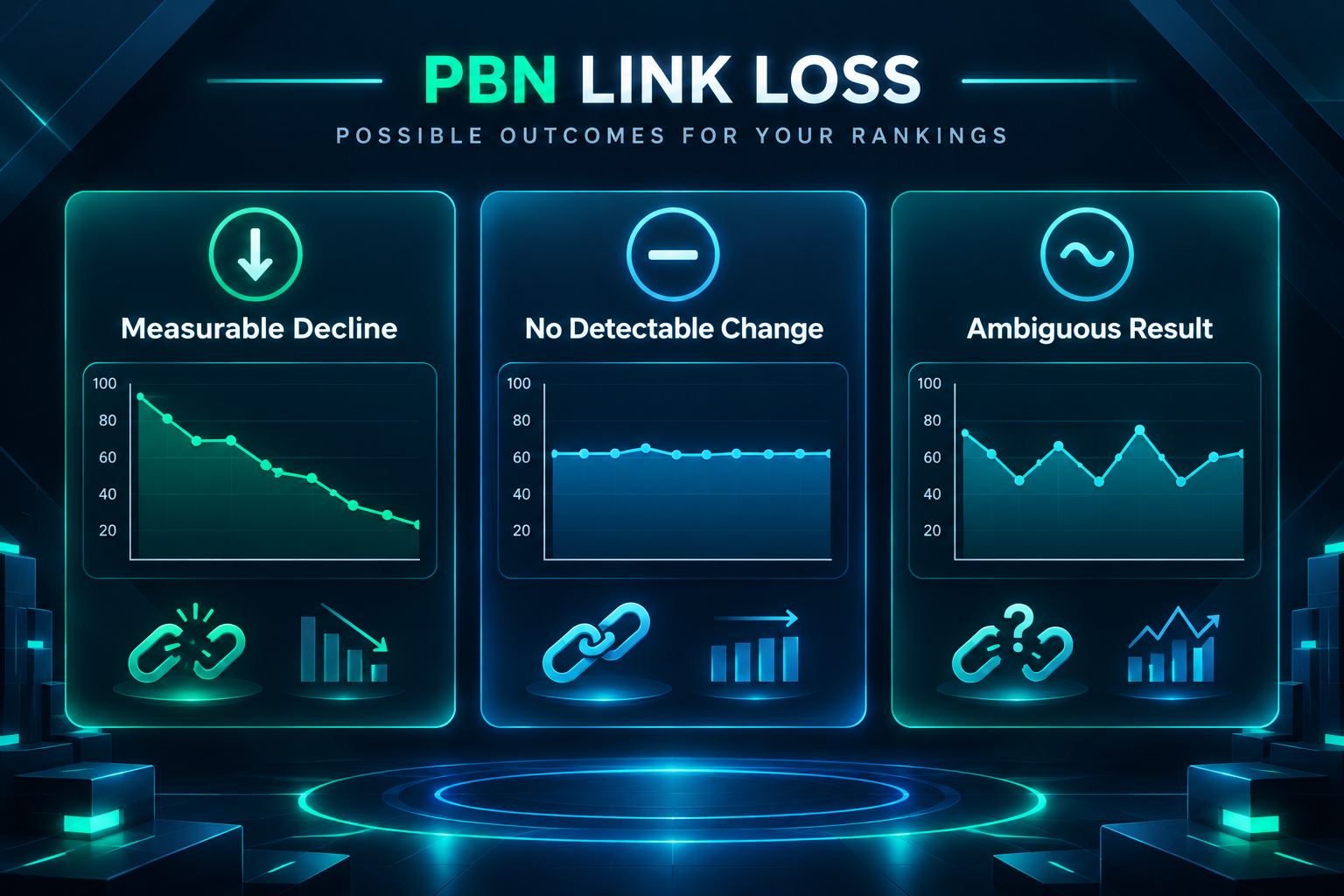
A measurable ranking decline — defined as a sustained downward shift in positions and impressions that began within a plausible time window after the link removal, is concentrated on the target page, and cannot be explained by algorithm updates, on-page changes, or competitor gains — suggests the lost PBN link was contributing a meaningful ranking signal to that page. The size of the decline gives you a rough indication of the link’s relative contribution, though it cannot be translated into a precise weighting figure because Google does not publish link-value formulas.
No detectable change after a link loss can mean several things. The link may have been contributing less than other signals in the profile, making its removal insufficient to produce a visible ranking movement. The page may have enough other strong referring domains that the profile remained robust after the loss. Alternatively, the link may have already been devalued by Google before it was removed — for example, if the hosting domain had been deindexed or its link equity had been algorithmically discounted. A no-change result does not necessarily mean the link was worthless; it may mean the profile had sufficient depth to absorb the loss.
An ambiguous result — where some ranking movement occurred but cannot be cleanly attributed to the link loss — is the most common outcome. In this case, the most useful approach is to document the timeline, note the concurrent factors, and use the data as a reference point for future link-building decisions rather than drawing a firm conclusion about the specific link’s value.
Practical Monitoring Tools and Workflow
A practical measurement workflow for PBN link impact does not require a complex technical setup, but it does require consistent data collection across a small set of tools used together.
- Google Search Console: Monitor the target page’s impressions, clicks, and average position weekly. Export the performance data filtered by page and compare across time periods. Check the links report for changes in referring domain count and anchor text distribution.
- Rank-tracking tool (Semrush, Ahrefs, or equivalent): Track daily or weekly positions for the primary keyword and a cluster of related terms. Use the competitor comparison feature to distinguish your page’s movement from broader market shifts.
- Backlink monitor (Ahrefs, Majestic, or Semrush): Set up alerts for lost referring domains on the target page. Export a backlink profile snapshot at regular intervals to maintain a historical record.
- Algorithm update tracker: Check Semrush Sensor, MozCast, or similar volatility indicators whenever you observe a ranking movement, to determine whether a broad update may be a confounding factor.
- Change log: Maintain a simple record of on-page changes, technical updates, new link acquisitions, and link losses with dates. This log is essential for the elimination process described above.
Running this workflow consistently across all PBN-supported pages — not just after a link loss — gives you the historical data needed to make attribution assessments with reasonable confidence. Retrospective measurement without prior data collection is significantly less reliable.
What the Measurement Tells You About Link Quality and Campaign Decisions
The measurement process described here serves a practical purpose beyond diagnosing a single link loss. Over time, tracking the ranking response to link gains and losses across multiple pages and campaigns gives you a clearer picture of which link characteristics correlate with measurable ranking contributions in your specific niche and competitive environment.
Links from domains with strong topical relevance to the target page, clean referring domain histories, and contextually placed anchors tend to produce more detectable ranking contributions when lost than links from domains with weaker topical alignment or thinner profiles. This pattern — observed across your own campaign data rather than assumed from general SEO principles — is the most reliable guide to link quality assessment for your specific situation.
If you are evaluating whether to replace a lost PBN link, the measurement data helps you assess the urgency and likely impact of a replacement. A link whose loss produced a clear and sustained ranking decline warrants prompt attention. A link whose loss produced no detectable change may be lower priority relative to other campaign activities.
When reviewing your PBN link strategy or discussing requirements with a provider, the data you have collected — baseline positions, traffic trends, backlink profile snapshots, and timeline records — gives you a concrete basis for the conversation rather than relying on general assumptions about link value.
Frequently Asked Questions
How long should I wait before concluding that a lost PBN link caused a ranking drop?
Allow at least four to six weeks after the confirmed link removal before drawing conclusions. Ranking responses to link changes are not instantaneous — Google must recrawl the source page, update its index, and process the change through its ranking systems. A ranking movement observed within the first few days of link removal is more likely caused by another factor. A sustained directional shift that begins one to three weeks after removal and persists for several weeks is a stronger signal of a link-related cause.
Can a PBN link loss cause a sitewide ranking decline rather than just affecting the target page?
A single link loss affecting one page would not typically produce a sitewide ranking decline. If you observe broad ranking declines across many pages simultaneously, the more likely causes are a Google algorithm update, a technical issue affecting the whole domain, or a significant change in the domain’s overall backlink profile. Sitewide effects from link changes generally require a substantial shift in the profile, not the removal of a single placement.
What if my rank-tracking tool and Google Search Console show different results?
Discrepancies between rank-tracking tools and Search Console are common and expected. Rank trackers measure position from a specific location, device type, and query at a specific time, while Search Console aggregates impression and click data across all users, locations, and query variations. Use Search Console as the primary source for traffic impact assessment and rank-tracking data for position trend analysis. Where they diverge, investigate whether the discrepancy is explained by personalization, location differences, or query variation before drawing conclusions.
Does a no-change result after losing a PBN link mean the link had no value?
Not necessarily. A link may have contributed to profile diversity, topical relevance signals, or overall domain authority in ways that are not immediately visible when a single link is removed. If the profile has sufficient depth from other referring domains, the loss of one link may not produce a detectable ranking movement even if the link was contributing value. A no-change result is informative but not conclusive evidence that the link was without effect.
Should I replace a lost PBN link immediately after detecting the loss?
The urgency of replacement depends on the measurement outcome. If the loss produced a clear and sustained ranking decline on a commercially important page, prompt replacement is worth prioritizing. If the loss produced no detectable change, replacement is lower priority. In either case, completing the measurement process before acting gives you a more informed basis for the decision than reacting immediately to the link loss notification.
How do I know if the PBN domain itself was deindexed rather than just the link removed?
Check whether the source domain is still indexed by searching for it directly in Google using the site: operator. If the domain returns no results, it has likely been deindexed, which means any links it hosted would no longer pass ranking signals regardless of whether the link is still present on the page. A deindexed source domain is a distinct situation from a link being removed from an active, indexed page, and the measurement implications differ accordingly.
Assessing Link Value and Planning Your Next Steps
Measuring the effect of losing a PBN link is fundamentally an exercise in structured observation and careful attribution. The process requires baseline data, a consistent monitoring workflow, and a disciplined approach to ruling out alternative causes before drawing conclusions about the link’s contribution. No single tool or data point provides a complete answer — the most reliable assessments combine Search Console performance data, rank-tracking trends, backlink profile snapshots, and a record of concurrent changes.
What the measurement process reveals is genuinely useful for campaign management. It tells you which placements in your profile are producing detectable ranking contributions, which pages are most sensitive to link changes, and where replacement or reinforcement is most likely to have a measurable impact. Over time, this data builds a practical understanding of link quality that is specific to your niche, your competitive environment, and your domain’s current profile state.
If you have experienced a link loss and want to assess the impact on your campaign, or if you are looking to strengthen a page that has shown sensitivity to backlink changes, reviewing your current backlink requirements with PBN Backlinks Service can help you identify appropriate placements based on your domain’s profile and competitive context.