

Private Blog Network link building remains one of the most debated strategies in professional SEO. For businesses competing in high-stakes verticals — finance, legal, health, and e-commerce — understanding how PBN backlinks work, how they are built, and what risks they carry is essential before committing budget to this tactic.
This guide covers the full operational scope of PBN link building: how a private blog network is structured, how to evaluate expired domains, what risks every SEO professional must assess, and where PBNs fit within a modern link building strategy.
What Is a Private Blog Network?
A private blog network (PBN) is a collection of websites — typically built on expired domains — controlled by a single entity and used exclusively to build backlinks pointing to a primary “money site.” The defining characteristic is concealed ownership, creating the appearance of independent editorial endorsements from multiple unrelated sources.
PBN link building operates on PageRank mechanics: search engines treat links from authoritative external domains as trust signals. By owning the linking sites, PBN operators gain complete control over anchor text distribution, URL destination, and link velocity — precision that is impossible to achieve through conventional outreach.
The modern private blog network has evolved significantly since early link farms. A professionally managed PBN in 2026 resembles a portfolio of legitimate niche publications, each with original content, diversified hosting, and an independent editorial identity.
| PBN Characteristic | Technical Requirement | Strategic Purpose |
| Ownership | Single-entity control, hidden via WHOIS privacy | Precision anchor text and placement control |
| Domain Origin | Expired domains with established RD profiles | Inherit DR to bypass authority sandbox |
| Content | Niche-specific, EEAT-aligned original articles | Satisfy topical authority quality signals |
| Link Intent | Controlled equity transfer to main site | Accelerate rankings for commercial keywords |

Mon-Fri: 09:00 AM – 06:00 PM
How PBN Links Work in Search Engine Rankings
When Google crawls a PBN site and follows a contextual link to the money site, it registers that link as an editorial citation from an independent, established source. The search engine factors that citation into its authority assessment, influencing where the money site ranks in search results.
A PBN backlink from a domain with DR 45 and 60 referring domains (RDs) carries substantially more weight than a link from a freshly registered domain with no backlink history. The equity transfer is real — but only when the source domain carries genuine historical authority and is not already flagged by SpamBrain.
Link velocity is equally critical. Backlinko’s analysis of 11.8 million Google search results confirms that domain-level authority remains one of the strongest ranking signals across competitive SERPs. A sudden cluster of PBN links appearing simultaneously contradicts the gradual cadence of natural link acquisition and triggers algorithmic review.
Are PBN Backlinks Good for SEO?
PBN backlinks can produce measurable ranking improvements when sourced from aged domains with DR 40+, TF 20+, and a TF/CF ratio close to 1.0. In competitive niches where organic link acquisition is slow or structurally blocked, PBN backlinks provide page-level ranking control that outreach alone cannot efficiently deliver.
However, Google explicitly classifies PBN link building as a link scheme under its webmaster guidelines. Every PBN backlink carries inherent risk that must be weighed against its ranking benefit — a calculation that looks very different for an affiliate site versus an established e-commerce brand.
Benefits of PBN Links for Link Building Strategies
PBN link building offers three core advantages that conventional link building methods cannot match:
- Control. Operators decide anchor text, destination URL, publication date, and surrounding context — eliminating dependence on third-party webmaster decisions.
- Speed. Aged domains with established authority can accelerate rankings within weeks, compressing timelines that organic link building would stretch to twelve to eighteen months.
- Cost efficiency at scale. Once a network is operational, the marginal cost per additional link drops significantly compared to recurring guest post or niche edit fees of $150 to $1,500 per placement.
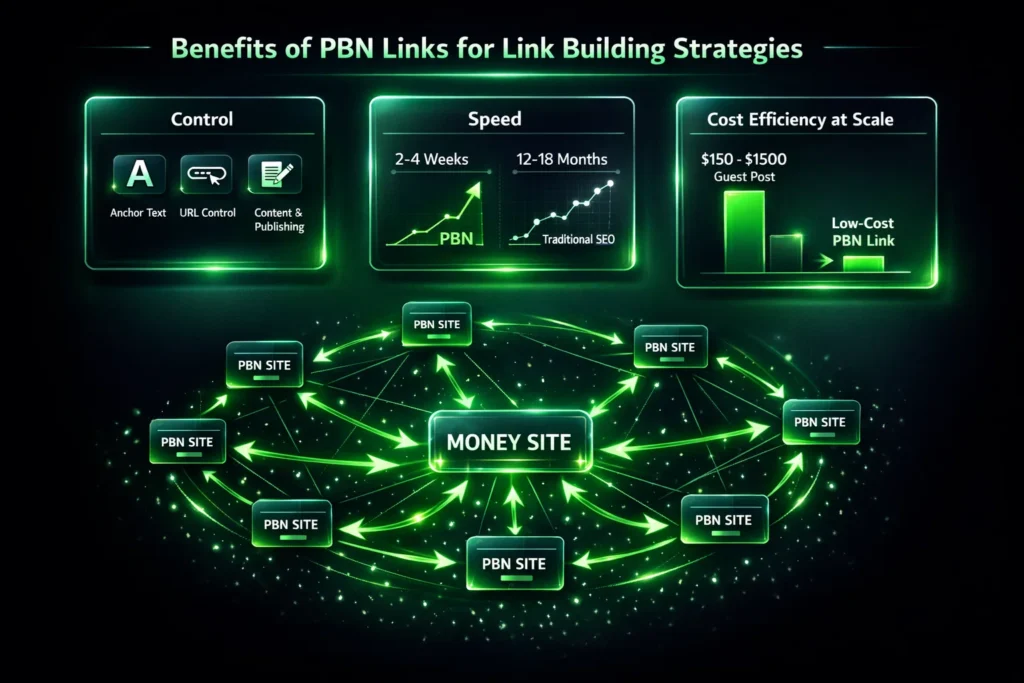
For time-sensitive campaigns — product launches, seasonal offers, or competitive keyword targets — that combination of speed and control has direct commercial value that justifies the upfront infrastructure investment.
Why SEO Professionals Use PBN Link Building
SEO professionals deploy PBN link building in three primary scenarios:
- Organic link acquisition in the niche is structurally limited (gambling, CBD, crypto, legal).
- A campaign requires measurable ranking movement within a defined commercial timeframe.
- Surgical anchor text optimization is needed for specific transactional or product pages.
In restricted verticals, many authoritative publishers refuse backlink placements regardless of outreach quality. PBN backlinks fill this acquisition gap. Ahrefs’ study of over one billion web pages found that 66.3% of pages have zero referring domains — demonstrating the scale of the link acquisition problem that PBNs are often deployed to solve.
PBN Backlinks vs. Natural Backlinks: Key Differences
| Attribute | PBN Backlinks | Natural Editorial Backlinks |
| Anchor Text | Full operator control | Set by the linking webmaster |
| Placement Timing | On-demand | Third-party publishing schedule |
| Link Velocity | Controlled deployment | Organic and unpredictable |
| UR Impact | Dependent on source page UR | Consistent from editorial context |
| Google Risk | Classified as a link scheme | Algorithm-proof |
| Cost | Infrastructure-based | Outreach or content-earned |
PBN Setup: Building a Sustainable Private Blog Network
A sustainable PBN setup requires investment across four areas: domain acquisition, hosting infrastructure, content production, and link deployment management. Cutting corners in any one area increases footprint detection risk — the identification of multiple sites as belonging to a single owner — which can result in network-wide deindexing.
The non-negotiables for a professional PBN setup:
- Unique IP address per site across diverse hosting providers
- Separate domain registrar accounts with WHOIS privacy enabled from day one
- Randomized CMS installations (WordPress, Ghost, Joomla)
- Diversified plugin stacks, themes, and admin usernames
- No Google Analytics, Search Console, or AdSense accounts connected to any network site
- Original content of 800+ words per article with author personas and niche credentials
Google’s SpamBrain processes link signals continuously in 2026, not periodically. A footprint detected today results in devaluation today — not at the next algorithm update.
Expired Domain Selection for PBN Sites
The quality ceiling of any private blog network is determined by the expired domains it is built upon. An expired domain carries accumulated DR, TF, and RD from its previous life as a legitimate website — authority that a newly registered domain cannot replicate for years.
The domain evaluation framework covers five critical dimensions:
- Backlink profile quality. Referring domains must be topically relevant, high-TF sources — not previous link farms or other PBN clusters.
- Historical content integrity. Verified via the Wayback Machine; gaps in publishing history or extended parking periods are disqualifying red flags.
- Current indexation. Confirmed via a site: search in Google. A domain with strong DR but zero indexation almost always carries a manual or algorithmic penalty.
- Metric thresholds. Minimum benchmarks must be met before acquisition.
- Topical alignment. The domain must relate logically to the money site’s niche to maximize equity transfer.
| Evaluation Metric | Minimum Threshold | Preferred Target |
| Domain Rating (DR) | 20+ | 40+ |
| Trust Flow (TF) | 15 | 20+ |
| TF/CF Ratio | 0.5+ | ~1.0 |
| Referring Domains (RD) | 20+ unique | 50+ unique |
| Domain Age | 5+ years | 10+ years |
| Indexation | At least 1 page | Full historical URL indexation |
Quality expired domains in competitive niches sell for $500 to several thousand dollars at auctions on GoDaddy, DropCatch, and NameJet. Total operational cost per PBN site — including hosting, content, and maintenance — runs $150 to $400 per month at professional standards.
Anchor Text Strategy for PBN Link Building
Anchor text distribution is one of the highest-leverage variables in PBN link building. A profile dominated by exact-match commercial anchors is a statistically detectable manipulation signal. SpamBrain identifies these distributions through anomaly analysis of the broader link graph.
The professional anchor text pyramid for PBN deployments:
- Branded anchors (company name, product name): 40–50%
- Naked URL anchors (bare domain or page URL): 20–25%
- Generic anchors (“this guide,” “learn more,” “click here”): 10–15%
- Partial-match keyword anchors: 10–15%
- Exact-match commercial keyword anchors: 1–5% maximum
This distribution mirrors natural editorial link profiles, where most webmasters link using brand names or page titles rather than commercial keyword phrases. Anchor text strategy should be audited quarterly as the money site’s link profile grows from multiple sources.
Identify PBN Risks: What SEO Professionals Need to Know
The risks associated with PBN link building fall into three measurable categories:
- Algorithmic devaluation. SpamBrain identifies the link as manipulative and stops counting it — no penalty notification, no ranking drop, just zero ROI on the entire domain investment.
- Manual action penalties. Google’s spam review team issues a formal suppression visible in Search Console. Recovery takes 75 to 90 days on average and typically restores only 75% of pre-penalty organic traffic.
- Opportunity cost. Capital invested in a PBN that gets devalued could have funded editorial links or digital PR assets that compound in value indefinitely.
For established brands generating significant organic revenue, a manual penalty resulting in a 60 to 100% traffic loss represents financial exposure that frequently exceeds the total cost of the PBN operation many times over.
Risks Associated with PBN Link Building
Specific operational risks include:
- Network-wide deindexing when IP clustering or shared registrar patterns are detected, stripping the money site of every network link simultaneously.
- Link graph contamination if any PBN domain was previously used in another operator’s network — toxic equity transfers both ways.
- Content quality devaluation as Google’s helpful content classifiers identify thin or AI-spun articles and filter links from those pages out of ranking calculations.
- Disavow tool exposure following Google’s 2026 confirmation of TLD-level disavowal capability — enabling Google to neutralize entire spammy TLD extensions like .xyz or .top at scale.
Brand reputation damage with partners, advertisers, and clients adds an indirect cost to penalty scenarios that is difficult to quantify but significant in practice.
How Search Engines Identify a PBN Network

| Detection Signal | Mechanism | Consequence |
| IP / Subnet Clustering | Sites sharing C-class IP blocks | Network-wide deindexing |
| Link Graph Loops | Closed circuits of cross-linking sites | Cluster-wide devaluation |
| Anchor Over-Optimization | Statistical analysis of exact-match ratios | Ranking suppression for target pages |
| Thin / Templated Content | Vector similarity mapping across network sites | Filtering from search results |
| WHOIS / Registrar Patterns | Shared ownership data across domains | Manual investigation trigger |
| Google Product Connections | Shared GA, GSC, or AdSense IDs | Immediate footprint confirmation |
Using PBN Links as Part of Your SEO Strategies
PBN links are most effective as a surgical precision tool — targeting specific commercial pages that cannot attract natural editorial links — rather than the sole or primary link building channel. A link profile built entirely from PBN backlinks lacks the RD diversity and UR variance that characterize organic authority growth and is statistically straightforward to identify.
The most defensible SEO strategy in 2026 combines PBN backlinks with earned editorial links, digital PR citations, and structured content designed to attract natural links over time. PBN links provide immediate page-level UR support while longer-term organic efforts build the domain-level DR and trust signals that protect against algorithmic shifts.
PBN link building is particularly effective at the page level rather than exclusively at the homepage. Product category pages, service landing pages, and local SEO pages frequently lack editorial appeal but require strong UR signals to compete in transactional SERPs. These are the specific deployment targets where PBN link building delivers the clearest ROI.
Implementing PBN Links for Local SEO
Local SEO campaigns present a distinct use case for PBN link building. In local search, ranking signals combine traditional DR and UR metrics with geographic relevance and Google Business Profile engagement. PBN backlinks built on expired domains with local topical history — former city directories, regional news sites, or local trade association domains — carry geographic authority signals that generic PBN domains cannot replicate.
Anchor text for local SEO PBN deployments should reflect geographic search intent:
- Geographic partial-match anchors (“plumber in Austin TX”) carry lower over-optimization risk than pure commercial keyword anchors.
- Location-branded anchors (“ServiceName Houston”) blend commercial and geographic signals naturally.
- NAP-consistent branded anchors reinforce local entity signals that support Google Business Profile rankings.
How to Use PBN Link Building Without Triggering Penalties
The operational checklist for reduced-risk PBN deployment:
Infrastructure:
- One unique IP per site across diverse hosting providers and C-class subnets
- Separate registrar accounts with WHOIS privacy from acquisition date
- Randomized CMS platforms, themes, and plugin stacks
- Zero Google-owned tracking products on any network site
Content:
- Original niche-relevant articles of 800+ words
- Unique author personas with credible bios and external profile links
- Active publishing schedule simulating an editorial calendar
- One to two outbound links per article to authoritative non-competing sites (Wikipedia, industry journals)
Deployment:
- Allow new PBN sites to age four to eight weeks before publishing any outbound link.
- Limit outbound links to the money site to one or two per PBN domain.
- Drip-feed links in small batches over weeks — never bulk-publish simultaneously.
- Distribute link destinations across the money site, not concentrated on a single commercial page.
- Audit the money site’s full link profile quarterly and adjust anchor text ratios accordingly.
Alternatives to PBN Link Building for Sustainable SEO Success
For organizations with established brands, significant existing organic traffic, or low tolerance for penalty risk, sustainable SEO success requires link building strategies that earn genuine editorial authority without algorithmic reversal risk.
The core alternatives:
- Digital PR. Original research and data-driven content campaigns targeting tier-one publications. A single link from a DR 80+ publication typically outweighs dozens of PBN backlinks in ranking impact and carries zero penalty risk.
- Guest posting. Niche-relevant article placements on mid-to-high DR publications. Cost ranges from $150 to $1,500 per placement depending on domain authority.
- Niche edits. Contextual backlinks inserted into existing indexed content on relevant sites. Generally faster to deploy than fresh guest posts and cost $100 to $1,000 per placement.
- Broken link building. Identifying dead resource pages on high-DR domains and offering replacement content. Acquisition cost is primarily labor and averages $30 to $200 per secured link.
- Resource page link building. Targeting curated industry resource pages for inclusion, earning DR-weighted links with long editorial shelf lives.
Editorial Links and Organic Link Building Methods
Editorial links — placed by independent webmasters who choose to reference content because it genuinely serves their audience — carry the highest authority signal in Google’s evaluation framework. They represent uncoerced endorsements that are effectively algorithm-proof.
Content assets that include original data attract three to five times more referring domains than purely informational content over twelve months, according to Ahrefs research. Digital PR campaigns built around proprietary surveys, industry benchmarks, and original data studies regularly earn links from publications with DR 70 to 90+ — link equity that no PBN can match in per-link ranking impact.
The trade-off is time. Editorial link building requires consistent content investment and outreach infrastructure. It produces results over twelve to twenty-four months rather than weeks. For campaigns where that timeline is commercially acceptable, it is the structurally superior strategy.
Building a Sustainable SEO Plan Without PBNs
A sustainable SEO plan distributes link building efforts across three tiers:
- Tier 1 — Domain authority. Digital PR and original research targeting DR 60+ publications for domain-level trust signals and AI Overview citation eligibility.
- Tier 2 — Page-level equity. Guest posting and niche edit outreach targeting DR 30–60 sites for commercial page UR support.
- Tier 3 — Profile diversification. Broken link building, resource page outreach, and business directory citations maintaining RD diversity and anchor text variance.
| Link Building Method | Cost Per Link (2026) | Scalability | Risk Level | Long-Term Value |
| PBN (Managed) | $150–$400 | Moderate | High | Uncertain |
| Guest Posting | $150–$1,500 | High | Medium | Strong |
| Niche Edits | $100–$1,000 | High | Medium | Strong |
| Digital PR | $50–$2,000 | Medium | Very Low | Exceptional |
| Broken Link Building | $30–$200 | Medium | Very Low | Strong |
PBN Link Building vs. Modern SEO: Making the Right Choice
The choice between PBN link building and modern organic SEO is a calculation of time horizon, risk tolerance, and commercial objectives. PBN link building delivers speed and anchor text precision — ranking movement for specific pages within weeks. Organic SEO built around editorial links delivers compounding DR and UR growth that survives algorithmic evolution.
For businesses in restricted niches — gambling, cryptocurrency, adult, CBD — where organic link acquisition is structurally blocked, PBN backlinks are often a competitive necessity rather than a grey-hat option. In these verticals, the question is not whether to use PBN link building but how to execute it with sufficient technical discipline to manage detection risk.
For established brands with existing organic traffic, the risk calculus shifts significantly. A manual penalty resulting in 60 to 100% traffic loss creates financial exposure that routinely exceeds the total value of ranking gains a PBN could deliver. These organizations are better served by the hybrid model: digital PR for domain-level DR, targeted outreach for page-level UR, and PBN links — if used at all — restricted to pages that present zero brand risk in a penalty scenario.
The hybrid approach defines the most sophisticated SEO strategies of 2026. Digital PR builds credibility and trust that makes a domain resilient to algorithmic shifts. PBN backlinks provide surgical UR control for commercial pages where earned links are slow to accumulate. Deploying both in proportion to campaign objectives creates a link profile that is simultaneously high-authority, naturally distributed, and strategically optimized.
FAQ: PBN Link Building and SEO Performance
A PBN link is a backlink placed on a site within a private blog network — a group of domains controlled by a single entity to build backlinks to a money site. Google classifies PBN links as a link scheme. Effective PBN links originate from domains with DR 40+, TF 20+, and a clean referring domain profile of 50+ unique RDs.
PBN links from high-quality expired domains with DR 40+ and clean RD profiles remain effective in 2026 when deployed with technical precision within a diversified link profile. Google’s SpamBrain now processes link signals continuously, meaning poorly executed PBN links are devalued within days of detection rather than at periodic updates.
Search engines detect PBNs through IP and subnet clustering, shared WHOIS data, duplicate CMS plugin stacks, statistically abnormal anchor text ratios, link graph loops between network sites, and thin content identified via vector similarity analysis. Detection is continuous in 2026, not periodic.
Primary risks include algorithmic devaluation (zero ROI with no notification), network-wide deindexing following footprint detection, and manual action penalties that suppress rankings and reduce organic traffic by 60 to 100%. Recovery from manual actions averages 75 to 90 days and typically restores only 75% of pre-penalty traffic volume.
Effective alternatives include digital PR campaigns built around original data, strategic guest posting on niche-relevant DR 30–70 publications, niche edit outreach for contextual link placements, and broken link building targeting high-authority resource pages. These methods produce editorial backlinks with no algorithmic risk that compound in value over time.
Internally managed PBN link building costs $150 to $400 per link on a setup-plus-maintenance basis, covering domain acquisition, hosting, content, and operational overhead. This compares to $150 to $1,500 for guest posting and $100 to $1,000 for niche edits. The cost-per-link advantage of PBNs at scale is offset by the risk of complete capital loss in a deindexing or penalty scenario.
Use an SEO tool like Ahrefs to spot PBN backlinks you didn’t build — look for a spike in low-DR domains with exact-match anchor text and TF/CF ratios below 0.5. Submit a disavow file using the domain: operator in Google Search Console to neutralize links built from a network targeting your site. The best long-term protection is a strong base of high-quality links from authoritative sources, which dilutes the impact of any manipulative link building attack.
Building a private blog network yourself gives you full control over link patterns, outgoing links, and hosting diversification — but costs $3,000 to $5,000 minimum for a ten-site setup. When you buy from services that sell PBN links, you have zero visibility into how many other money sites share the same PBN websites, making network-wide deindexing a shared risk you cannot manage. For long-term SEO, building your own network is structurally safer — provided you have the budget to maintain it properly.
Google’s SpamBrain algorithm detects private blog networks automatically through IP clustering, shared WHOIS data, and link patterns — no manual report required. PBN links are considered part of a link scheme and a violation of webmaster guidelines, and SpamBrain processes these signals continuously in 2026, not at periodic updates. Assuming detection only happens via manual reports is one of the most expensive misconceptions in modern SEO.
PBN links are considered a black hat SEO tactic by Google’s classification — they are explicitly listed as part of a link scheme and a violation of search quality guidelines. That said, many SEO professionals treat using a PBN network as grey hat in practice, particularly in restricted or competitive verticals where backlinks through organic outreach are structurally unavailable. The classification matters less than the consequence: algorithmic devaluation or a manual action that collapses your site’s SEO performance overnight.
To spot PBN backlinks in a purchased link package, use an SEO tool like Ahrefs or Majestic and check whether the linking domains share C-class IP subnets, have near-identical CMS configurations, or show outgoing links concentrated on unrelated money sites — these are the clearest signals that links from a PBN were delivered. Private blog network backlinks also tend to come from domains with a suspicious DR-to-RD ratio: high DR but very few unique referring domains pointing to the site itself. If you identify links built from a network you didn’t authorize, disavow them immediately to protect your site’s SEO performance.
test commet, not spam