

Managing hreflang on multilingual PBN sites requires more precision than on a standard website because each network property must send clear, consistent language and regional signals without creating footprints that undermine the network’s overall structure. When hreflang is implemented incorrectly across a private blog network, the result is not just poor international SEO performance on the PBN properties themselves — it can also dilute the link equity passed to your target pages and introduce crawl inconsistencies that affect how search engines interpret the entire network.
Key Takeaways
- Hreflang attributes tell search engines which language and regional version of a page to serve to specific audiences; on PBN sites, incorrect implementation can weaken both the network property and the links it passes.
- Each PBN property in a multilingual setup must include reciprocal hreflang annotations — every language version must reference all other versions, including itself, or the signal is treated as incomplete.
- The three implementation methods — HTML head tags, HTTP headers, and XML sitemaps — each carry different maintenance requirements; sitemaps are often the most manageable approach for larger multilingual networks.
- Common errors such as missing self-referencing hreflang, mismatched language codes, and broken return tags are the primary causes of hreflang failure on PBN properties.
- Monitoring hreflang validity across a network requires regular crawl audits; tools such as Screaming Frog can identify annotation errors before they affect crawl behavior.
What Hreflang Does and Why It Matters on PBN Properties
Hreflang is an HTML attribute — or an equivalent XML sitemap or HTTP header annotation — that tells Google and other supporting search engines which language and, optionally, which regional audience a specific page is intended for. The attribute uses ISO 639-1 language codes such as en, de, or fr, and optionally appends ISO 3166-1 Alpha-2 country codes such as en-US, en-GB, or de-AT to distinguish regional variants of the same language.
On a standard website, hreflang primarily affects which page variant appears in search results for users in different regions or language contexts. On a PBN property, the stakes extend further. A multilingual PBN site that serves content in multiple languages needs hreflang to ensure that the correct language version of a page is indexed and associated with the right audience. If the German version of a PBN article is indexed instead of the English version when a link points to an English-language target page, the contextual relevance of that placement is weakened. Hreflang is therefore not just a technical nicety on PBN properties — it directly affects the quality and relevance signal of the links those properties pass.
Bing also supports hreflang annotations, though its implementation guidance differs slightly from Google’s. For PBN networks targeting audiences across multiple search engines, it is worth verifying current Bing Webmaster Tools documentation, as Bing’s handling of hreflang has historically been less consistent than Google’s.
The Three Implementation Methods for Hreflang
There are three accepted ways to implement hreflang annotations, and each has practical implications for how a multilingual PBN site is managed.
HTML Head Tags
The most common method places link rel="alternate" tags with hreflang attributes inside the <head> section of each page. Each language version of a page must include a complete set of annotations referencing all other language versions and itself. For example, if a PBN property has an English page, a German page, and a French page covering the same topic, each of those three pages must contain three hreflang tags — one pointing to itself, one pointing to the German version, and one pointing to the French version. Missing any of these creates an incomplete signal that search engines may ignore.
For WordPress-based PBN sites, plugins such as Polylang or WPML can automate the generation of these tags when configured correctly. However, plugin-generated hreflang should always be verified with a crawl audit rather than assumed to be correct, because plugin conflicts, theme customizations, and caching layers can interfere with tag output.
HTTP Headers
For non-HTML content such as PDFs, hreflang can be delivered via HTTP response headers. This method is rarely relevant for standard PBN blog content but may apply if a network property serves downloadable resources. HTTP header implementation requires server-level configuration and is generally more complex to maintain across a distributed network of properties.
XML Sitemaps
The XML sitemap method places hreflang annotations inside the sitemap file rather than on individual pages. This approach is often the most practical for larger multilingual PBN networks because it centralizes the annotation management. Instead of modifying every page’s HTML, the network operator updates the sitemap, which search engine crawlers reference during indexing. The sitemap method still requires that every URL listed includes a complete set of reciprocal annotations — the same completeness rules apply regardless of implementation method. Submitting the sitemap through Google Search Console or Bing Webmaster Tools can help confirm that the annotations are being read correctly.
Reciprocal Annotation: The Most Critical Requirement
The single most important rule in hreflang implementation — and the most frequently violated one on multilingual PBN sites — is that all annotations must be reciprocal. If the English version of a PBN page references the German version with a hreflang tag, the German version must also reference the English version. If the German page does not return the reference, Google treats the annotation as broken and may disregard the entire hreflang cluster for that page group.
On a PBN network where different language versions of a property may be hosted on separate installations, managed by different CMS configurations, or updated at different times, maintaining reciprocal annotations requires a deliberate workflow. A common failure pattern is updating the English version of a page — adding a new language variant, for example — without updating the corresponding hreflang tags on the existing German and French versions. The result is a partially broken annotation set that search engines cannot fully interpret.

A practical approach is to treat hreflang updates as a network-wide task rather than a per-page task. When any language version of a page is added, modified, or removed, the annotation sets across all related language versions should be reviewed and updated in the same workflow. For networks using XML sitemaps, this is easier to enforce because the sitemap file serves as a single point of control for the annotation cluster.
Language Code Accuracy and Regional Targeting
Hreflang values must use correctly formatted language and region codes. Using an incorrect or non-standard code — such as en-uk instead of en-GB, or ger instead of de — causes the annotation to be ignored. Search engines do not attempt to interpret approximate codes; they either recognize the value or discard it.
For multilingual PBN sites targeting specific regional markets, the decision between a language-only code such as es and a language-region code such as es-MX or es-ES depends on the intended audience. A language-only code signals that the content is appropriate for all speakers of that language regardless of location. A language-region code signals that the content is specifically tailored for a particular country. If a PBN property is designed to support link placements targeting a specific regional market — for example, Spanish-language content aimed at Mexican audiences — using es-MX is more precise and may improve the relevance signal of links pointing to target pages in that market.
The x-default hreflang value is used to designate a fallback page for users who do not match any of the specified language or region variants. On a multilingual PBN site, using x-default on the primary language version of a page is a reasonable practice, particularly when the network property serves audiences across multiple regions without a dedicated page for every locale.
Common Hreflang Errors on Multilingual PBN Sites
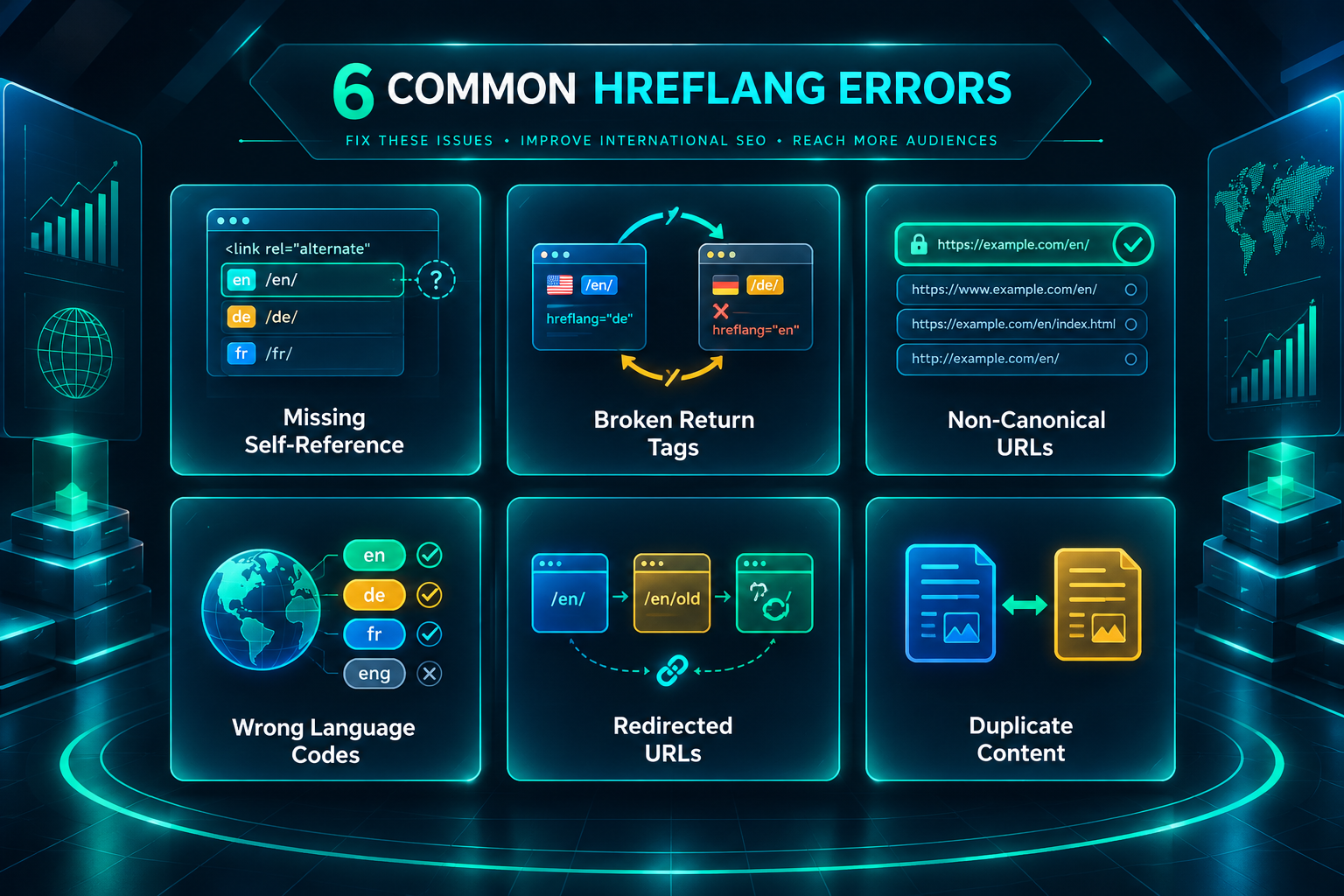
Several implementation errors appear consistently across multilingual sites, and PBN properties are not exempt from them. Understanding these errors makes it easier to audit a network and correct problems before they affect link quality or crawl behavior.
- Missing self-referencing tag: Every page must include a hreflang tag pointing to itself. Omitting the self-reference is one of the most common errors and causes the entire annotation cluster to be treated as incomplete.
- Non-canonical URLs in hreflang tags: Hreflang annotations must reference the canonical version of each URL. If a page has a canonical tag pointing to a different URL, the hreflang tag must use the canonical URL, not the alternate. Mismatches between canonical and hreflang URLs create conflicting signals that search engines resolve unpredictably.
- Broken return tags: As described above, every language version must reference every other language version. A missing return tag on any one version breaks the cluster.
- Incorrect or inconsistent URL formats: Hreflang tags must use consistent URL formats — either all with trailing slashes or all without, and consistently using HTTP or HTTPS. Mixing formats across annotations in the same cluster creates ambiguity.
- Hreflang pointing to redirected or non-indexable URLs: If a URL referenced in a hreflang tag returns a redirect, a 404 error, or a noindex directive, the annotation is effectively broken. On PBN networks where pages are occasionally restructured or removed, this is a realistic maintenance risk.
- Duplicate content across language versions: Hreflang is not a substitute for genuinely differentiated content. If two language versions of a PBN page are near-identical — for example, machine-translated content with minimal editing — the hreflang annotation may not prevent duplicate content issues, and the link placements on those pages may carry reduced relevance.
Crawl Auditing and Ongoing Monitoring
Hreflang errors are not always visible without a dedicated crawl audit. For multilingual PBN networks, regular auditing is a practical necessity rather than an optional step, because errors accumulate over time as content is added, updated, or restructured.
Screaming Frog SEO Spider can crawl a site and report hreflang annotations found on each page, flag missing self-references, identify non-reciprocal tags, and highlight URL format inconsistencies. Running a Screaming Frog audit across each PBN property in a multilingual network provides a systematic view of annotation health. The tool’s hreflang tab consolidates annotation data in a format that makes it straightforward to identify which pages have incomplete or broken clusters.
Google Search Console provides a separate signal through its International Targeting report, which can surface hreflang errors detected during Google’s crawl of a property. However, Search Console access requires verification of each property, which may not always be practical or desirable for every site in a private blog network. In cases where Search Console verification is not used, crawl-based auditing with tools such as Screaming Frog becomes the primary monitoring method.
For XML sitemap-based implementations, validating the sitemap structure before submission is an important step. Sitemap files with malformed hreflang entries may be partially processed or ignored, and the error may not be immediately apparent without a validation check.
Hreflang and Link Equity Considerations
A question that arises specifically in the context of multilingual PBN management is whether hreflang affects how link equity flows from a PBN property to a target page. Hreflang itself is not a link attribute — it does not modify the rel attribute of a hyperlink, and it does not directly alter how PageRank or link signals are passed through an anchor. Its function is to help search engines understand which language version of a page to surface for a given user query.
However, hreflang indirectly affects link quality in a practical sense. If a PBN property’s German-language page is incorrectly indexed as the primary version of an English-language article — because hreflang was absent or broken — then a contextual link from that page to an English-language target may be evaluated in a context that does not match the target page’s language and audience. Topical and linguistic relevance are factors that search engines consider when evaluating the context of a link, so maintaining correct hreflang implementation helps ensure that the indexed version of a PBN page matches the intended language context of the link placement.
For PBN networks that include placements in multiple languages targeting different regional markets, this alignment between the language of the linking page and the language of the target page is worth maintaining deliberately. A Spanish-language contextual placement linking to a Spanish-language target page should be on a page that is correctly identified as Spanish-language content through both its hreflang annotation and its canonical indexing.
Structural Considerations for Multilingual PBN Properties
The URL structure chosen for a multilingual PBN site affects how hreflang is implemented and maintained. The three common structures are subdirectories such as example.com/de/, subdomains such as de.example.com, and separate country-code top-level domains such as example.de. Each structure has different implications for a PBN network.
Subdirectory structures keep all language versions under a single domain, which simplifies domain management and consolidates any domain-level authority signals. Hreflang implementation on a subdirectory structure is generally straightforward because all URLs share the same root domain. Subdomains treat each language version as a distinct host, which can complicate crawl management and requires that hreflang annotations correctly reference the subdomain URLs. Separate ccTLD domains are the most administratively complex option for a PBN network because each domain requires independent management, registration, and hosting — though they may provide stronger regional signals in some markets.
For most multilingual PBN properties, a subdirectory structure offers the most manageable balance between implementation simplicity and language signal clarity. The choice should be made before the network property is built, because migrating between URL structures after content and links are in place introduces additional complexity and the risk of broken hreflang annotations during the transition.
Frequently Asked Questions
Does hreflang affect which version of a PBN page gets indexed?
Hreflang helps search engines understand which language version of a page is intended for which audience, which influences which version is surfaced in search results for a given user. It does not override canonical tags or noindex directives. If a PBN page has a canonical tag pointing to a different URL, that canonical signal takes precedence over hreflang for indexing purposes.
Can I use a WordPress plugin to manage hreflang across a multilingual PBN network?
Plugins such as Polylang and WPML can automate hreflang tag generation on WordPress-based PBN properties. However, plugin output should be verified with a crawl audit tool such as Screaming Frog rather than assumed to be correct. Plugin conflicts, caching configurations, and theme customizations can interfere with tag output in ways that are not immediately visible.
What happens if hreflang annotations are missing on a multilingual PBN site?
Without hreflang annotations, search engines must infer which language version of a page to serve based on other signals such as content language, URL structure, and link context. This inference is imprecise, and the wrong language version may be indexed or surfaced for a given audience. For PBN properties, this can mean that a link placement appears in a language context that does not match the target page, potentially reducing the relevance of the placement.
How often should hreflang annotations be audited on a PBN network?
The appropriate audit frequency depends on how actively the network is updated. For networks where content is added or modified regularly, a monthly crawl audit is a reasonable baseline. For more static networks, quarterly audits may be sufficient. Any time a new language version is added to a property or existing pages are restructured, a targeted audit of the affected annotation clusters should be run immediately.
Does hreflang create a footprint risk for a PBN network?
Hreflang annotations themselves are a standard technical SEO feature used on legitimate multilingual websites worldwide. Their presence on a PBN property does not inherently create a footprint. The footprint risk in a multilingual PBN context is more likely to arise from other factors such as shared hosting infrastructure, identical CMS configurations across properties, or thin content that is clearly machine-translated without meaningful editing. Correct hreflang implementation is a quality signal, not a liability.
Should hreflang tags on PBN properties use language-only codes or language-region codes?
The choice depends on the intended audience for the PBN property and the target pages it supports. Language-only codes such as es are appropriate when the content is intended for all speakers of that language regardless of location. Language-region codes such as es-MX are more appropriate when the content and link placements are specifically targeting a defined regional market. Using the more specific code where the regional targeting is clear can improve the precision of the language signal.
Building a Reliable Hreflang Workflow for Your Multilingual PBN
Hreflang management on multilingual PBN sites is a technical discipline that rewards systematic implementation over ad hoc fixes. The core requirements — reciprocal annotations, correct language codes, canonical URL consistency, and regular crawl auditing — are the same as on any multilingual website, but the distributed nature of a private blog network means that errors can accumulate across multiple properties without a centralized monitoring process to catch them.
Choosing the right implementation method for your network’s scale matters. For smaller networks with a manageable number of properties, HTML head tag implementation with plugin assistance and periodic Screaming Frog audits is a practical approach. For larger networks with frequent content updates across multiple language versions, XML sitemap-based hreflang offers more centralized control and reduces the risk of per-page annotation errors going undetected.
The quality of hreflang implementation on a PBN property is ultimately part of the broader quality of that property as a link source. A multilingual PBN site with correctly implemented hreflang, well-differentiated content across language versions, and consistent canonical signals is a more reliable placement environment than one where language annotations are broken or absent. If you are evaluating multilingual PBN placements or building out a network that will serve multiple language markets, reviewing the hreflang implementation of each property is a worthwhile step in the quality assessment process. PBN Backlinks Service can help you assess placement quality and discuss how multilingual network properties fit your specific link-building goals.