

Matching an expired domain’s history to the niche of your private blog network is one of the most consequential decisions in PBN construction. A domain that once covered health topics, then pivoted to finance, then sat dormant for two years carries a very different profile than one that consistently published content in a single vertical. Understanding how to read that history — and how to use it to select domains that reinforce rather than undermine your PBN’s topical authority — is a practical skill that directly affects the quality of the links you build.
Key Takeaways
- Topical consistency in a domain’s archived history is a stronger quality signal than domain age or a single authority metric alone.
- Wayback Machine snapshots, referring domain anchor text, and link-profile composition together give a more complete picture of a domain’s niche alignment than any one data source.
- A domain whose backlinks, content, and anchor text all point to the same subject area is generally a stronger candidate for a niche-specific PBN site than one with mixed or unrelated history.
- Niche mismatches between a domain’s history and its new PBN role can dilute the contextual relevance of the links it passes, though the precise ranking effect depends on many site-specific factors.
- Evaluating spam history, previous repurposing, and link-profile stability is as important as confirming topical relevance before acquiring a domain.
Why Domain History Matters for PBN Niche Alignment
When a domain expires and becomes available for acquisition, it carries the accumulated history of everything it was before: the content it published, the websites that linked to it, the anchor text those links used, and the subject matter it was associated with over time. Search engines index and evaluate websites in part by understanding what a domain is about, and that understanding is built from signals accumulated over the domain’s lifetime. A domain that spent several years as a legitimate resource in the gardening niche, for example, has referring domains, anchor text, and archived content that collectively signal a gardening context. Placing that domain into a PBN targeting a gardening affiliate site preserves a degree of topical coherence that a domain with a scattered or unrelated history cannot replicate.
The practical implication is that topical relevance between a PBN site and the target it links to is influenced not only by the content you publish on the PBN site after acquisition, but also by the historical signals already attached to the domain. A strong match between the domain’s past subject matter and the niche you intend to cover makes it easier to build a credible, contextually relevant PBN site. A poor match creates a gap that fresh content alone may not fully bridge, because the referring domains and anchor text pointing to the expired domain still reflect its original purpose.
Reading Archived Content to Identify Niche Consistency
The Internet Archive’s Wayback Machine is the primary tool for reviewing what a domain published during its active years. Before acquiring any expired domain for a PBN, reviewing multiple snapshots across different time periods reveals whether the site maintained a consistent subject focus or shifted topics repeatedly. A domain that consistently covered personal finance, investment basics, and budgeting across five years of snapshots is a meaningfully different asset from one that covered technology news for two years, then switched to travel, then went dark.
When reviewing archived snapshots, look for the following signals of niche consistency:
- Category and navigation structure: Did the site’s menu and category labels stay within the same subject area across multiple snapshots?
- Content topics: Do the article titles and page topics cluster around a recognizable niche, or do they span unrelated subjects?
- Internal linking patterns: Did the site link internally between topically related pages, suggesting genuine editorial depth in one area?
- Advertising and monetization context: Affiliate links, display ad categories, and product references often reveal the niche the site was genuinely targeting.
A domain with three or more years of consistent niche coverage, visible across multiple Wayback Machine snapshots, is generally a stronger candidate for a niche-specific PBN site than one with only a single snapshot or a history of topic changes. Gaps in the archive — periods where no snapshots exist — are worth noting, as they may indicate the domain was dormant, redirected, or used for a different purpose during that time.
Analyzing Referring Domains and Anchor Text for Topical Signals
Archived content tells you what the domain published; the backlink profile tells you how other websites categorized it. These two data sources should agree. When a domain’s referring domains are predominantly websites in the same niche — for example, a fitness domain whose backlinks come from other health, nutrition, and exercise sites — that alignment reinforces the domain’s topical identity. When referring domains span unrelated industries, the domain’s niche signal is weaker and harder to leverage for a tightly focused PBN site.
SEO tools such as Ahrefs, Semrush, and Majestic allow you to review a domain’s referring domain list and anchor text distribution before purchase. When evaluating an expired domain for PBN use, examine:
- Referring domain niches: Are the sites linking to this domain topically related to the niche you intend to target? A high proportion of niche-relevant referring domains strengthens the domain’s contextual profile.
- Anchor text distribution: Do the anchors reflect the domain’s intended subject area? Anchors that include niche-relevant terms, brand names consistent with the original site, and natural descriptive phrases suggest an organically built link profile. A heavy concentration of exact-match commercial anchors unrelated to the domain’s archived content may indicate previous link manipulation.
- Link-profile stability: Has the number of referring domains remained relatively stable over time, or has it declined sharply? A significant drop in referring domains after the site went inactive may indicate that linking sites removed or disavowed those links, which reduces the domain’s practical link equity.
- Referring domain quality: Metrics such as Domain Rating (Ahrefs), Trust Flow (Majestic), and Domain Authority (Moz) are proprietary scores, not Google ranking signals, but they can help identify whether the referring domains are themselves credible, established sites or low-quality link farms.
The goal is to find a domain whose referring domain profile and anchor text distribution tell a coherent story that matches the niche you plan to build around. When the archived content, the referring domains, and the anchor text all point to the same subject area, the domain is well-positioned for a niche-aligned PBN site.
Identifying Red Flags in Domain History
Not every expired domain with strong metrics is suitable for a PBN, and some domains carry historical problems that make them poor candidates regardless of their authority scores. Reviewing domain history thoroughly before acquisition helps avoid acquiring a domain that has already been used as a PBN, penalized for spam, or repurposed in ways that compromise its credibility.
Common red flags to check during domain history review include:
- Previous PBN use: If archived snapshots show thin, templated content with heavy outbound links to unrelated commercial sites, the domain has likely already been used as a PBN site. Its link profile may have been partially devalued as a result.
- Sudden niche changes: A domain that abruptly shifted from a legitimate editorial niche to a completely unrelated commercial topic — particularly if that shift coincides with a change in ownership — may have been acquired and repurposed previously, which can affect the coherence of its historical signals.
- Spam anchor text: A backlink profile dominated by exact-match commercial anchors in unrelated niches, or anchors in multiple languages pointing to unrelated sites, suggests the domain attracted or was used for manipulative link building.
- Deindexed or penalized history: Searching for the domain in Google (using a site: query) and checking whether it currently appears in search results can indicate whether the domain has been deindexed. A domain that does not appear in search results at all may have a penalty history worth investigating further before acquisition.
- Trademark conflicts: Some expired domains carry brand names or trademarks that create legal risk if reused. Checking the domain’s archived content for brand identity and verifying trademark databases is a practical step before acquisition.
Matching Domain History to Specific PBN Niches
The practical process of matching a domain’s history to a PBN niche involves comparing what the domain was with what you need the PBN site to be. The closer that match, the more naturally the new PBN site can extend the domain’s existing topical identity rather than contradict it.
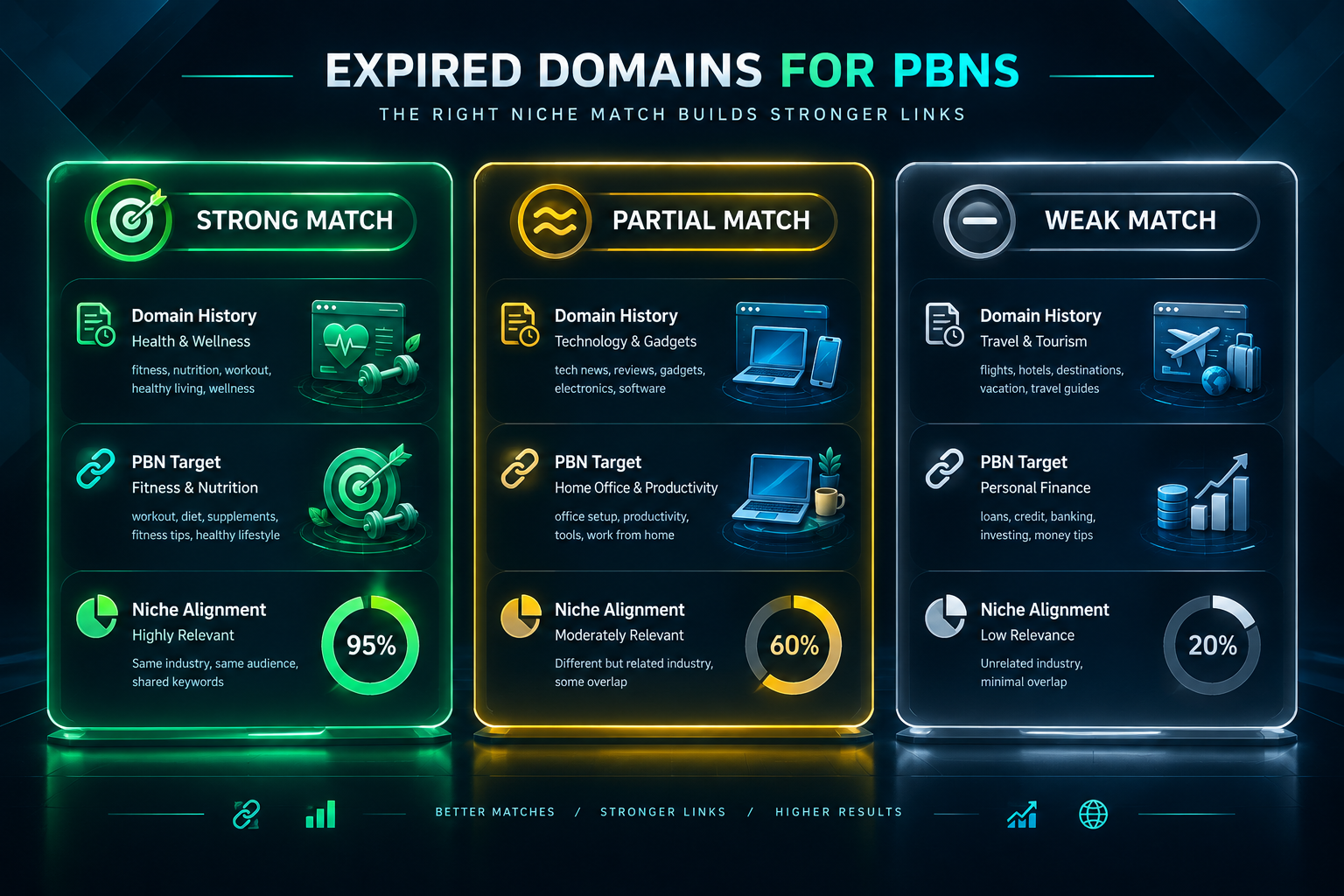
Consider the following matching scenarios and what they mean in practice:
Strong Match: Consistent Niche History Aligns with Target
A domain that spent four years as a legitimate resource covering home improvement topics — with referring domains from construction, DIY, and interior design sites, and anchor text reflecting those subjects — is a strong candidate for a PBN site targeting a home improvement affiliate or contractor website. The domain’s historical signals already establish a topical context that the new PBN content can reinforce. Building relevant, useful content on this domain extends its existing identity rather than creating a contradiction between its past and present.
Partial Match: Related but Not Identical Niche
A domain with a history in general wellness content — covering topics like stress management, sleep, and nutrition — may be a reasonable candidate for a PBN site targeting a specific health product or fitness service, even if the original site did not cover that exact sub-niche. The topical overlap is meaningful, and the referring domain profile likely includes health-adjacent sites that provide relevant context. The new PBN content should focus on the overlapping subject matter rather than introducing unrelated topics that widen the gap between the domain’s history and its current purpose.
Weak Match: Unrelated or Mixed History
A domain with a history in automotive content — car reviews, maintenance guides, and parts comparisons — is a weak candidate for a PBN site targeting a legal services firm or a software product. The referring domains, anchor text, and archived content all point to a completely different subject area. While fresh content can establish a new topical direction over time, the domain’s existing link profile continues to signal its original niche, creating a contextual mismatch that is difficult to resolve through content alone. In most cases, a domain with a strong history in the target niche is a more efficient choice than attempting to repurpose a domain with an unrelated background.
Using Multiple Data Sources for a Complete History Assessment
No single tool or data source provides a complete picture of a domain’s history. A reliable assessment combines several sources to cross-reference what each reveals:
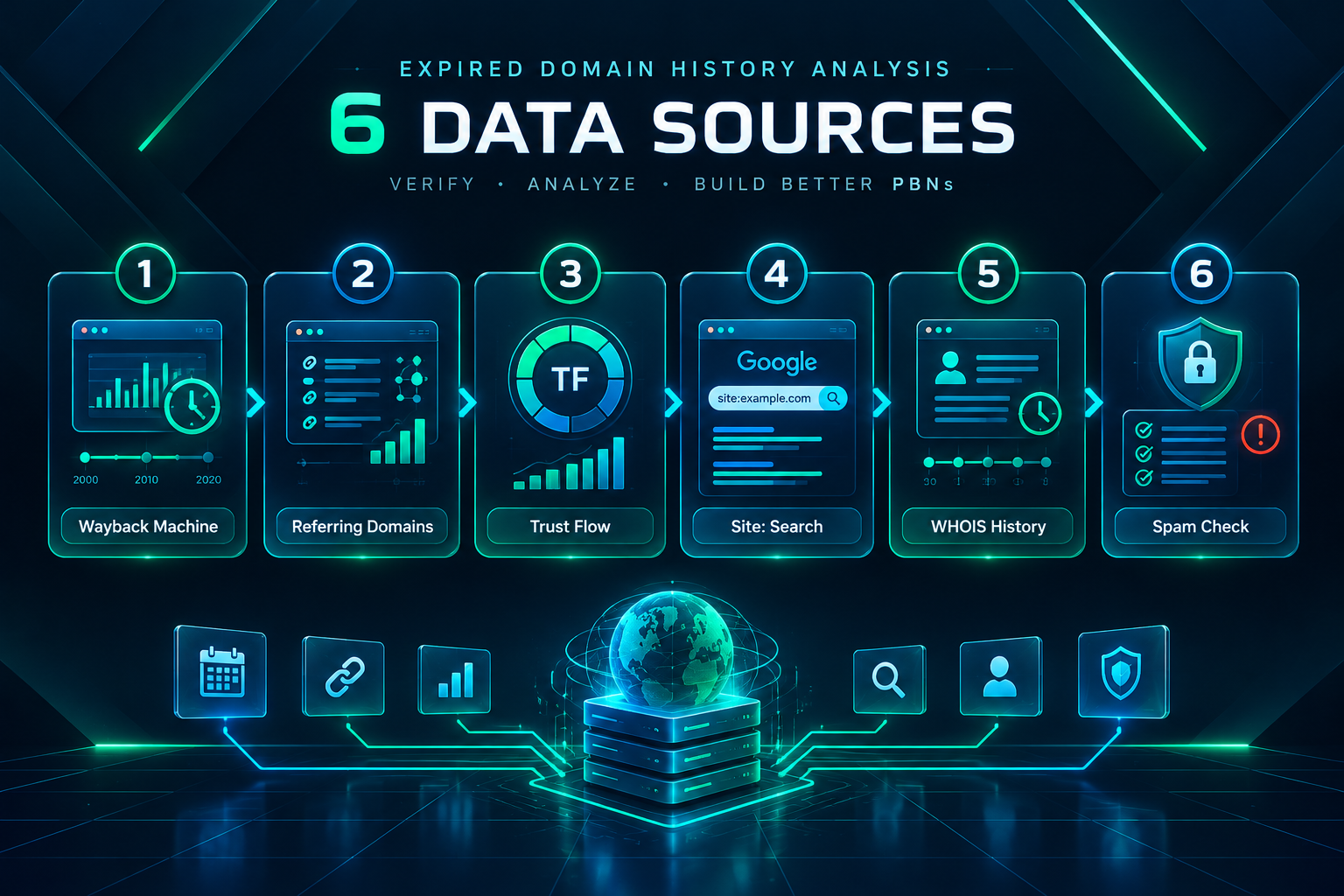
- Wayback Machine: Review snapshots from multiple years to assess content consistency, niche focus, and any periods of dormancy or topic change.
- Ahrefs or Semrush referring domain report: Examine the niche distribution of referring domains, the anchor text profile, and the trend in referring domain count over time.
- Majestic Trust Flow and Citation Flow: These proprietary metrics can help identify whether the domain’s link profile is concentrated in topically relevant sites (higher Trust Flow relative to Citation Flow) or diluted across unrelated sources.
- Google site: search: A basic check for current indexation status. A domain that returns no results may warrant additional investigation.
- WHOIS and domain registration history: Reviewing ownership changes can reveal whether the domain changed hands multiple times, which sometimes correlates with repurposing or previous PBN use.
- Spam and blacklist checks: Tools that check domains against known spam databases can surface domains that were previously used for email spam or link schemes, which may affect their credibility.
Cross-referencing these sources takes more time than reviewing a single metric, but it produces a significantly more reliable assessment of whether a domain’s history genuinely supports the niche you intend to build around.
How Topical Relevance Affects the Links a PBN Site Passes
The relevance of a PBN site to the target it links to is one of the factors that influences how useful that link placement may be. A PBN site built on a domain with a strong, consistent history in the target niche, publishing relevant content, and linking contextually to a target page in the same subject area creates a more coherent placement than a PBN site with a mismatched history linking to an unrelated target. The mechanism is straightforward: the surrounding content, the domain’s historical associations, and the anchor text of the link all contribute to the context in which the link is evaluated.
This does not mean that a domain with a partial niche match is worthless, or that only perfect historical alignment produces useful placements. Many effective PBN campaigns use domains with related rather than identical histories, particularly when the target niche is broad enough to encompass the domain’s historical subject matter. The key consideration is whether the domain’s history creates a plausible, coherent context for the content you plan to publish and the links you plan to place — not whether every historical detail is an exact match for the target niche.
Practical Steps Before Acquiring an Expired Domain for a PBN
A structured review process reduces the risk of acquiring a domain that looks strong on paper but carries historical problems that undermine its value as a PBN asset. The following sequence covers the most important checks:
- Identify candidate domains through expired domain marketplaces, auction platforms, or domain research tools, filtering by niche-relevant metrics and subject matter.
- Review Wayback Machine snapshots from at least three different time periods to assess content consistency and niche focus.
- Pull the referring domain report in Ahrefs or Semrush and assess the niche distribution and anchor text profile of the backlink profile.
- Check for red flags: spam anchors, sudden niche changes, previous PBN use patterns, and sharp declines in referring domain count.
- Run a Google site: search to check current indexation status.
- Review WHOIS history for ownership changes that may indicate previous repurposing.
- Confirm there are no trademark conflicts with the domain’s original brand identity.
- Compare the domain’s historical niche against the target niche and assess whether the match is strong, partial, or weak before making an acquisition decision.
Frequently Asked Questions
How many Wayback Machine snapshots should I review before deciding on a domain?
Reviewing snapshots from at least three distinct time periods — ideally spread across the domain’s active years — gives a reasonable picture of content consistency. A single snapshot can be misleading if it captures an unusual period in the site’s history. If the domain was active for five or more years, sampling snapshots from the early, middle, and later periods of its activity provides a more reliable assessment of niche consistency.
Does a domain need to be in exactly the same niche as my PBN target to be useful?
Not necessarily. A strong topical overlap — where the domain’s history covers a related subject area rather than an identical one — can still support a relevant PBN placement, particularly when the target niche is broad. The practical question is whether the domain’s historical signals create a coherent context for the content you plan to publish and the links you intend to place. A partial match is workable; a completely unrelated history is harder to leverage effectively.
What does a sharp decline in referring domains indicate?
A significant drop in referring domain count after a domain went inactive may indicate that linking sites removed or disavowed their links to the domain, or that those linking sites themselves went offline. Either scenario reduces the practical link equity the domain carries. A stable or gradually declining referring domain count is generally a more positive signal than a sudden sharp drop.
Can I use a domain with a mixed niche history if the metrics are strong?
Strong metrics alone do not compensate for a fundamentally mismatched or incoherent niche history. A domain with high authority scores but a history spanning unrelated topics may carry less contextual value for a niche-specific PBN site than a domain with more modest metrics and a consistent, relevant history. Evaluating both the quality and the topical coherence of the domain’s history produces a more reliable acquisition decision than relying on a single metric.
How do I check whether a domain was previously used as a PBN?
Archived snapshots that show thin content, heavy outbound links to unrelated commercial sites, or templated layouts with minimal original editorial content are common indicators of previous PBN use. An anchor text profile dominated by exact-match commercial terms unrelated to the domain’s apparent niche is another signal. These patterns do not guarantee previous PBN use, but they warrant closer scrutiny before acquisition.
Is domain age a reliable indicator of niche relevance?
Domain age indicates how long a domain has existed, but it does not by itself confirm niche relevance or link-profile quality. An older domain with a consistent, relevant history in the target niche is a stronger candidate than an older domain with a scattered or unrelated history. Age is one factor among several, not a standalone quality signal.
Choosing Domains That Strengthen Your PBN’s Topical Foundation
Matching expired domain history to a PBN niche is fundamentally an exercise in coherence: finding domains whose past subject matter, referring domain profile, and anchor text distribution align with the niche you intend to build around, so that the PBN sites you create extend a credible topical identity rather than contradict it. The most reliable approach combines archived content review, referring domain analysis, anchor text assessment, and red-flag checks into a structured evaluation before any acquisition decision is made.
No domain will be a perfect match in every dimension, and partial niche alignment is often workable when the topical overlap is meaningful and the link profile is clean. The practical goal is to identify domains where the historical signals support rather than undermine the contextual relevance of the placements you plan to build. Domains that meet that standard — consistent niche history, relevant referring domains, clean anchor text, and no significant red flags — form a stronger foundation for a PBN than domains selected primarily on the basis of a single authority metric.
If you are evaluating expired domains for a private blog network and want to assess how well specific domains align with your target niche, PBN Backlinks Service can help you review domain quality and placement fit as part of a broader link-building strategy discussion.