

Running a multilingual website introduces a layer of complexity that most standard link-building guides overlook. When a site targets audiences in multiple languages or countries, the backlink profile needs to reflect that geographic and linguistic diversity — and PBN backlinks can be structured to support that goal. Understanding how PBN links interact with language-targeted pages, hreflang signals, and international search visibility helps website owners and SEO specialists make more informed decisions about where and how to place links across a multilingual property.
Key Takeaways
- PBN backlinks for multilingual websites work most effectively when the linking domain’s language, topical context, and geographic signals align with the target page’s language version.
- Hreflang annotations on the target site help search engines associate each language version with the correct audience, but backlinks from language-matched sources can reinforce those signals.
- Domain selection for multilingual PBN placements should account for the linking site’s content language, country-code top-level domain where relevant, and historical topical relevance.
- Anchor text strategy for multilingual campaigns requires language-specific variation — translated or locally natural anchor phrases rather than direct English equivalents applied across all versions.
- Results and ranking impact vary by language market, competition level, and how well the overall international SEO setup is configured on the target site.
Why Multilingual Websites Have Distinct Link-Building Needs
A multilingual website typically serves separate language or country audiences through distinct URL structures — subdirectories such as /fr/ or /de/, subdomains such as fr.example.com, or separate country-code domains such as example.fr. Each of these configurations creates separate indexable pages that search engines evaluate partly on the basis of their own backlink signals. A strong backlink profile pointing exclusively to the English version of a site does relatively little to improve the visibility of the French or German versions in their respective search markets.
Search engines use a combination of signals to determine which language or country version of a page to serve to a given user. These signals include hreflang annotations, the language of the page content, the server location or CDN configuration, and the origin and language context of inbound links. Backlinks from domains whose content is written in the same language as the target page, or from domains with a relevant country-code top-level domain (ccTLD), can contribute to the geographic and linguistic relevance signals that influence rankings in language-specific search results. This is the core reason why a multilingual link-building strategy — including PBN placements — benefits from being structured around language and market segments rather than treated as a single unified campaign.
How PBN Links Work for Multilingual Pages
A PBN backlink functions by passing link equity from a donor domain to a target page. For a multilingual website, the relevant question is not only whether the link passes equity, but whether the linking context reinforces the language and geographic relevance of the specific page being targeted. A PBN placement on a French-language domain pointing to the French version of a product page sends a different set of contextual signals than the same link placed on an English-language domain pointing to the same URL.
The mechanism is similar to standard PBN link building: a contextual link is placed within relevant content on a donor domain, and that link points to the target URL. What changes in a multilingual context is the selection criteria for the donor domain and the content surrounding the link. For a Spanish-language target page, the ideal PBN placement would appear within Spanish-language content on a domain that has historically covered relevant topics in Spanish, ideally with a backlink profile that includes Spanish-language or Latin American referring domains. This alignment between the linking domain’s language environment and the target page’s language version is what makes the placement contextually coherent from a search-engine perspective.
It is worth noting that search engines do not publish a precise formula for how language-matched backlinks are weighted relative to other signals. The relationship between linking domain language and ranking improvement in a specific language market is an area where SEO practitioners observe patterns, but the exact weighting remains uncertain. What is reasonably established is that topical and linguistic relevance of the linking context is a meaningful quality factor in link evaluation, and that this applies to PBN placements as it does to any other link type.
Hreflang, Language Signals, and Backlink Alignment
Hreflang is an HTML attribute that tells search engines which language and regional version of a page to serve to users in different markets. A correctly implemented hreflang setup is a prerequisite for effective multilingual SEO, and it affects how backlinks to individual language versions are interpreted. When hreflang annotations are in place and correctly cross-referencing all language variants, a backlink to the French version of a page is more clearly associated with the French-language audience signal than it would be on a site without hreflang.
PBN backlinks pointing to a specific language version of a page work within this framework. The link contributes to the authority of that URL, and the hreflang setup helps search engines understand that the URL is intended for a particular language or regional audience. A common implementation issue is pointing PBN links to the root domain or the English version of a page when the intended beneficiary is a different language version. This misalignment means the link equity may not flow to the intended page, and the language-specific ranking signal is diluted. Verifying the exact target URL before placing a multilingual PBN link is a practical step that avoids this problem.
For sites using subdirectory or subdomain structures, the target URL for each language version is distinct, and each version benefits from its own backlink signals. For sites using separate ccTLDs for each market — for example, a separate .de domain for Germany — the link-building strategy for each domain is effectively independent, and PBN placements for each ccTLD should be evaluated on the basis of that domain’s own backlink profile and competitive landscape.
Domain Selection for Multilingual PBN Placements
Selecting appropriate PBN donor domains for a multilingual campaign involves several considerations that go beyond standard domain quality checks. The following factors are particularly relevant when the target page is in a language other than English.
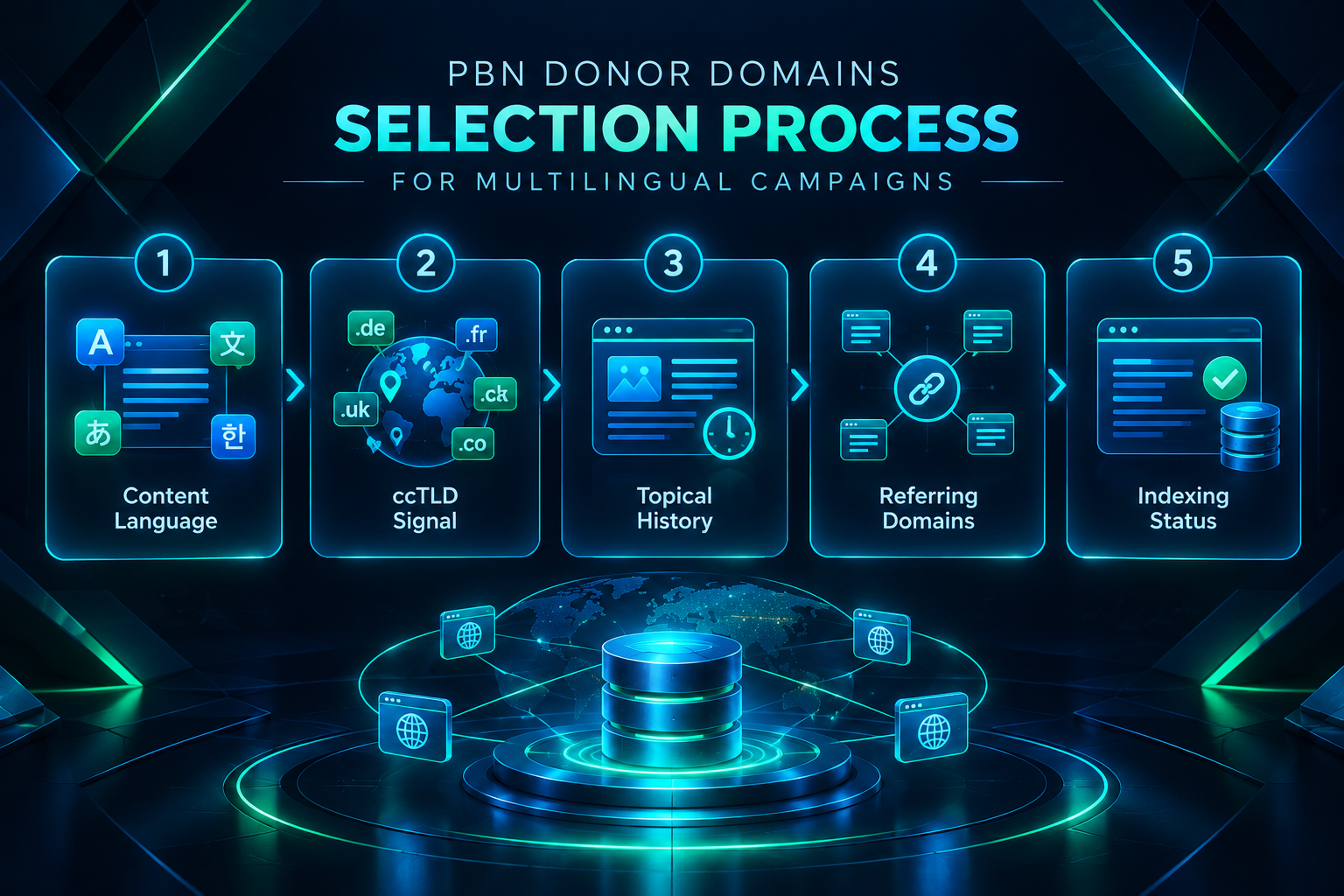
- Content language of the donor domain: A domain whose existing content is written in the same language as the target page provides a more linguistically coherent placement context. A German-language PBN domain linking to a German-language target page is a stronger contextual match than a multilingual domain with mixed-language content.
- Country-code top-level domain: A ccTLD such as .fr, .de, or .es carries a geographic signal that can reinforce country-specific relevance. This is not a mandatory requirement — generic TLDs with language-appropriate content can also be relevant — but ccTLDs may add an additional geographic signal for country-targeted campaigns.
- Historical topical relevance: The domain’s archived content and referring domain profile should be relevant to the niche of the target page. A domain that previously covered travel content in Italian is a more suitable donor for an Italian-language travel page than a domain with an unrelated history.
- Referring domain profile of the donor: A PBN domain whose own backlinks come predominantly from relevant language-matched sources has a more coherent link profile for multilingual placements. A domain with a strong backlink profile from French-language referring domains is a more contextually appropriate donor for a French-language target page.
- Indexing status and crawlability: The donor domain should be indexed and crawlable in the target market’s primary search engine. In most European and Latin American markets this means Google, but for campaigns targeting markets where other search engines have significant share, indexing in those engines is also relevant.
Proprietary metrics such as Domain Rating from Ahrefs, Domain Authority from Moz, or Trust Flow from Majestic can be useful reference points when evaluating donor domains, but these scores are not Google ranking signals and should not be the sole basis for domain selection. A domain with a moderate metric score but strong language-matched topical relevance may be a more suitable donor for a multilingual placement than a high-metric domain with no relevant language context.
Anchor Text Strategy Across Language Versions
Anchor text strategy for multilingual PBN campaigns requires language-specific planning. Using English anchor phrases for links pointing to non-English pages is a common oversight that reduces the contextual coherence of the placement. Effective anchor text for a French-language target page should use French-language phrases — either the translated target keyword, a natural descriptive phrase in French, or a branded anchor that reflects how the brand is referenced in French-language content.
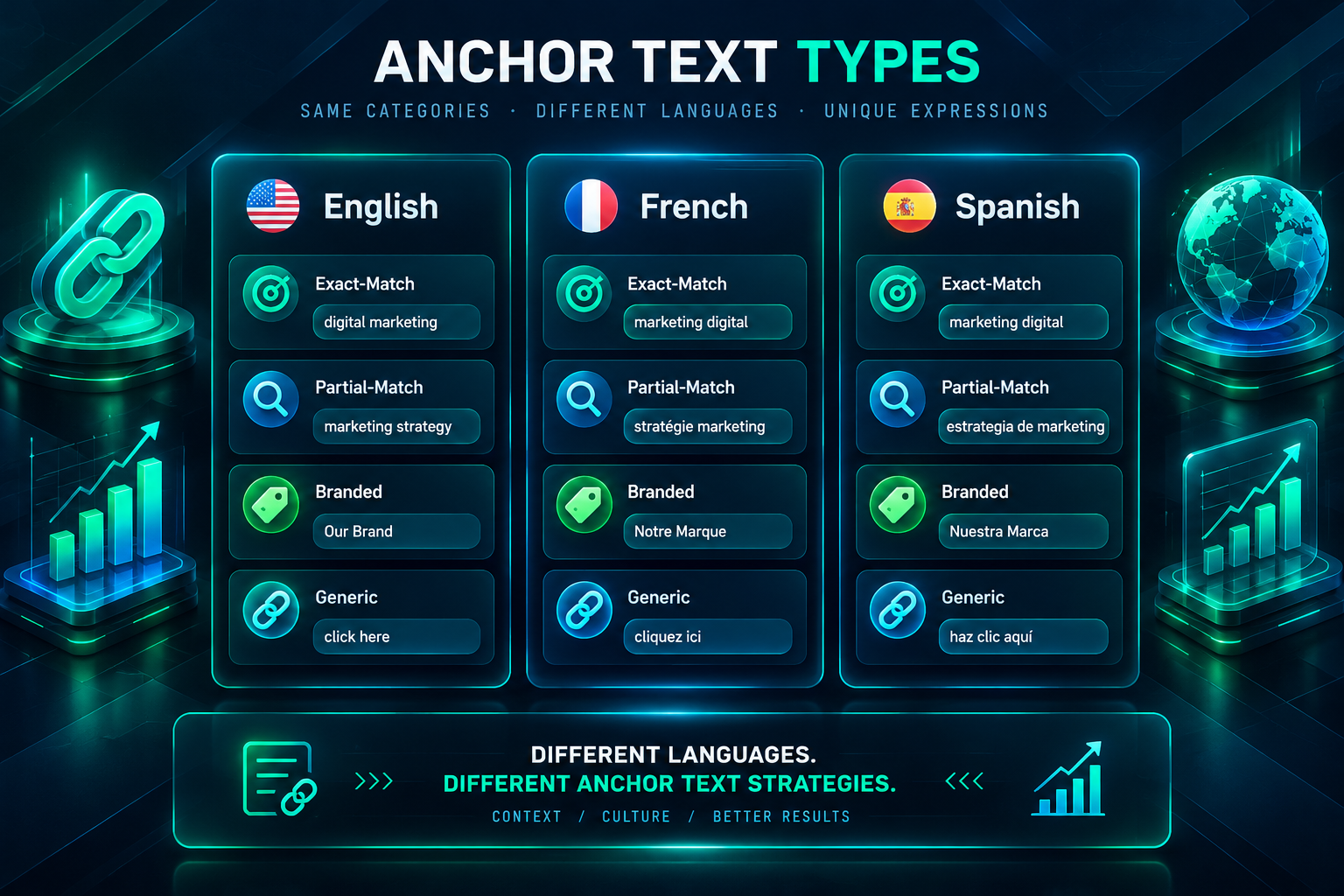
The distribution of anchor types — exact-match keyword anchors, partial-match anchors, branded anchors, and generic anchors — should be planned separately for each language version of the site. The competitive anchor landscape in a French-language search market may differ from the English-language equivalent, and the appropriate balance of anchor types should reflect the norms of the specific language market rather than being copied directly from the English-language campaign. Reviewing the anchor profiles of competing pages in the target language market can provide useful reference points for this planning.
Over-reliance on exact-match keyword anchors in any language can attract scrutiny, and this consideration applies equally to multilingual PBN campaigns. A varied anchor profile that includes branded, partial-match, and natural-language anchors in the target language is generally a more sustainable approach than a campaign built predominantly on exact-match anchors translated directly from English.
Placement Context and Content Quality on Multilingual PBN Domains
The content surrounding a PBN link on a multilingual donor domain should be written in the same language as the target page and should be topically relevant to the subject of the linked content. A contextual link placed within a well-written, topically relevant article in the target language provides a more coherent placement than a link inserted into thin or machine-translated content.
Machine translation has improved significantly, but content produced solely through automated translation without editorial review can still produce unnatural phrasing that reduces the contextual quality of the placement. For multilingual PBN campaigns where content quality is a priority, placements on domains with natively written or professionally edited content in the target language are preferable. This is a practical quality consideration rather than a guarantee of any specific ranking outcome.
The placement page itself — the specific page on the PBN domain where the link appears — should ideally cover a topic related to the target page’s subject matter. A link from a French-language article about home renovation to a French-language target page about interior design services is contextually coherent. A link from an unrelated French-language page about financial products to the same target page is a weaker contextual match, regardless of the domain’s overall metrics.
Campaign Structure for Multilingual PBN Link Building
A practical multilingual PBN campaign is typically structured around the individual language versions of the target site rather than the root domain as a whole. This means identifying the specific URLs that need ranking improvement in each language market, assessing the existing backlink profile for each language version separately, and planning placements that address the gaps in each market independently.
For a site with three language versions — English, German, and Spanish — the link-building plan for each version should account for the competitive backlink landscape in that specific language market. The number of placements needed, the domain selection criteria, and the anchor text distribution will differ across the three versions based on the competition and the existing authority of each language version. Treating all three versions as a single campaign with identical placement parameters is unlikely to produce optimal results in each market.
Link velocity — the rate at which new backlinks are acquired — should be considered separately for each language version. A language version that currently has very few backlinks may benefit from a gradual build rather than a rapid influx of new placements, regardless of the pace of the English-language campaign. The appropriate velocity depends on the existing profile, the competitive environment, and the overall SEO maturity of the specific language version.
Realistic Expectations and Limitations
PBN backlinks for multilingual websites can contribute to improved search visibility in language-specific markets when placements are well-matched to the target language, topically relevant, and directed at the correct language-version URLs. The degree of improvement depends on multiple factors including the competitiveness of the target keywords in the specific language market, the existing authority of the language version being targeted, the technical SEO setup of the multilingual site, and the quality of the PBN placements themselves.
Results are not immediate. After a PBN link is placed, the donor domain needs to be crawled and the link indexed before any potential ranking effect can begin. In competitive language markets, meaningful ranking movement may take several weeks to become measurable, and the contribution of individual placements is difficult to isolate from other SEO activity. Monitoring ranking changes for the specific language versions being targeted — using tools that report rankings in the correct country and language context — is necessary to assess whether placements are contributing to the intended outcome.
One practical limitation of multilingual PBN campaigns is the availability of high-quality donor domains in less common languages. While English, Spanish, French, German, and Portuguese PBN domains are relatively accessible, finding well-maintained, topically relevant PBN domains in languages such as Dutch, Polish, or Romanian may require more targeted sourcing. The quality of available domains in a given language market is a real constraint that affects what can be achieved through PBN placements alone in that market.
What to Discuss with a PBN Link-Building Provider
Before commissioning multilingual PBN placements, it is useful to clarify several points with the provider to ensure the campaign is structured appropriately for the target language markets.
- Language availability: Confirm which languages the provider can source quality donor domains for, and ask about the content language and editorial standards on those domains.
- Domain selection criteria: Ask how donor domains are selected for non-English placements, including whether ccTLDs are available and how topical relevance is assessed for each language market.
- Target URL specification: Confirm that placements will be directed to the specific language-version URLs rather than the root domain or the English version of the site.
- Anchor text planning: Discuss how anchor text will be handled for each language version, including whether the provider can work with language-specific keyword targets and natural-language anchor variation.
- Content quality on placement pages: Ask whether placement content is written natively or translated, and how the provider ensures contextual relevance between the placement article and the target page.
- Indexing verification: Confirm how the provider monitors whether placed links are indexed in the relevant search engine for each target market.
Frequently Asked Questions
Do PBN links need to be in the same language as the target page?
Language matching between the PBN donor domain and the target page improves the contextual coherence of the placement. A French-language donor domain linking to a French-language target page provides a more linguistically aligned signal than a cross-language placement. While search engines can process cross-language links, language-matched placements are generally considered a stronger contextual fit for language-specific ranking goals.
Can a single PBN domain be used to link to multiple language versions of the same site?
A single PBN domain can technically link to multiple URLs, but linking to several language versions of the same site from one donor domain may create a footprint that reduces the value of each individual placement. It is generally more effective to use separate donor domains for each language version, particularly when the target language versions are in different markets with distinct competitive landscapes.
Does hreflang implementation affect how PBN links are processed?
Hreflang annotations help search engines associate each URL with its intended language and regional audience. A correctly implemented hreflang setup means that a backlink to a specific language-version URL is more clearly associated with that audience segment. PBN links pointing to language-version URLs on a site with correct hreflang implementation are more likely to contribute to the intended language-specific ranking signal than the same links on a site with missing or incorrect hreflang.
How many PBN placements are needed for a multilingual campaign?
The number of placements depends on the competitive backlink landscape in each specific language market, the existing authority of each language version, and the target keywords. There is no universal number that applies across all multilingual campaigns. A review of the backlink profiles of competing pages in each language market provides a more useful reference point than a fixed placement count.
Are ccTLD PBN domains always better for country-targeted campaigns?
Country-code top-level domains carry a geographic signal that can reinforce country-specific relevance, but they are not the only factor in domain selection. A generic TLD domain with strong language-matched content, relevant topical history, and a coherent backlink profile can also be a suitable donor for a country-targeted campaign. ccTLDs are one useful signal among several rather than a mandatory requirement.
Can PBN links help with rankings in search engines other than Google?
PBN backlinks may contribute to rankings in other search engines that use link signals as part of their ranking algorithms. The specific weighting of backlink signals varies by search engine, and the indexing behavior of PBN domains in non-Google search engines should be verified separately. For campaigns targeting markets where Bing, Yandex, or other engines have meaningful share, confirming that donor domains are indexed in those engines is a relevant practical step.
Structuring a Multilingual PBN Strategy Around Your Target Markets
PBN backlinks can be a practical component of a multilingual link-building strategy when the campaign is structured around the specific language versions being targeted rather than applied as a uniform English-language approach across all markets. The key variables — donor domain language, content quality, anchor text in the target language, correct URL targeting, and alignment with the site’s hreflang setup — determine how well individual placements serve the intended ranking goals in each language market.
The availability and quality of PBN donor domains varies by language, and the competitive backlink landscape differs across markets, so each language version of a multilingual site benefits from its own placement plan rather than a scaled copy of the English-language campaign. Monitoring ranking performance separately for each language version, in the correct country and language context, is necessary to assess whether placements are producing the intended effect and to guide ongoing campaign decisions.
If you are evaluating PBN placements for a multilingual website, discussing the specific language markets, target URLs, and competitive context with PBN Backlinks Service can help clarify which placement options are available and how a campaign might be structured to address the distinct needs of each language version.