

PBN links vs platform-based links is a practical comparison between controlled authority assets from aged domains and self-published links from user-generated properties. Our agency owns, operates, and manages private blog network infrastructure for contextual placement, aged domain vetting, anchor text distribution, indexing checks, outbound link control, and footprint protection.
The better choice depends on competition, risk tolerance, target keyword difficulty, content quality, and current link profile. PBN execution and platform execution both need quality control, because weak domains, thin pages, and unnatural velocity can reduce SEO impact.
Quick Answer: PBN Backlinks vs Web 2.0 Backlinks for SEO
PBN links usually provide stronger ranking pressure because a private blog network can use aged domains, topical relevance, controlled outbound links, and contextual placement. Platform links often work better for diversification, tiered link building, brand presence, and supporting content ecosystems.
- PBN links fit campaigns that need controlled authority links and faster results.
- Web 2.0s fit campaigns that need low-cost diversity and branded assets.
- PBN links and platform links can work together when anchor text and velocity are managed.
- Best results depend on execution quality, not the link source label alone.
Best Choice for Faster Ranking Growth
PBN links are often stronger for faster ranking growth because aged domains can pass authority through contextual links from relevant content. Our agency checks Ahrefs, Semrush, Majestic, Google Search Console data, and live SERP strength before approving placements. Faster results require domain quality, not random bulk links.

Mon-Fri: 09:00 AM – 06:00 PM
Best Choice for Safer Link Diversification
Platform links are useful when the goal is to diversify your link profile without relying on one source type. Publishing sites such as wordpress.com and other high-DA user-generated websites can support brand entities, secondary content, internal links, and a broader link-building strategy.
Best Choice for New Websites
New websites usually need conservative link velocity, branded anchors, topical content, and foundational authority signals. Web 2.0 links often make sense early, while PBN links can work when placements are gradual and target pages already provide useful content. New money sites need stability before aggressive authority building.
Best Choice for Competitive Niches
Competitive niches usually require authority links, careful anchor text, and relevant domains. PBN links can outperform Web 2.0 links because PBN owners control the domain, article topic, outbound link environment, and contextual placement. For affiliates, PBN backlinks for affiliate websites can support commercial pages with measured velocity.
What Are PBN Backlinks?
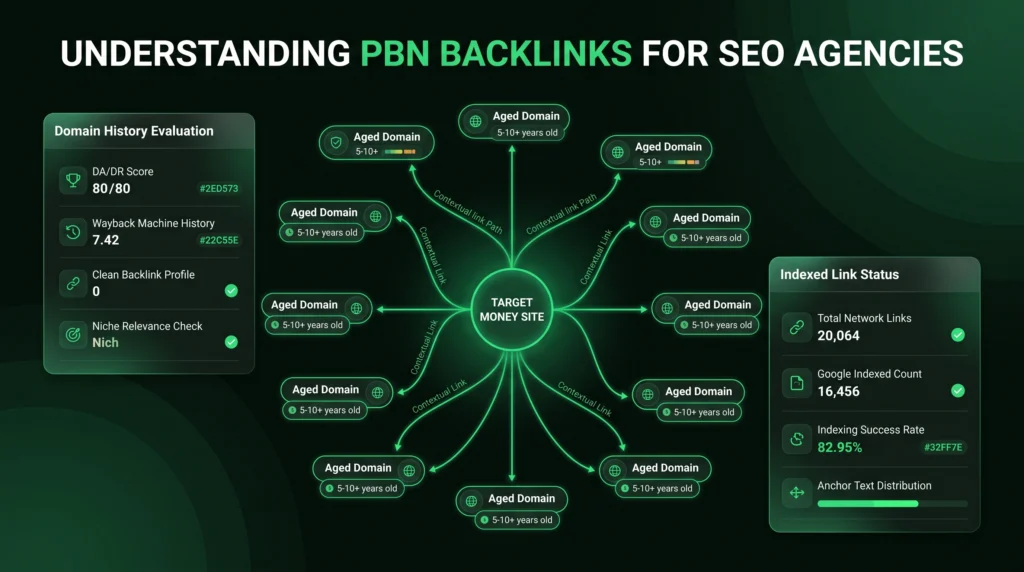
PBN links are contextual links placed on privately owned websites built from aged domains with existing authority history. A private blog network gives a PBN agency control over domain selection, content standards, outbound links, indexing, hosting variation, CMS setups, and placement quality.
Our agency treats PBN links as controlled authority-building assets. The workflow is operational, not random:
- Acquire aged domains with clean history and relevant referring domains.
- Rebuild private blog sites with original content and natural structure.
- Publish contextual backlinks inside relevant articles.
- Monitor indexing, rankings, anchors, and outbound link patterns.
Definition And How PBN Backlinks Work
PBN links work by placing a link back to a money site from an aged private blog domain with verified history, authority signals, and topical relevance. A professional private blog network uses domain history checks, link profile analysis, original wordpress content, diverse hosting, and controlled outbound links.
Pros of PBN Backlinks
PBN links provide control that standard link-building methods cannot always deliver. A PBN agency can choose article topic, anchor text, destination URL, publication date, outbound link limits, and supporting internal links. PBN links can boost your SEO rankings when domain quality and content relevance are verified.
Cons of PBN Backlinks
PBN backlinks require stronger quality control than casual outreach or user-generated Web 2.0 sites. Weak domain history, visible footprint patterns, duplicate themes, shared hosting signals, unnatural anchors, and low editorial quality can reduce link value or increase ranking volatility. Risk comes from poor execution.
Link Power, Control, And Anchor Text Choice
PBN backlinks offer link power because aged domains may already have referring domains, domain authority indicators, topical history, and index stability. Anchor text choice must be conservative, with branded anchors, URL anchors, partial-match anchors, and occasional exact-match keyword anchors based on link profile data.
Google Penalty Risk
Within this heading, Google penalty risk means campaign risk from unnatural signals, not fear-based framing. Search engines evaluate link patterns, relevance, content quality, indexing behavior, and visible network signals, so PBN campaigns need footprint control, aged domain vetting, topical content, CMS variation, and velocity planning.
What Are Web 2.0 Backlinks?
Web 2.0 links are links placed on user-generated or self-publishing platforms, often through blogs, profiles, documents, communities, or subdomain-based Web 2.0 properties. A Web 2.0 domain can include wordpress.com, publishing platforms, website builders, and other high-DA properties.
- Web 2.0 sites can help build brand presence.
- Web 2.0 websites can support tiered link-building.
- Web 2.0 properties can create contextual supporting content.
- Web 2.0 links may have limited authority when the page itself has no inbound signals.
Definition And How Web 2.0 Backlinks Work
Web 2.0 links work by creating content on a user-generated platform and linking from that content to a target website. The link may come from a subdomain, profile page, blog post, or published asset. A Web 2.0 backlink becomes more useful when indexed, relevant, active, and internally supported.
Pros of Web 2.0 Backlinks
Web 2.0 links are accessible, flexible, and useful for building links around branded content. Web 2.0 sites can help diversify your link profile, support entity signals, and create additional pages that drive traffic when the content is helpful.
Cons of Web 2.0 Backlinks
Web 2.0 links may have weaker SEO impact because many new Web 2.0 properties lack referring domains, organic traffic, and page-level authority. Some platforms also apply spam filters, moderation, nofollow attributes, or devaluing Web 2.0s when content looks thin.
High-Authority Web 2.0 Platforms
High-authority Web 2.0 platforms can support SEO strategies when content is original, relevant, and indexed by Google. A high-DA platform does not automatically create high-quality backlinks; the individual subdomain still needs content quality, indexation, and link signals.
PBN Backlinks vs Web 2.0 Backlinks: Main Differences
PBN vs Web 2.0 decisions should compare control, authority, cost, risk profile, and campaign purpose. The strongest campaigns often use PBN links and Web 2.0 assets differently rather than treating them as identical link-building methods.
| Factor | PBN Backlinks | Web 2.0 links |
| Control | High placement control | Medium platform control |
| Authority | Aged domain value | Parent platform value |
| Best Use | Authority links | Diversity and support |
| Risk Factor | Footprints and anchors | Thin pages and moderation |
Link Longevity
PBN backlinks usually offer stronger link longevity because the PBN agency controls the private blog, hosting, content updates, outbound links, and renewal process. Web 2.0 links depend on platform rules, account activity, moderation, and content quality. Longevity improves when Web 2.0 properties look active and useful.
Niche Limitations
PBN backlinks can be planned around niche relevance because aged domains may be acquired based on topic, historical content, and referring domain context. This makes topical relevance in PBN backlinks a major quality factor for authority links.
Content Creation Costs
PBN content creation costs are higher because a private blog should look like a real website with original articles, internal links, categories, formatting, and editorial consistency. Web 2.0 content is cheaper to publish, but cheap content often produces weak results.
Link Power
PBN backlinks often provide stronger link power because an aged domain may already have referring domains, domain authority indicators, indexed pages, and historical trust signals. Web 2.0 links can still support authority when layered correctly, especially in tiered campaigns.
Setup, Installation, And Control
PBN setup requires domain acquisition, DNS management, hosting diversification, CMS variation, theme selection, content planning, security updates, and index monitoring. Web 2.0 setup is faster because platforms handle hosting and CMS infrastructure, but platform control and moderation can restrict strategy.
Anchor Text Flexibility
PBN backlinks provide stronger anchor text flexibility because the agency controls the article, sentence context, and placement location. Web 2.0 links also allow anchor choice, but aggressive anchors on thin pages can look unnatural. Anchor flexibility matters only when the link profile supports the target keyword.
Web 2.0 Link Building Strategy
A Web 2.0 link-building strategy should focus on relevance, page quality, indexation, and supporting role within the backlink profile. Web 2.0 links often work best when the goal is to support branded assets, tiered pages, and secondary content.
- Choose Web 2.0 sites with stable indexation.
- Publish original content around relevant topics.
- Use natural anchors and contextual links.
- Add internal links within each Web 2.0 property.
- Monitor indexing and remove weak placements.
Pick Quality Platforms And Stay Relevant
Quality Web 2.0 platforms should have stable indexing, clear editorial tools, usable formatting, and reliable account history. A Web 2.0 domain with high-DA metrics is more useful when the created page can be indexed and maintained around a relevant topic.
Create Valuable Original Content
Original content helps Web 2.0 links avoid spam filters and gives the page a reason to exist beyond the link. A useful article should answer a real search intent, mention named entities, and connect naturally to the linked page.
Use Natural Varied Links And Anchors
Natural anchors make Web 2.0 links look like part of a broader content ecosystem. A balanced mix can include branded anchors, plain URLs, generic phrases, topic phrases, and occasional partial-match keywords. Anchor diversity protects campaign stability.
Build Depth, Activity, And Trust
A Web 2.0 network becomes stronger when each property has more than one post, consistent topic focus, internal links, and periodic updates. Maintained Web 2.0 websites can support brand presence, drive traffic, and help tiered link-building campaigns look more natural.
Start Small And Scale Strategically
Web 2.0 links should be scaled gradually, especially for new websites or money sites with limited backlink history. Start with branded pages, supporting content, and low-risk anchors before expanding into keyword-focused placements. Strategic scaling is more reliable than sudden volume.
PBN Link Building Strategy
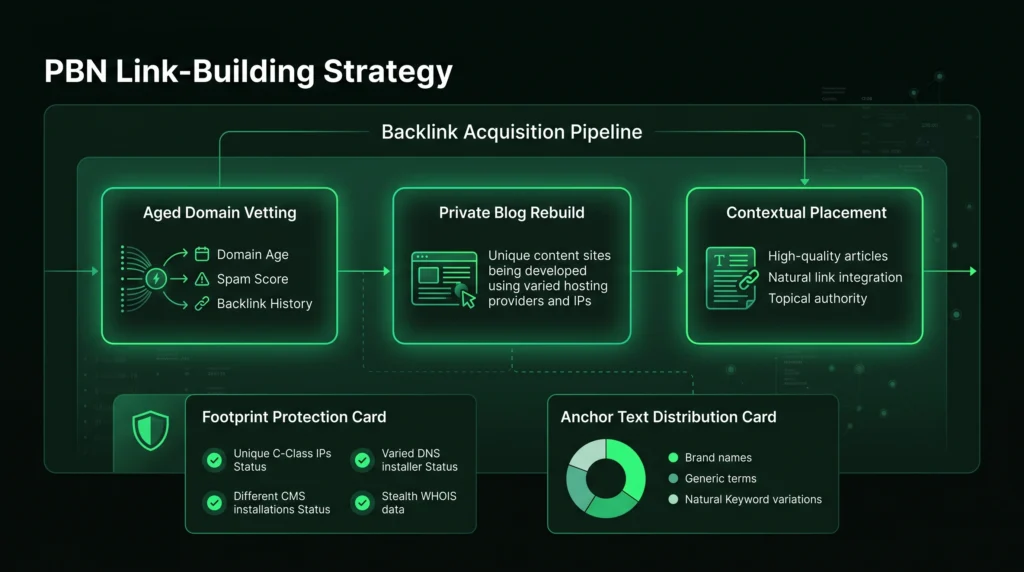
A PBN link-building strategy should begin with domain quality and end with monitoring. Our agency plans PBN placements around domain history, topical relevance, anchor distribution, link velocity, and indexation stability.
- Review expired domain history and referring domains.
- Rebuild the private blog with original content.
- Match article topic to target page intent.
- Place contextual backlinks manually.
- Monitor index status, rankings, and anchor balance.
- Adjust future placements based on performance.
PBN Site Quality Checks
PBN site quality checks protect the campaign from weak domains, visible footprints, and low editorial value. A controlled private blog network should pass manual review before any link placement is approved.
- Clean domain history without irrelevant redirects.
- Strong referring domains and natural anchor history.
- Original content with topical relevance.
- Limited outbound links per article and per site.
- Stable indexation and realistic site structure.
- Hosting, CMS, and theme variation across the network.
Safe Anchor Text Distribution
Safe anchor text distribution depends on current backlink profile, keyword difficulty, target page strength, and competing SERP patterns. Our agency reviews anchor ratios before placing authority links because exact-match overuse can create unnatural link patterns. Anchor planning should support rankings without artificial concentration.
Hosting, Footprints, And Network Separation
Footprint protection is central to private blog network management. Hosting diversification, CMS variation, theme differences, author profiles, publishing schedules, DNS separation, and outbound link control reduce visible network patterns. A private blog should not look like a copied template built only for links.
PBNs, Guest Posts, And Web 2.0 Backlinks
PBNs, guest posts, and Web 2.0 backlinks serve different roles in a complete link-building strategy. Guest posts can support brand exposure, Web 2.0 properties can build supporting assets, and PBN backlinks can provide controlled authority placements.
A mature backlink profile usually includes multiple link-building methods. Some campaigns use outreach, niche edits, digital PR, PBN placements, Web 2.0 properties, and PBN links for tier 2 link building depending on competition, budget, timeline, and risk profile.
Guest Posts as Safer Alternative
Guest posts are useful when a brand wants visibility on third-party authoritative websites with editorial traffic and audience exposure. PBN backlinks are different because the agency controls the private blog infrastructure, content timing, anchors, and outbound link environment. The better choice depends on campaign goals.
When PBN Backlinks Beat Guest Posts
PBN backlinks can outperform guest posts when a campaign needs specific anchor text, controlled topical relevance, faster placement timelines, and authority links from aged domains. Guest posts may take longer because outreach depends on publisher approval.
When Web 2.0 Backlinks Support Tiered Link Building
Web 2.0 backlinks support tiered link building when they link to supporting pages, guest posts, niche edits, or selected PBN placements rather than always pointing directly to a money site. Tiered Web 2.0 links should still use original content and natural anchors.
How Mixed Link Sources Improve Backlink Profile
Mixed link sources improve a backlink profile because search engine rankings rarely depend on one link type. A balanced profile may include editorial links, guest posts, niche edits, PBN backlinks, Web 2.0 links, citations, and brand mentions. The goal is controlled diversity, not random volume.
Common Mistakes And SEO Metrics to Track
Common mistakes in PBN and Web 2.0 campaigns usually come from poor quality control, aggressive anchors, weak content, and unnatural scaling. Professional monitoring should track indexation, rankings, anchor ratios, referring domains, organic traffic, and link stability.
- Weak domain history or irrelevant topical background.
- Spammy or low-quality content around the link.
- Too many exact-match anchors.
- Unnatural link velocity on new money sites.
- Outbound link overload on private blog pages.
- Ignoring Google Search Console, Ahrefs, Semrush, and Majestic data.
Thin Web 2.0 Content
Thin Web 2.0 content limits SEO impact because the page has little independent value. A short user-generated post with no depth, no internal links, and one obvious money-site link can struggle to stay indexed. Useful pages produce more durable value.
Over-Optimized Anchors
Over-optimized anchors create unnatural concentration around one keyword. This issue appears when many PBN links, Web 2.0 links, and niche edits repeat the same exact-match phrase without enough branded or URL-based variation. Our agency reviews anchor text before each placement.
Poor PBN Site Selection
Poor PBN site selection reduces authority and increases campaign risk profile. Warning signs include irrelevant domain history, unstable indexation, spammy links, excessive outbound links, duplicated wordpress themes, and no real topical content. Aged domains need clean history and relevant backlinks.
Link Velocity Issues
Link velocity issues happen when link growth does not match the website’s size, authority, content output, or historical acquisition pattern. A new website receiving many authority links too quickly may create volatility instead of stable growth. Controlled campaigns use staged placements.
Metrics for Authority, Traffic, Indexation, And Rankings
Useful metrics include referring domains, domain authority indicators, topical trust, organic traffic trends, index status, anchor ratios, outbound link count, and ranking movement. Ahrefs, Semrush, Majestic, and Google Search Console can reveal different parts of the backlink picture. No single metric is enough.
Final Verdict: Which Backlink Source Should You Choose?
Choose PBN backlinks when the campaign needs controlled authority, contextual link placement, aged domains, anchor planning, and faster results in competitive SERPs. Choose Web 2.0 backlinks when the campaign needs supporting assets, brand presence, diversity, and tiered link-building support.
- Use PBN backlinks for authority building and competitive keywords.
- Use Web 2.0 links for diversity and supporting content.
- Combine both when the backlink profile needs balance.
- Review PBN backlink packages when campaign scope, placement volume, and risk tolerance are clear.
Best Option by Budget
Web 2.0 backlinks usually cost less because platforms provide hosting, CMS tools, and publishing access. The tradeoff is weaker page-level authority and more dependence on indexation, content quality, and platform rules. PBN backlinks cost more because aged domain acquisition and network management require operational investment.
Best Option by Risk Tolerance
Web 2.0 links suit conservative campaigns that want diversification, supporting content, and gradual link-building. PBN backlinks suit campaigns with clear quality standards, realistic risk tolerance, and demand for controlled authority links. Risk tolerance should guide domain quality, anchor text, link velocity, and monitoring intensity.
FAQ
PBN backlinks are usually better for controlled authority building because aged domains, contextual placement, outbound link limits, and anchor planning can be managed directly. Web 2.0 backlinks are better for diversification and supporting assets. The better choice depends on competition, budget, risk tolerance, and execution quality.
Web 2.0 link building can still work when the content is original, relevant, indexed, and part of a broader link strategy. Web 2.0 links often perform poorly when pages are thin, abandoned, or built only for exact-match anchors. Quality and maintenance determine usefulness.
Web 2.0 backlinks can be suitable for new websites when they use branded anchors, relevant content, and gradual link velocity. New websites should avoid sudden spikes, thin user-generated pages, and aggressive keyword anchors. Conservative execution helps maintain ranking stability.
PBN backlinks can create campaign risk when poor domain history, visible footprints, aggressive anchors, irrelevant content, or unnatural link velocity appear together. A professional PBN agency manages these factors through domain vetting, content standards, hosting separation, outbound link control, and ongoing monitoring.
Niche sites often benefit from PBN backlinks when topical relevance, aged domains, and controlled anchors are important for competitive keyword growth. Web 2.0 links can support brand presence and tiered assets. The strongest choice depends on niche competition and current backlink profile strength.
PBN and Web 2.0 backlinks can work together when each source has a defined role. PBN links can provide authority, while Web 2.0 properties can support diversification, tiered link building, and branded content. Anchor distribution and link velocity should be planned together.