

When a client relationship ends, the PBN links that were built to support their website do not simply disappear. Those placements remain live on network domains, pointing to URLs that may soon redirect, expire, or become irrelevant. Managing PBN link changes after client offboarding requires a structured approach that protects the network’s long-term value, keeps remaining placements purposeful, and avoids leaving orphaned or misdirected links that could dilute the quality of the domains involved.
Key Takeaways
- PBN links pointing to an offboarded client’s URLs should be audited promptly to determine whether they redirect, return errors, or remain live on pages that no longer serve a campaign goal.
- Orphaned links — those pointing to dead or redirected pages — reduce the practical value of a PBN domain’s outbound link equity and should be updated or removed as part of offboarding.
- Anchor text used for the former client may need to be revised if it is highly brand-specific or exact-match to a domain you no longer manage, to keep the placement contextually coherent.
- A documented offboarding checklist protects both the agency or SEO provider and the client by creating a clear record of which links were placed, which were modified, and which were removed.
- Monitoring the former client’s domain after offboarding can reveal whether redirects or ownership changes affect any remaining link equity, giving you time to act before network domains are impacted.
Why PBN Link Offboarding Deserves a Dedicated Process
PBN link management is often discussed in the context of building campaigns, but the offboarding phase receives far less attention despite carrying meaningful operational consequences. When a client stops a retainer, switches providers, or sells their website, the PBN placements that were created for their campaign continue to exist. Each of those placements occupies space on a network domain, consumes a portion of that domain’s outbound link profile, and carries anchor text that was chosen specifically for the former client’s target pages. Without a deliberate offboarding process, those links can become liabilities rather than assets for the network.
The core issue is that a PBN domain’s value depends partly on the quality and relevance of its outbound links. A placement pointing to a 404 page, a parked domain, or a URL that now redirects to an unrelated business sends a signal — to crawlers and to anyone auditing the network — that the domain’s content is not well maintained. Over time, accumulating stale or misdirected outbound links can affect how the domain is perceived and how its remaining placements perform. Treating offboarding as a routine administrative step rather than an SEO-relevant task is a common oversight that agencies and independent PBN operators should address systematically.
Auditing Existing Placements Before Making Changes
The first practical step after a client offboarding is a full audit of every PBN placement associated with that client’s campaign. This means compiling a list of every network domain where a link was placed, the specific URL on that domain where the placement lives, the anchor text used, and the destination URL the link points to. This information should already exist in a campaign management document, but if records are incomplete, a crawl of the relevant network pages using a tool such as Screaming Frog can surface the outbound links and their current status codes.
For each placement, check whether the destination URL returns a 200 status, a redirect chain, a 404, or another error. URLs that still return a 200 and belong to a domain the former client still owns are the simplest case — the link is live and functional, and the decision about whether to keep, update, or remove it is a business and editorial one. URLs that now return a 404 or redirect to an unrelated page require more immediate attention because those placements are no longer serving any useful purpose and may reflect poorly on the network domain’s outbound link quality.
It is also worth checking whether the former client’s domain has changed ownership or been redirected to a competitor’s site. Domain sales and redirects after client offboarding are not uncommon, particularly in competitive niches. A PBN link that previously pointed to a legitimate business page could, after a domain sale, end up pointing to a completely different website — one that may not be topically relevant to the network domain’s content or to any campaign you are running.
Options for Handling Orphaned or Misdirected PBN Links
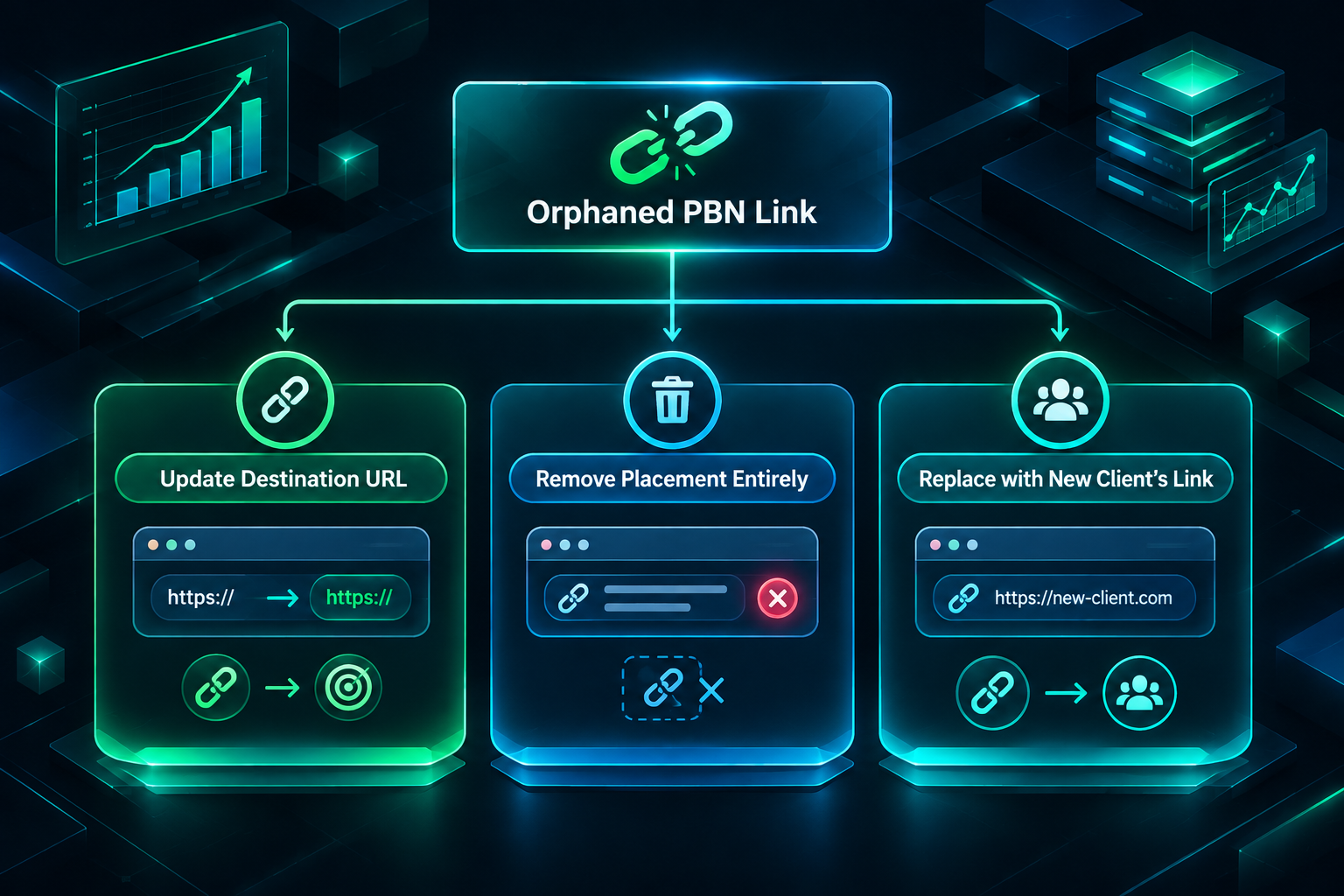
Once the audit is complete, each placement falls into one of several categories, each requiring a different response. Understanding these options helps agencies and PBN operators make consistent decisions rather than handling each case ad hoc.
Updating the Destination URL
If the network domain’s content is topically compatible with another client or campaign target, the most efficient option is to update the destination URL within the existing placement. This preserves the placement’s position on the network domain, keeps the outbound link active and functional, and redirects the link equity toward a new target. The anchor text may also need to be revised if it was highly specific to the former client’s brand or exact-match keyword. Updating both the URL and the anchor text within the surrounding contextual paragraph ensures the placement remains coherent and relevant to the network domain’s content.
Removing the Placement Entirely
In cases where no suitable replacement target exists, or where the placement was in a section of the network domain’s content that no longer makes editorial sense, removing the link is a cleaner option than leaving a broken or misdirected outbound link in place. Removing the link does not necessarily mean removing the entire article or post on the network domain — the surrounding content may still contribute to the domain’s topical depth. The link itself can be unlinked, leaving the anchor text as plain text, or the sentence can be revised to remove the reference entirely.
Replacing the Placement with a New Client’s Link
If the network domain has strong topical relevance and the placement position is valuable — for example, a contextual link within a well-indexed, authoritative post — replacing the former client’s link with a new client’s link is often the most commercially efficient choice. This approach requires that the new destination URL is topically compatible with the surrounding content and that the anchor text is updated to reflect the new target. Forcing a mismatched anchor or destination into an existing placement for the sake of convenience can undermine the contextual quality that makes PBN placements effective.
Anchor Text Revision After Offboarding
Anchor text management is one of the more nuanced aspects of PBN link changes after client offboarding. During an active campaign, anchor text is chosen to support a specific target page’s keyword strategy — often a mix of exact-match, partial-match, branded, and generic anchors distributed across placements. When the client leaves, those anchors remain in place on the network domains, and some of them may be highly specific to the former client’s brand or target keywords.
Brand-specific anchors are generally the most straightforward to handle: if the anchor references a brand name that is no longer relevant to any active campaign, it should be updated when the placement is reassigned. Exact-match keyword anchors require more careful consideration. If the anchor targets a keyword that is relevant to a new client’s campaign and the destination URL is being updated to point to that client’s page, the anchor may be reusable with minor revision. If the keyword is specific to the former client’s niche and the new target is in a different vertical, the anchor should be revised to match the new context.
One practical consideration is that changing anchor text on a live PBN placement will eventually be reflected in backlink data tools such as Ahrefs or Majestic once those tools re-crawl the page. If the former client has access to their own backlink data, they may notice the anchor change. This is generally not a concern from a technical standpoint, but it is worth noting in the offboarding documentation so that both parties have a clear record of what was agreed.
Handling Redirects and Domain Changes on the Client’s Side
A common scenario after client offboarding is that the former client’s domain undergoes changes that affect where PBN links resolve. The client may implement a site-wide redirect to a new domain, sell the domain to a third party, allow the domain to expire, or restructure their URL architecture in ways that break the specific page-level URLs that PBN links were pointing to.
Site-wide 301 redirects from the former client’s domain to a new domain will pass the PBN link’s destination through to the redirect target. Whether this is acceptable depends on where the redirect leads. If the former client has rebranded and the redirect goes to their new domain, the link may still serve a purpose if the client relationship continues under the new brand. If the redirect goes to an unrelated business or a domain that has been sold, the placement should be updated or removed promptly.
Domain expiry is a more abrupt scenario. If the former client allows their domain to expire and it is subsequently registered by a domain investor or a competitor, any PBN links pointing to that domain will resolve to whatever content the new registrant publishes. This is a situation where monitoring the former client’s domain after offboarding — even briefly — provides useful early warning. Tools that track domain registration status or that alert on DNS changes can help identify this scenario before it becomes a problem for the network domains involved.
Documenting the Offboarding Process
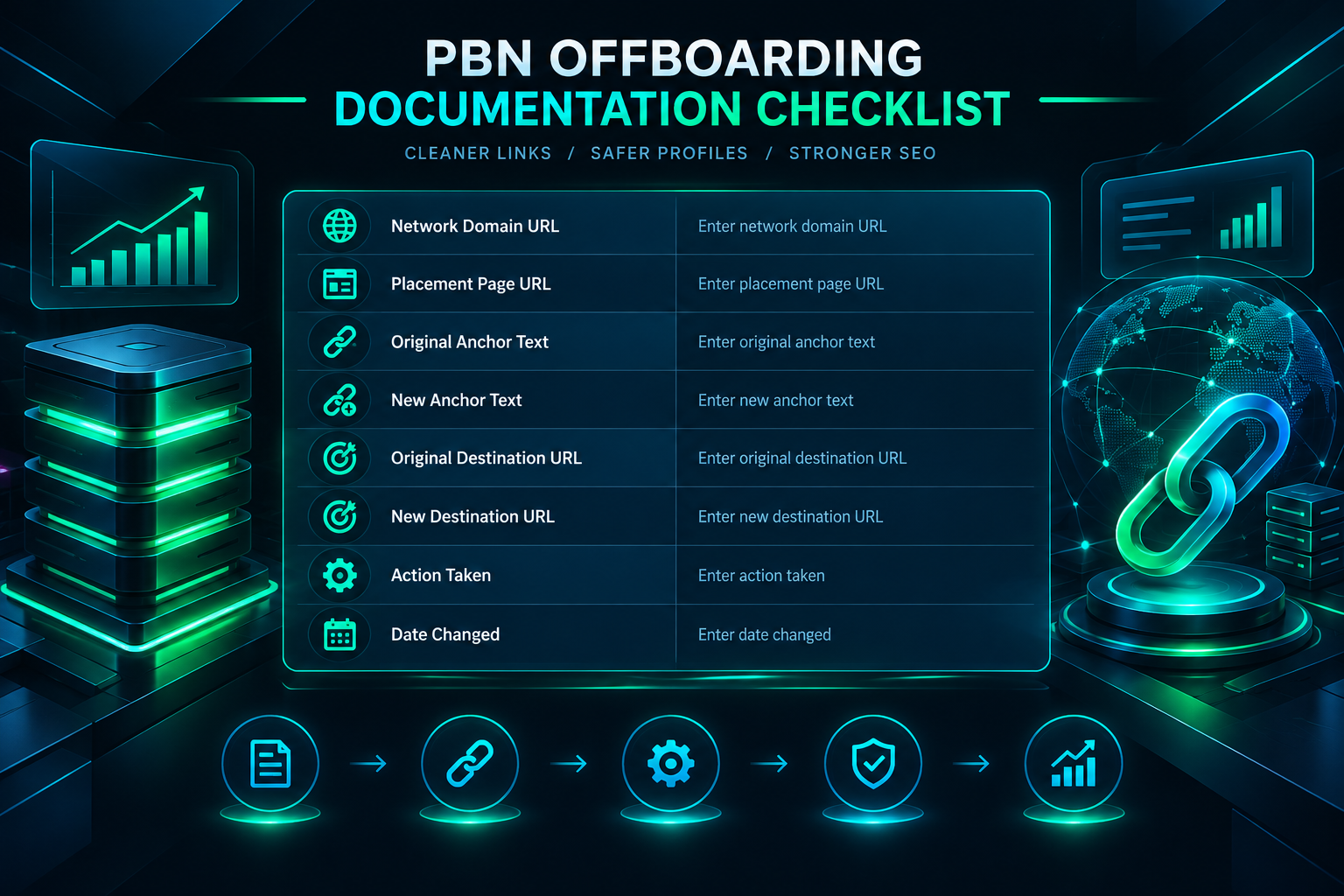
A documented offboarding checklist serves two purposes: it protects the agency or PBN operator by creating a clear record of what was done, and it provides a reference point if questions arise later about which links were placed, modified, or removed. The documentation does not need to be elaborate, but it should capture the essential information for each placement.
A practical offboarding record for each PBN placement should include the network domain URL, the specific post or page URL where the placement lives, the original anchor text, the original destination URL, the action taken (updated, removed, or retained), the new destination URL and anchor text if updated, and the date the change was made. This record can be maintained in a shared spreadsheet or a project management tool, depending on the agency’s workflow.
For agencies managing PBN campaigns on behalf of multiple clients simultaneously, maintaining this documentation also makes it easier to identify which network domains have available placement capacity after an offboarding, which domains have been recently modified, and which placements are approaching a point where the surrounding content may need to be refreshed to maintain topical relevance.
Monitoring Network Domains After Link Changes
After PBN link changes have been made in response to a client offboarding, a brief monitoring period helps confirm that the changes have been implemented correctly and that the network domains are behaving as expected. The key things to verify are that updated destination URLs return a 200 status, that removed links are no longer present in the page source, and that any revised anchor text appears correctly in the published content.
It is also worth checking whether the modified pages on the network domains are being re-crawled and re-indexed after the changes. If a network domain’s pages are indexed regularly, changes to outbound links and anchor text will be picked up relatively quickly. If indexing is slow, the old link data may persist in backlink tools for a period after the change has been made on the page itself. This lag is normal and does not indicate a problem with the implementation.
For agencies that use backlink monitoring tools as part of their standard workflow, adding the network domains to a monitoring list after offboarding changes can surface any unexpected issues — such as a placement page being deindexed or a domain’s crawl rate changing — that might otherwise go unnoticed. Ahrefs, Majestic, and similar tools can be used to verify that the updated outbound links are being recorded correctly once re-crawling has occurred.
Communicating Link Changes to the Departing Client
Whether and how to communicate PBN link changes to a departing client depends on the terms of the original service agreement and the nature of the offboarding. In most PBN service arrangements, the network domains and their content remain the property of the provider, not the client. The client has purchased link placements, not ownership of the network domains or the content on them. This distinction is important because it means the provider generally has the right to update, reassign, or remove placements after the client relationship ends.
That said, transparent communication about what will happen to existing placements after offboarding reduces the likelihood of disputes. If the service agreement specifies that links will be maintained for a defined period after the contract ends, that commitment should be honored and documented. If the agreement does not address post-offboarding link maintenance, it is reasonable to inform the client that placements may be updated or removed as part of the provider’s standard network management process.
Clients who have been monitoring their backlink profile using tools such as Ahrefs or Semrush may notice changes to their link count or anchor text distribution after offboarding. Providing a brief explanation of what changes were made and why — without disclosing specific network domain details — can help maintain a professional relationship and reduce the risk of the former client raising concerns about link manipulation or profile changes.
Protecting Network Domain Quality Through Consistent Offboarding Practices
The long-term value of a private blog network depends significantly on the quality and relevance of the content and outbound links on each domain. A network domain that accumulates stale placements pointing to dead URLs, irrelevant redirects, or expired domains gradually loses the editorial coherence that makes its links useful. Consistent offboarding practices — auditing placements promptly, updating or removing links that no longer serve a purpose, and maintaining accurate records — are part of the ongoing maintenance that keeps a network performing well across multiple client campaigns.
This is particularly relevant for agencies that manage PBN campaigns at scale. When dozens or hundreds of placements are active across a network at any given time, and client turnover is a regular occurrence, the cumulative effect of unmanaged offboarding can be significant. Building offboarding into the standard campaign lifecycle — rather than treating it as an afterthought — is a practical way to protect the network’s long-term utility and the quality of the placements it can offer to future clients.
Frequently Asked Questions
What happens to PBN links if a client’s domain expires after offboarding?
If the former client’s domain expires and is registered by a new owner, any PBN links pointing to that domain will resolve to whatever content the new registrant publishes. This can result in placements pointing to unrelated or low-quality content, which reduces the practical value of those outbound links on the network domain. Monitoring the former client’s domain registration status for a period after offboarding allows you to identify this scenario early and update or remove affected placements before the situation persists.
Should anchor text be changed immediately after a client offboards?
Anchor text should be updated when the placement is being reassigned to a new destination URL, or when the existing anchor is so brand-specific or keyword-specific to the former client that it no longer makes contextual sense on the network domain. There is no strict timeline requirement, but updating anchor text as part of the same edit in which the destination URL is changed keeps the placement coherent and avoids a period where the anchor and destination are mismatched.
Can PBN placements be transferred to a new client in the same niche?
Yes, if the network domain’s content is topically relevant to the new client’s target pages, reassigning a placement to a new client in the same or a closely related niche is often the most efficient use of an existing placement position. The destination URL and anchor text should be updated to reflect the new target, and the surrounding content should be reviewed to confirm that the placement remains contextually coherent after the change.
How long should a provider monitor a former client’s domain after offboarding?
The appropriate monitoring period depends on the number of placements involved and the former client’s domain activity. A minimum of 30 to 60 days is a reasonable starting point for checking domain registration status, redirect behavior, and URL availability. For clients with a large number of placements or domains in volatile niches where ownership changes are common, a longer monitoring window may be warranted.
Does removing a PBN link after offboarding affect the former client’s rankings?
Removing a PBN link may affect the former client’s backlink profile, particularly if the placement was contributing to the authority or anchor text distribution of a target page. The extent of any ranking impact depends on the overall backlink profile, the competitiveness of the target keywords, and how many other links support the same pages. This is a factor worth noting in the offboarding documentation and, where appropriate, in communications with the departing client.
What records should be kept after PBN link changes are made during offboarding?
At a minimum, records should include the network domain URL, the placement page URL, the original and updated anchor text, the original and updated destination URL, the action taken, and the date of the change. These records protect the provider in the event of disputes and provide a useful reference for future network management decisions.
Building Offboarding Into Your PBN Campaign Workflow
Managing PBN link changes after client offboarding is not a one-time task — it is a recurring operational responsibility that becomes more important as a network grows and client turnover becomes a regular part of the business cycle. The agencies and independent operators who handle offboarding systematically tend to maintain cleaner networks, experience fewer issues with stale or misdirected outbound links, and are better positioned to reassign placements efficiently when new campaigns begin.
The practical steps — auditing placements, assessing destination URL status, updating or removing links, revising anchor text, documenting changes, and monitoring network domains afterward — are manageable when they are built into a standard offboarding checklist rather than handled reactively. For agencies managing PBN campaigns at scale, investing in clear internal processes for this phase of the campaign lifecycle protects both the network’s long-term quality and the agency’s ability to deliver consistent results for future clients.
If you are evaluating how PBN placements are managed across a campaign lifecycle — including how link changes are handled when client relationships end — reviewing your current workflow against these steps is a useful starting point. PBN Backlinks Service can discuss placement management, network quality, and campaign structure with you to help ensure that your link-building approach remains purposeful at every stage.