

PBN backlinks built on domains registered or hosted in a different country can contribute to a website’s overall link authority, but their direct influence on local search rankings is more nuanced than a simple yes or no. Geographic signals, topical relevance, and the specific local ranking factors at play all shape how much value a cross-border PBN link may deliver to a locally targeted page. Understanding those variables helps website owners and SEO practitioners make more deliberate decisions about where to source backlinks for local campaigns.
Key Takeaways
- PBN links from another country can pass general link authority to a locally targeted page, but they carry weaker geographic relevance signals compared to links from country-specific domains or locally hosted sites.
- Topical relevance of the linking PBN domain often matters more for ranking impact than the country of registration or hosting alone.
- Local search rankings depend on a combination of signals including Google Business Profile, on-page local optimization, citation consistency, and backlinks — cross-border PBN links address only one part of that mix.
- Country-code top-level domains (ccTLDs) and locally hosted PBN sites may carry stronger geographic signals for local queries, making them worth prioritizing when local ranking is the primary goal.
- The practical value of any PBN link for local SEO depends on domain quality, placement context, anchor text, and how the link fits within the broader backlink profile of the target site.
How Search Engines Interpret Geographic Signals in Backlinks
Search engines use a range of signals to determine whether a webpage is relevant to a geographically specific query. For local search, those signals include the physical address and service area listed in a Google Business Profile, NAP (name, address, phone number) consistency across directories, on-page location signals, and the backlink profile of the target domain or page. Within the backlink profile, geographic relevance is one factor among many, and it is not the only dimension search engines evaluate.
A backlink’s geographic relevance can be inferred from several characteristics: the top-level domain extension (for example, a .co.uk domain signals UK relevance), the server’s IP address location, the language and content of the linking page, and the geographic focus of the linking site’s overall content. A PBN domain registered in Germany with German-language content and a .de extension sends clearer geographic signals for German local queries than a generic .com domain hosted on a US server with English content. However, neither configuration is automatically disqualifying for a local campaign — the question is how much weight each signal carries relative to the others.
Google has stated publicly that it uses multiple signals to determine the geographic relevance of a page, and that ccTLDs are a strong indicator of country targeting. Server location is a weaker signal and can be overridden by other factors such as content language and Search Console geotargeting settings. This means a PBN domain hosted outside the target country is not automatically irrelevant to a local campaign, but it may contribute less geographic signal than a locally hosted or locally registered domain would.
What Cross-Border PBN Links Can and Cannot Do for Local SEO
A PBN backlink from a domain in another country can still transfer link equity — sometimes called PageRank or link authority — to the target page. If the PBN domain has a meaningful backlink profile, relevant topical history, and a well-placed contextual link, that authority transfer can contribute to the target page’s overall ranking strength. Local search results are not entirely isolated from general domain authority; a stronger overall backlink profile can support rankings across both local and non-local queries.
Where cross-border PBN links are less effective is in reinforcing the geographic relevance signals that local search algorithms specifically weight. A local business competing for a query like “plumber in Manchester” benefits most from links that carry both authority and local relevance — ideally from UK-based domains, locally focused publications, regional directories, or industry sites with a clear UK audience. A PBN link from a US-based domain with no UK content or audience may add general authority without meaningfully strengthening the local relevance dimension of the backlink profile.
It is also worth noting that local search rankings are heavily influenced by factors outside the backlink profile entirely. Google Business Profile completeness and review signals, proximity to the searcher, on-page local optimization, and structured data all play significant roles. Cross-border PBN links, like any backlinks, address only the link authority component of local SEO — they do not substitute for the other local signals that search engines evaluate.
When Topical Relevance Outweighs Geographic Origin
Topical relevance is often a more decisive quality factor for a PBN link than the country of origin. A PBN domain with a strong history in the home improvement niche, a clean backlink profile, and contextually placed anchor text linking to a local contractor’s service page may deliver more ranking value than a geographically local but topically unrelated domain. Search engines assess the thematic relationship between the linking page and the target page as part of evaluating link quality, and a topically aligned link from abroad can outperform a geographically local but irrelevant one.
This distinction matters practically when selecting PBN placements for a local SEO campaign. If the choice is between a high-quality, topically relevant PBN domain hosted outside the target country and a low-quality, locally hosted domain with thin content and a weak backlink history, the topically relevant domain is likely the stronger placement. The ideal scenario for local campaigns is a PBN domain that combines both topical relevance and geographic alignment — but when that combination is unavailable, topical quality generally takes priority over geographic origin alone.
Contextual placement also amplifies or diminishes the value of any PBN link regardless of geography. A link embedded naturally within a substantive, relevant article on a well-maintained PBN site carries more weight than a link dropped into a sidebar or footer on a thin, poorly maintained domain. The surrounding content, the anchor text used, and the overall quality of the linking page all affect how much value the link may contribute to the target page’s rankings.
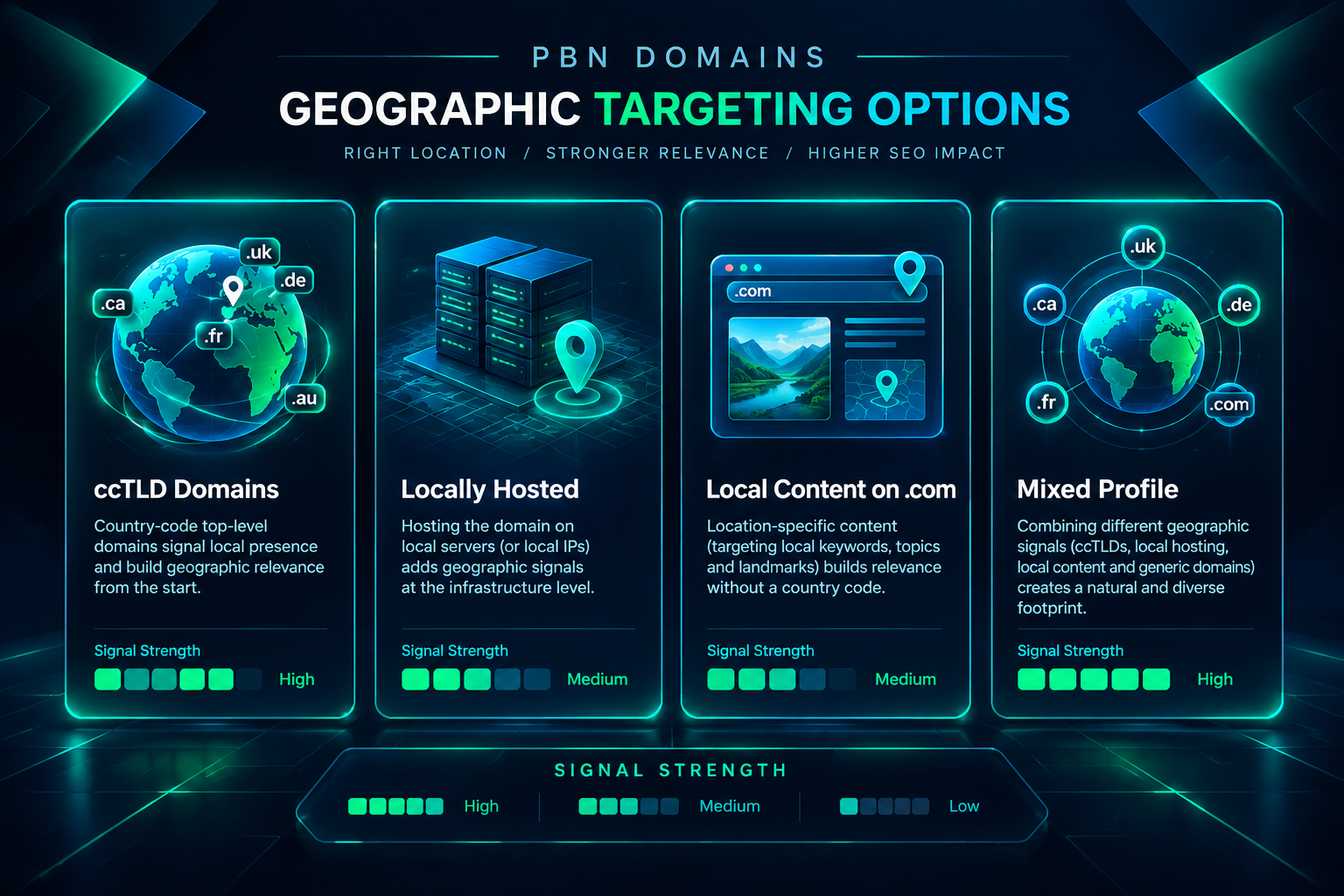
Geographic Targeting Options Within a PBN Strategy
For website owners and SEO practitioners who want to maximize geographic relevance within a PBN link-building strategy, several practical options are worth considering. Each involves trade-offs between availability, cost, and the strength of the geographic signal produced.
- Country-code top-level domains (ccTLDs): PBN domains using ccTLDs such as .co.uk, .com.au, or .de carry the strongest geographic signal for their respective countries. Acquiring quality expired ccTLD domains with relevant backlink histories can be more competitive and costly than sourcing generic .com domains, but the geographic signal benefit for local campaigns is meaningful.
- Locally hosted PBN domains: Hosting a PBN domain on a server with an IP address in the target country adds a geographic signal, though this is a weaker indicator than a ccTLD. It can still contribute to the overall geographic relevance picture, particularly when combined with locally focused content.
- Locally focused content on generic domains: A .com PBN domain that publishes content specifically about the target city, region, or country — and links to local businesses within that content — can carry some geographic relevance even without a ccTLD or local hosting. The content itself signals geographic focus to search engines.
- Mixed geographic profiles: Many local SEO campaigns use a combination of geographically targeted links and general authority links. Cross-border PBN links can serve as part of the general authority layer while locally targeted placements address the geographic relevance dimension.
Assessing PBN Domain Quality for Local Campaigns
Regardless of geographic origin, the quality of a PBN domain determines how much value a placement is likely to deliver. For local SEO campaigns, domain quality assessment should cover the same core factors that apply to any PBN placement, with additional attention to geographic and topical fit.
Relevant domain history is a foundational quality indicator. A PBN domain that previously operated as a genuine local business website, a regional news outlet, or a locally focused industry resource carries both topical and geographic relevance that can benefit a local campaign. Checking the domain’s archived content through tools like the Wayback Machine helps verify whether the historical content aligns with the target niche and geography. A domain that previously served a different country or a completely unrelated industry provides weaker geographic and topical signals regardless of its current metrics.
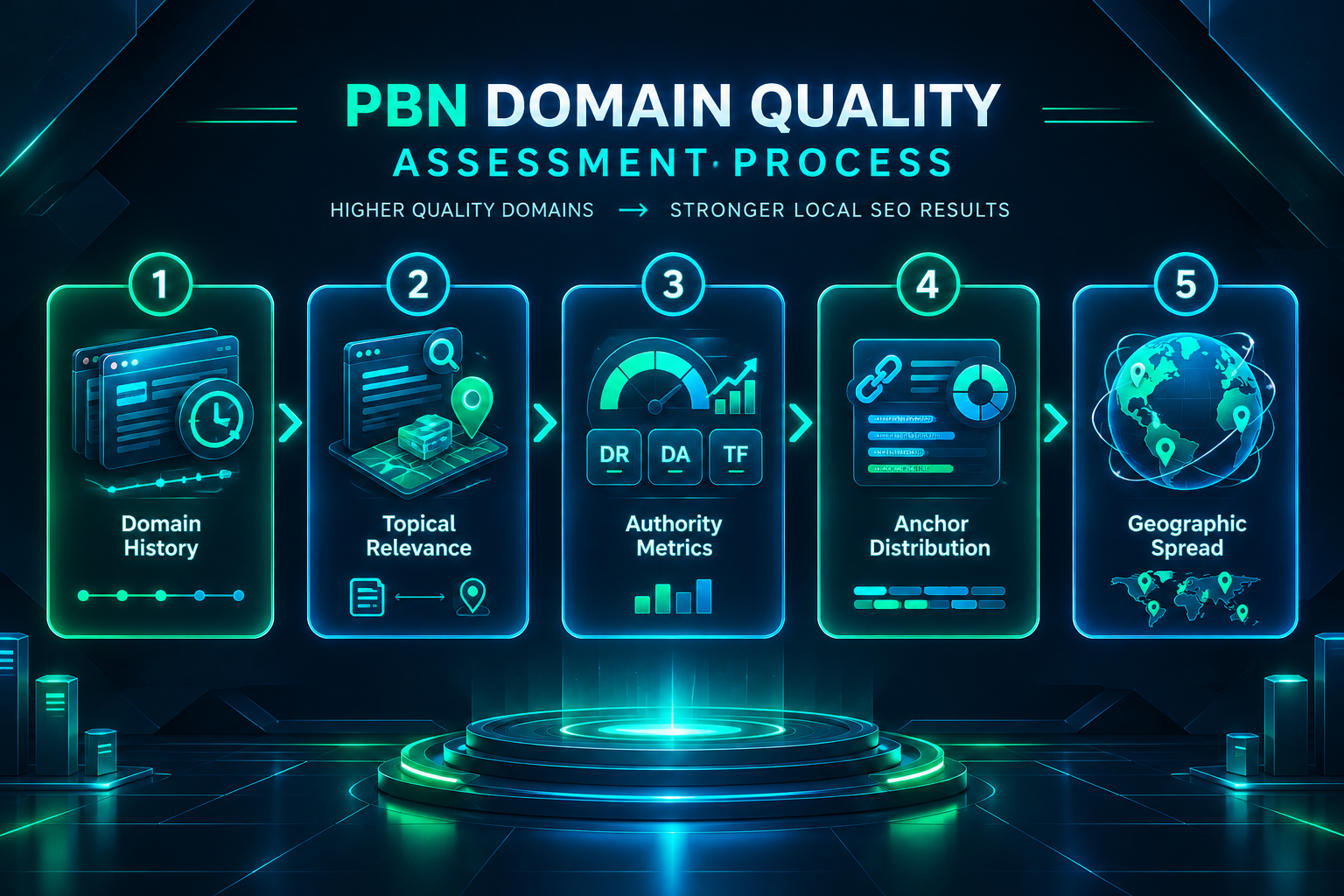
Third-party authority metrics from tools such as Ahrefs (Domain Rating), Moz (Domain Authority), or Majestic (Trust Flow and Citation Flow) provide a useful starting point for evaluating a PBN domain’s backlink profile strength. These proprietary metrics are not Google ranking scores and should not be treated as direct predictors of ranking impact, but they help identify domains with meaningful link equity versus those with inflated or manipulated profiles. For local campaigns, reviewing the geographic distribution of a domain’s referring domains can also indicate whether the domain’s existing authority is concentrated in the target country or spread across unrelated markets.
Anchor text distribution on the PBN domain itself is another quality consideration. A domain whose existing backlinks use heavily over-optimized anchor text may carry footprint risks that affect the value of placements built on it. Similarly, a domain with a sudden spike in referring domains followed by a sharp drop may indicate previous link manipulation that has already been discounted by search engines.
Anchor Text Strategy for Cross-Border PBN Links in Local Campaigns
Anchor text selection for PBN links pointing to locally targeted pages requires the same strategic care as any link-building campaign, with some local-specific considerations. For local queries, anchor text that includes the target location alongside the primary keyword — for example, “roofing contractor in Bristol” — can reinforce both the topical and geographic relevance of the link. However, over-reliance on exact-match location-based anchors across multiple PBN placements can create an unnatural pattern in the backlink profile.
A varied anchor text profile that includes branded anchors, partial-match anchors, generic anchors, and some exact-match location-based anchors tends to look more natural and distributes relevance signals more effectively. Cross-border PBN links can use the same anchor text strategy as locally sourced links — the geographic origin of the linking domain does not require a different anchor approach. What matters is that the anchor text is contextually appropriate for the linking page’s content and contributes to a diverse, natural-looking anchor profile for the target page.
For local landing pages targeting specific service areas, anchors that reference the service and location together can be useful when used selectively. For the target domain’s homepage or a broader service page, branded or partial-match anchors are often more appropriate and less likely to create an over-optimized pattern.
Realistic Expectations for Local Ranking Impact
The ranking impact of any individual PBN link — whether from the same country or abroad — is difficult to isolate and measure precisely. Local search rankings respond to the cumulative effect of multiple signals, and a single cross-border PBN link is unlikely to produce a dramatic ranking shift on its own. The more competitive the local market, the more a comprehensive approach to local SEO — combining on-page optimization, Google Business Profile management, citation building, and a well-structured backlink profile — becomes necessary.
Cross-border PBN links are most likely to contribute meaningfully when they are part of a broader link-building strategy rather than the sole source of backlinks for a local campaign. In less competitive local markets, even a modest improvement in overall link authority from well-placed PBN links may be sufficient to move a page into a more visible ranking position. In highly competitive local markets, geographic relevance in the backlink profile becomes a more important differentiator, making locally targeted placements a higher priority.
Indexing timelines also affect when any ranking impact becomes measurable. A PBN link must be crawled and indexed by search engines before it can influence rankings, and indexing is not guaranteed or immediate. Monitoring whether PBN placements are indexed — using tools such as Google Search Console or site-specific search queries — is a practical step in assessing whether placements are contributing to the campaign.
Frequently Asked Questions
Does the country of a PBN domain’s hosting affect its value for local SEO?
Server location is one geographic signal that search engines may use, but it is a relatively weak indicator compared to ccTLD extension and content language. A PBN domain hosted outside the target country can still contribute link authority to a local campaign, though locally hosted domains may carry a marginally stronger geographic signal when other factors are equal.
Are ccTLD PBN domains always better for local campaigns than .com domains?
ccTLD domains carry a stronger country-targeting signal, which can be advantageous for local SEO. However, a high-quality .com PBN domain with strong topical relevance, locally focused content, and a clean backlink profile may outperform a low-quality ccTLD domain with thin content and a weak link history. Domain quality and topical relevance remain important alongside geographic signals.
Can cross-border PBN links hurt local rankings?
A cross-border PBN link from a well-maintained, topically relevant domain is unlikely to harm local rankings simply because of its geographic origin. Potential negative effects are more closely associated with overall link quality issues — thin content on the linking page, manipulative anchor text patterns, or a PBN domain with a problematic backlink history — rather than the country of origin specifically.
How many PBN links does a local campaign typically need?
There is no universal answer. The appropriate number of PBN placements depends on the competitiveness of the local market, the current strength of the target site’s backlink profile, the quality of the individual placements, and the other local SEO signals in place. A review of the target site and its local competitors’ backlink profiles provides a more reliable basis for estimating placement needs than any fixed formula.
Should cross-border PBN links be combined with locally targeted links for local SEO?
Combining cross-border PBN links that contribute general authority with locally targeted placements that reinforce geographic relevance is a practical approach for local campaigns. The two types of links address different dimensions of the ranking signal mix, and a profile that includes both can be more effective than relying exclusively on one geographic source.
Does anchor text need to include the target location when using cross-border PBN links?
Including location-based anchor text in some placements can reinforce geographic relevance signals, but it should be used selectively within a varied anchor profile. Over-optimizing with exact-match location anchors across multiple placements can create an unnatural pattern. A mix of branded, partial-match, and location-specific anchors is generally more appropriate.
Choosing PBN Placements That Fit Your Local SEO Goals
Cross-border PBN links are not automatically ineffective for local campaigns, but their contribution depends on how well they are matched to the campaign’s specific needs. A PBN domain from another country that brings strong topical relevance, a clean backlink history, and a well-placed contextual link can add meaningful authority to a locally targeted page — even if it contributes less geographic signal than a locally registered or hosted domain would.
For local campaigns where geographic relevance in the backlink profile is a priority, the most practical approach is to assess each potential PBN placement on both its general quality and its geographic fit. Where locally targeted PBN domains with strong metrics are available, they are worth prioritizing. Where they are not, high-quality cross-border placements can still serve a useful role in building the overall authority of the target site, particularly when combined with other local SEO signals.
If you are evaluating PBN placements for a local SEO campaign and want to assess which domain types and placement configurations are most appropriate for your target market and competition level, PBN Backlinks Service can help you review your backlink requirements and identify placements suited to your goals.