

Running a private blog network involves more than the initial investment in domains and setup. The recurring costs of keeping a PBN operational, indexed, and effective accumulate month after month, and underestimating them is one of the most common reasons network owners find their ROI disappointing. Understanding how to calculate PBN maintenance costs accurately allows you to budget realistically, decide whether building or buying links makes more financial sense for your situation, and identify where spending can be optimized without compromising network quality.
Key Takeaways
- PBN maintenance costs are driven by four primary recurring categories: hosting, domain renewals, content production, and monitoring tools — each of which scales with network size.
- A realistic per-site monthly cost for a well-maintained PBN property typically ranges from roughly $15 to $60 or more, depending on hosting strategy, content frequency, and tooling choices.
- Domain renewal is often underestimated because premium aged domains can carry annual renewal fees significantly above standard rates, and some registrars charge differently for certain TLDs.
- Content is frequently the largest variable cost in a PBN budget, and the frequency of new content per site directly affects both indexing health and the perceived quality of each property.
- Calculating total network cost per link placed — rather than per site — gives a more useful picture of whether a self-managed PBN delivers value compared with purchasing placements from an established provider.
Why Recurring Costs Matter More Than Setup Costs
Most discussions about PBN investment focus on the upfront expense: acquiring expired or aged domains at auction, paying for initial site builds, and purchasing a CMS theme or plugins. These are real costs, but they are one-time. The recurring costs are what determine whether a private blog network remains financially viable over a 12-, 24-, or 36-month horizon. A network of 20 sites that costs $4,000 to build but $800 per month to maintain will cost more than $13,000 in its first year of operation. That figure changes the calculation significantly when compared against purchasing contextual link placements from an established PBN provider.
Recurring costs also compound a second problem: neglect. When a network owner underestimates ongoing expenses and cuts corners on content, hosting renewals, or monitoring, the quality of individual PBN properties tends to decline. Sites that lose content freshness, accumulate broken links, or fall out of the index stop contributing meaningful link equity to the target site. Budgeting accurately from the start is therefore both a financial and a quality-management decision.
The Four Core Recurring Cost Categories
1. Hosting
Hosting is typically the most predictable recurring expense in a PBN budget. The standard approach for reducing footprint risk involves distributing sites across multiple hosting providers, different IP ranges, and ideally different countries or data centers. This means a network owner rarely uses a single shared hosting plan for all properties. Instead, costs are spread across several accounts, which increases the per-site hosting cost compared with a standard website.
Common hosting configurations for PBN properties include individual shared hosting accounts at different providers, VPS instances partitioned across sites, or cloud hosting with separate accounts. Budget shared hosting plans can cost as little as $3 to $8 per month per account, while more robust VPS or managed hosting options may run $10 to $30 per month per instance. For a 20-site network using a diversified hosting strategy, monthly hosting costs alone can range from approximately $60 to $300 depending on the configuration chosen.
Some network operators use CDN or proxy services such as Cloudflare to add an additional layer of separation between the hosting environment and the public-facing domain. Cloudflare’s free tier covers basic use cases, but paid plans add cost if advanced features are needed. Factor in any SSL certificate costs if the hosting provider does not include them automatically, though most modern hosts bundle free SSL through Let’s Encrypt.
2. Domain Renewals
Domain renewal is the cost category most frequently underestimated in PBN budgets. Standard .com renewals typically cost $10 to $15 per year per domain at most registrars. However, many PBN operators specifically seek out aged or expired domains with established backlink profiles, and these domains sometimes carry premium renewal rates, particularly for certain country-code TLDs or specialty extensions. A domain originally registered at a standard rate may renew at a higher price depending on the registrar and TLD.
For a network of 20 domains renewing at an average of $12 per year, the annual domain renewal cost is approximately $240, or $20 per month when amortized. If the network includes premium TLDs or domains registered through higher-cost registrars, that figure can rise to $400 to $600 annually. Spreading renewals across multiple registrars — a common footprint-reduction practice — can also introduce slight price variation and additional account management overhead.
It is worth noting that domain renewal costs are fixed regardless of how actively a site is used. A PBN property that has stopped receiving content updates or has lost most of its indexed pages still incurs its annual renewal fee. Auditing the network periodically to identify underperforming domains and deciding whether to renew or retire them is a legitimate cost-management step.
3. Content Production
Content is typically the largest and most variable recurring cost in a private blog network. Each PBN property needs a baseline of published content to appear as a credible, active website rather than a placeholder. Beyond the initial content load at setup, ongoing content additions serve several purposes: they help maintain crawl frequency from search engine bots, support the indexing of new pages, and contribute to the overall appearance of an active site.
The frequency of new content per site varies widely among network operators. Some publish one to two new articles per month per property; others publish less frequently but invest more in the quality and length of each piece. Content costs depend on whether the operator writes in-house, uses freelance writers, or relies on AI-assisted drafting with human editing. Freelance article rates for competent English-language content typically range from $15 to $80 per article depending on length, niche complexity, and writer experience. AI-assisted content with human editing can reduce per-article cost but introduces its own quality-control requirements.
For a 20-site network publishing one article per month per site at an average cost of $25 per article, monthly content spend is $500. At $40 per article, that rises to $800 per month. Content is therefore the line item with the greatest potential to either inflate or compress the total network budget, and it is the area where quality trade-offs are most directly felt in terms of site credibility and indexing health.
4. Monitoring and SEO Tools
Maintaining a PBN effectively requires ongoing visibility into the health of each property. This includes tracking whether sites remain indexed, monitoring backlink profiles for unexpected changes, checking domain metrics, and identifying technical issues such as broken links, slow load times, or plugin conflicts. These tasks require either manual time investment or paid tooling — and usually both.
SEO tools commonly used in PBN management include Ahrefs, Semrush, and Majestic for backlink profile monitoring and domain metric assessment. Screaming Frog is frequently used for technical site audits. Google Search Console can be used for individual properties, though some operators prefer not to connect PBN sites to a Google account for footprint reasons. Ahrefs and Semrush subscriptions range from approximately $99 to $449 per month depending on the plan tier, though many operators share a single subscription across their network management workflow rather than purchasing separate accounts per site.
Additional tool costs may include uptime monitoring services, rank tracking for the target sites receiving PBN links, and WordPress plugin licenses for security or performance. Allocating $50 to $150 per month for tooling is a reasonable estimate for a mid-sized network, assuming shared subscriptions and selective use of premium features.
How to Calculate Total Monthly PBN Maintenance Cost
Calculating the total recurring cost of a private blog network requires summing all four categories and then dividing by the number of sites to arrive at a per-site monthly figure. A further useful calculation divides the total monthly cost by the number of active link placements the network delivers to arrive at a cost-per-link metric.
The following framework illustrates the calculation for a 20-site network:
| Cost Category | Monthly Estimate (20 sites) | Per-Site Monthly |
|---|---|---|
| Hosting (diversified) | $120 – $300 | $6 – $15 |
| Domain renewals (amortized) | $20 – $50 | $1 – $2.50 |
| Content (1 article/site/month) | $400 – $800 | $20 – $40 |
| Tools and monitoring | $50 – $150 | $2.50 – $7.50 |
| Total | $590 – $1,300 | $29.50 – $65 |
These figures are illustrative estimates based on commonly reported cost ranges in the SEO community. Actual costs will vary depending on niche, content quality targets, hosting choices, geographic distribution of the network, and tool subscriptions already in use. The per-site monthly cost of $29.50 to $65 is a useful planning benchmark, but networks with higher content standards, premium hosting, or more frequent publishing schedules will sit at the upper end or above this range.
Calculating Cost Per Link Placed
The per-site monthly cost is useful for budgeting, but the metric that most directly informs the build-vs-buy decision is cost per link placed. If a 20-site network costs $900 per month to maintain and delivers 10 active link placements to target sites in a given month, the effective cost per link is $90. If the same network delivers 20 placements, the cost per link drops to $45.
This calculation matters because a self-managed PBN is not infinitely scalable without proportional cost increases. Adding more target sites or increasing link velocity requires either adding more PBN properties — which increases hosting, content, and domain renewal costs — or increasing the number of links per PBN site, which may affect the perceived naturalness of each property’s outbound link profile. Neither option is cost-free, and both affect the quality calculus of the network.
Comparing the cost-per-link figure from a self-managed network against the per-placement price from an established PBN backlink provider gives a concrete basis for the build-vs-buy decision. Providers such as PBN Backlinks Service offer contextual link placements on established properties without the operator needing to absorb hosting, content, domain renewal, or monitoring costs directly. Whether that trade-off makes sense depends on the scale of the campaign, the operator’s available time, and the quality standards they require.
Hidden and Often-Overlooked Maintenance Costs
Beyond the four primary categories, several additional costs are frequently omitted from PBN maintenance budgets until they appear unexpectedly.
- Plugin and theme updates: WordPress sites require periodic plugin and theme updates to maintain security and compatibility. While many updates are free, premium plugins or themes carry annual license renewal fees, typically $20 to $100 per plugin per year. A network using three premium plugins across 20 sites could face $1,200 to $6,000 in annual plugin license renewals.
- Site recovery and technical fixes: Hacked sites, database errors, or hosting migrations require time or paid developer assistance. Budgeting a small contingency — perhaps $20 to $50 per site per year — for unexpected technical issues is prudent.
- Domain acquisition to replace retired sites: PBN properties occasionally need to be retired due to deindexation, loss of backlink profile quality, or domain expiry decisions. Replacing a retired site with a new aged domain acquisition reintroduces a one-time cost that should be amortized into the annual budget.
- Operator time: The time spent managing a PBN — publishing content, monitoring indexing, auditing backlink profiles, handling hosting issues, and placing links — has an opportunity cost. For SEO professionals billing at $50 to $150 per hour, even five hours of monthly PBN management represents $250 to $750 in implicit cost that rarely appears in a simple cost spreadsheet.
Factors That Affect How Much Your PBN Costs to Maintain
Not every private blog network costs the same to run. Several factors push maintenance costs higher or lower, and understanding them helps in designing a network that fits a realistic budget.
Network size: Larger networks benefit from some economies of scale in tooling — a single Ahrefs subscription covers 20 sites as easily as 5 — but hosting, content, and domain renewal costs scale roughly linearly with site count. A 50-site network will cost approximately 2.5 times as much to maintain as a 20-site network in most cost categories.
Content quality and frequency: Networks targeting competitive niches where site credibility matters more tend to require higher-quality, longer-form content published more frequently. This directly increases per-site content costs and is the single largest driver of variation between low-budget and high-quality PBN operations.
Hosting strategy: Operators who prioritize IP diversity and use multiple premium hosting providers will pay more than those using budget shared hosting. The trade-off involves footprint considerations and site performance, both of which affect how each property is perceived by crawlers.
Domain TLD and registrar mix: Networks using a mix of TLDs — including country-code extensions, .org, .net, and specialty domains — may face higher average renewal costs than networks built primarily on standard .com domains.
Niche complexity: Niches requiring specialist knowledge — finance, health, legal, or technical topics — typically demand higher content costs because competent freelance writers in those areas charge more. Generic or broad-topic niches are generally cheaper to produce content for.
Build vs. Buy: Using Maintenance Costs in the Decision
The maintenance cost calculation is central to the decision between building and managing a private blog network versus purchasing link placements from an established provider. Building a PBN gives the operator direct control over domain selection, content standards, and placement timing, but it requires sustained investment in all four cost categories plus operator time. Purchasing placements transfers those operational costs to the provider and converts a variable, management-intensive expense into a predictable per-placement fee.
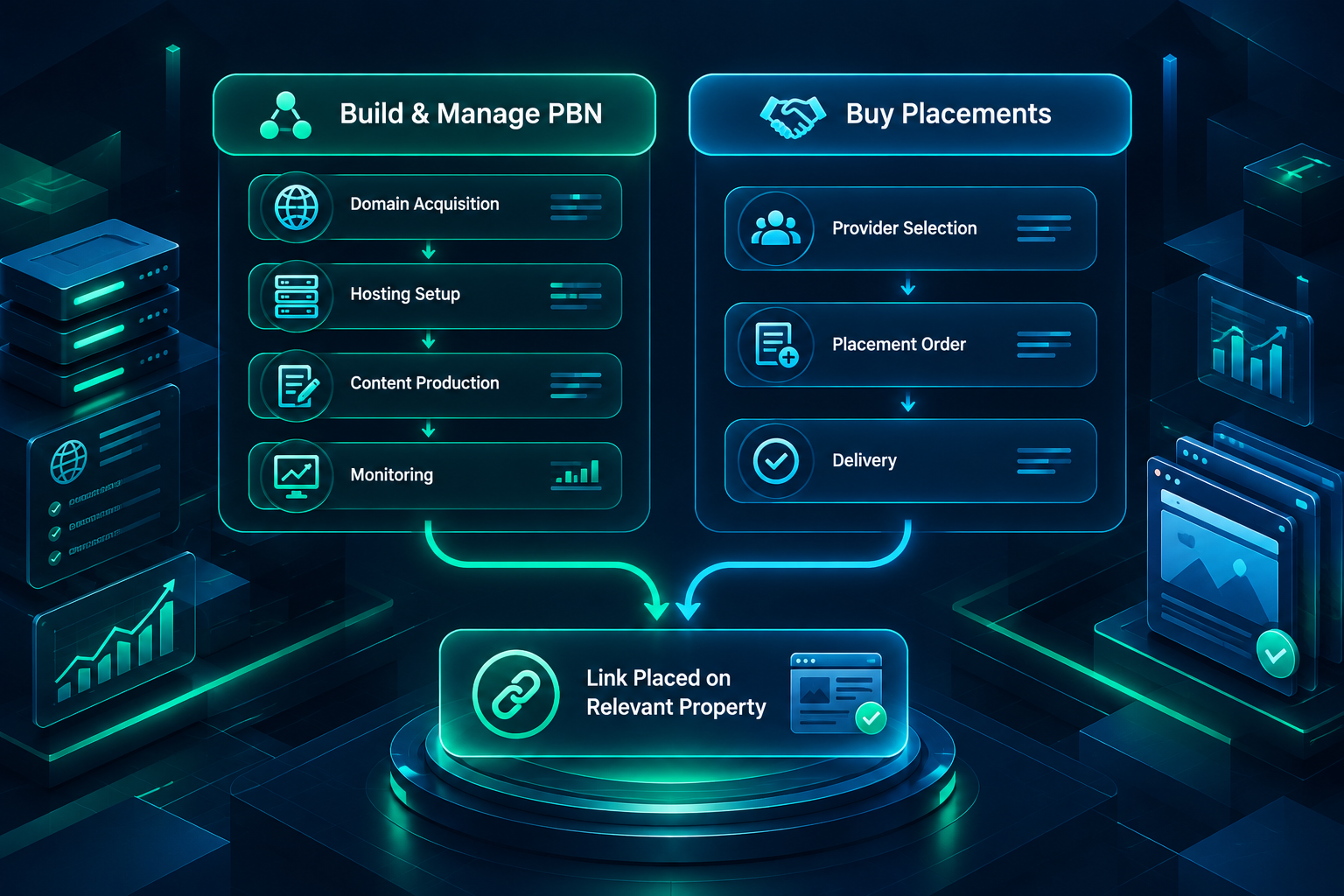
For SEO campaigns requiring a small number of high-quality placements on topically relevant properties, purchasing from a reputable provider is often more cost-efficient than building and maintaining a dedicated network. For operators running large-scale campaigns across many target sites, or those who require very specific niche relevance that is difficult to source externally, a self-managed network may justify its ongoing costs. The maintenance cost calculation — particularly the cost-per-link metric — is the most direct way to make that comparison on a financial basis rather than a theoretical one.
Frequently Asked Questions
What is a realistic monthly budget for maintaining a 10-site PBN?
A 10-site network with diversified hosting, one article per site per month at moderate quality, and shared tool subscriptions typically costs between $300 and $650 per month. Content is usually the largest line item. Costs will be lower if the operator writes content in-house and higher if premium hosting or specialist content is required.
Should domain renewal costs be included in monthly PBN maintenance calculations?
Yes. Even though domain renewals are paid annually, they should be amortized into the monthly budget by dividing the total annual renewal cost by 12. This prevents the renewal period from creating a budget spike and gives a more accurate picture of true monthly operating cost.
How does content frequency affect PBN maintenance costs?
Content frequency is directly proportional to content cost. Publishing two articles per site per month doubles the content line item compared with one article per month. Higher frequency can support better crawl rates and indexing health, but the financial impact is significant at scale. Most operators balance frequency against budget by publishing more often on higher-priority properties and less often on supporting sites.
Do PBN sites need ongoing content if they are already indexed?
Indexed sites do not strictly require continuous new content to remain indexed, but sites that stop receiving updates may be crawled less frequently over time. Reduced crawl frequency can affect how quickly new outbound links are discovered and followed. Most experienced PBN operators maintain at least a minimal publishing schedule on all active properties to preserve crawl activity.
How do I know if my PBN maintenance costs are too high relative to the value delivered?
Calculate the cost-per-link metric by dividing total monthly maintenance cost by the number of active placements delivered that month. Compare that figure against the per-placement price from established PBN providers for comparable domain quality and topical relevance. If the self-managed cost per link significantly exceeds the market rate for purchased placements of similar quality, the network’s cost structure may warrant review.
Can I reduce PBN maintenance costs without reducing network quality?
Some cost reduction is possible without quality trade-offs. Consolidating tool subscriptions, negotiating bulk content rates with reliable freelancers, auditing and retiring underperforming domains rather than renewing them, and using efficient hosting configurations can all reduce costs. However, cutting content quality or frequency, using a single shared hosting environment for all sites, or neglecting monitoring typically introduces quality and footprint risks that may reduce the effectiveness of the network over time.
Planning Your PBN Budget for the Long Term
Calculating PBN maintenance costs accurately is not a one-time exercise. Costs shift as the network grows, as content rates change, as hosting providers adjust pricing, and as domain renewals come due on different schedules. Building a simple tracking spreadsheet that logs each site’s hosting cost, renewal date, content spend, and tool allocation makes it straightforward to review the total network cost monthly and identify where the budget is drifting.
The most useful number to track over time is cost per active link placement. If that figure is rising — because some sites have lost indexing, content quality has declined, or the network has grown without a proportional increase in placements — it signals that the network needs either optimization or a reassessment of scale. If the cost per link is competitive with market rates for purchased placements of comparable quality, the self-managed network is delivering reasonable financial value for the investment.
For SEO managers and agencies evaluating whether to build, expand, or supplement a private blog network, PBN Backlinks Service offers contextual placements on established properties as an alternative to absorbing the full stack of hosting, content, domain, and monitoring costs internally. Reviewing placement options alongside your own network’s cost-per-link calculation gives a concrete basis for deciding where each approach fits within a broader link-building strategy.