

Recovery from a PBN-related penalty is not a fixed process with a guaranteed end date. How long it takes depends on the type of enforcement involved, the scope of the action, the steps taken in response, and how Google processes any subsequent reconsideration or algorithmic reassessment. For some websites, measurable improvement appears within weeks of addressing the underlying issues. For others, recovery stretches across several months or longer. Understanding what distinguishes these outcomes requires separating the different enforcement mechanisms, the variables that affect each one, and the realistic expectations for each stage of the process.
Key Takeaways
- PBN-related enforcement can take the form of a manual action, an algorithmic link devaluation, or a broader ranking adjustment — and each type follows a different recovery path with a different timeline.
- Manual action recovery typically involves submitting a reconsideration request after addressing the flagged links; Google’s documented review process can take several weeks, and ranking improvement may follow weeks or months after the action is lifted.
- Algorithmic adjustments do not have a formal reconsideration process; recovery depends on Google’s crawl and reassessment schedule, which is not publicly disclosed.
- The scope of the enforcement — whether it affects specific pages, a section of the site, or the entire domain — significantly influences how long recovery takes and what steps are most relevant.
- No public threshold defines exactly how many PBN links, what anchor text distribution, or what network footprint triggers a specific type of enforcement; website-specific assessment is necessary before drawing conclusions about cause or remedy.
Understanding the Different Types of PBN-Related Enforcement
Before estimating a recovery timeline, it is important to identify which type of enforcement is actually present. The terms manual action, algorithmic devaluation, ranking decline, and penalty are sometimes used interchangeably in SEO discussions, but they describe meaningfully different situations with different implications for recovery.

A manual action is a documented enforcement decision made by a Google reviewer. It appears in Google Search Console under the Manual Actions report and includes a description of the issue. Google’s link spam policies address paid links intended to manipulate PageRank, and a manual action related to unnatural links may reference inbound links, outbound links, or both. When a manual action is present, the site owner receives a notification and can take steps to address it before submitting a reconsideration request.
An algorithmic link devaluation is different. Google’s systems may assess certain links as unlikely to contribute ranking value without issuing a formal manual action. In this scenario, no notification appears in Search Console, and there is no reconsideration process. The site may experience a ranking decline that correlates with a link-related algorithm update, but the cause is not formally documented by Google. Distinguishing this from other causes of ranking decline — such as content quality issues, technical SEO problems, or competitor improvements — requires careful analysis of timing, affected pages, and backlink profile changes.
A sitewide ranking adjustment differs from a page-level or section-level action. Google has not published a formula that determines when a link-related enforcement action affects only specific pages versus the entire domain. The scope of the action influences both the recovery approach and the expected timeline, and it is not always possible to determine scope from ranking data alone without correlating it with Search Console data and backlink profile analysis.
Manual Action Recovery: Stages and Realistic Timelines
When a manual action related to unnatural links is confirmed in Google Search Console, the recovery process follows a broadly documented sequence, though the timeline at each stage varies.
The first stage involves identifying the links that contributed to the action. This typically means auditing the backlink profile using tools such as Ahrefs, Semrush, or Majestic to identify the placements in question, assessing their characteristics, and determining which ones are within the site owner’s control to address. For PBN-related placements, this may involve contacting placement providers to request removal, or preparing a disavow file for links that cannot be removed directly.
Google’s disavow tool allows site owners to submit a list of links or domains they want Google to discount when assessing their site. Google has stated that it processes disavow files, but it has not published a specific processing timeline. In practice, SEO practitioners report that disavow submissions may take several weeks to be processed, and the effect on rankings — if any — may not be immediately visible even after processing.
Once the site owner has addressed the flagged links and prepared documentation of the steps taken, a reconsideration request can be submitted through Search Console. Google has stated that reconsideration requests are reviewed by a human reviewer and that the process can take several weeks. If the reviewer determines that the issues have been adequately addressed, the manual action is lifted. If the request is denied, Google typically provides a brief explanation, and the process must be repeated.
After a manual action is lifted, ranking recovery is not immediate. The site must be recrawled and reassessed, and any ranking improvement depends on the site’s overall backlink profile, content quality, and competitive landscape. In documented industry discussions, practitioners report that ranking improvement after a manual action lift can take anywhere from a few weeks to several months, with significant variation depending on the site’s history and the extent of the original enforcement. No fixed timeline applies universally.
Algorithmic Reassessment: Why There Is No Set Recovery Window
For ranking declines that appear to be algorithmic rather than tied to a confirmed manual action, the recovery path is less defined. Google does not provide a reconsideration mechanism for algorithmic adjustments, and the reassessment schedule is not publicly disclosed.
Google’s crawl and index update cycles mean that changes to a backlink profile — whether through link removal, disavowal, or the natural aging of a network — are not reflected in rankings instantaneously. The time between a change being made and Google reassessing the affected pages can vary considerably depending on the site’s crawl frequency, the size of the backlink profile, and the nature of the algorithmic signal involved.
Some practitioners report observing ranking improvements following major Google algorithm updates that appear to reassess link quality signals across a broad range of sites. Others report that improvements appeared gradually over several months without a clear correlation to a specific update. Because Google does not publish the specific signals or thresholds involved in algorithmic link assessments, it is not possible to predict with precision when or whether a ranking recovery will occur following an algorithmic adjustment.
What can be said with reasonable confidence is that algorithmic recovery timelines are generally longer and less predictable than manual action recovery timelines, because there is no formal process to accelerate the reassessment. The practical implication is that patience and ongoing monitoring are necessary, and that attributing a ranking change to a specific cause requires careful analysis rather than assumption.
Factors That Affect How Long Recovery Takes
Several variables influence the recovery timeline for a PBN-related enforcement situation, and understanding them helps set realistic expectations.
Scope of the Enforcement Action
A page-level action affecting a small number of URLs typically resolves more quickly than a sitewide action affecting the entire domain. Sitewide manual actions require a more comprehensive response and a more thorough reconsideration review. The scope also affects how much of the site’s organic traffic and ranking positions are impacted during the recovery period.
Backlink Profile Complexity
Sites with large backlink profiles containing many different link types, domains, and anchor text patterns require more time to audit and address than sites with smaller, more straightforward profiles. The complexity of the audit affects how long the preparation stage takes before a reconsideration request can be submitted.
Quality and Completeness of the Response
A reconsideration request that clearly documents the steps taken, provides evidence of link removal or disavowal, and demonstrates that the site owner understands the issue is more likely to be accepted on the first submission than a request that is incomplete or vague. A denied reconsideration request resets the timeline and requires additional work before resubmission.
Site History and Prior Actions
A site that has previously received and resolved a manual action, or that has a history of aggressive link-building practices across multiple campaigns, may face a more cautious review process. Conversely, a site with a generally strong content and technical foundation may recover more quickly once the link-related issue is addressed.
Competitive Landscape
Even after a manual action is lifted or an algorithmic reassessment occurs, ranking recovery depends partly on what competitors have done during the same period. If competing pages have strengthened their backlink profiles or improved their content while the affected site was in recovery, the site may not return to its previous ranking positions even after the enforcement issue is resolved.
Technical SEO and Content Quality
A site with unresolved technical SEO issues — such as crawlability problems, slow page speed, or thin content — may not recover rankings even after a link-related enforcement action is addressed. Recovery from a link-related action does not compensate for other ranking factors that may be limiting the site’s performance.
What the Recovery Process Typically Involves
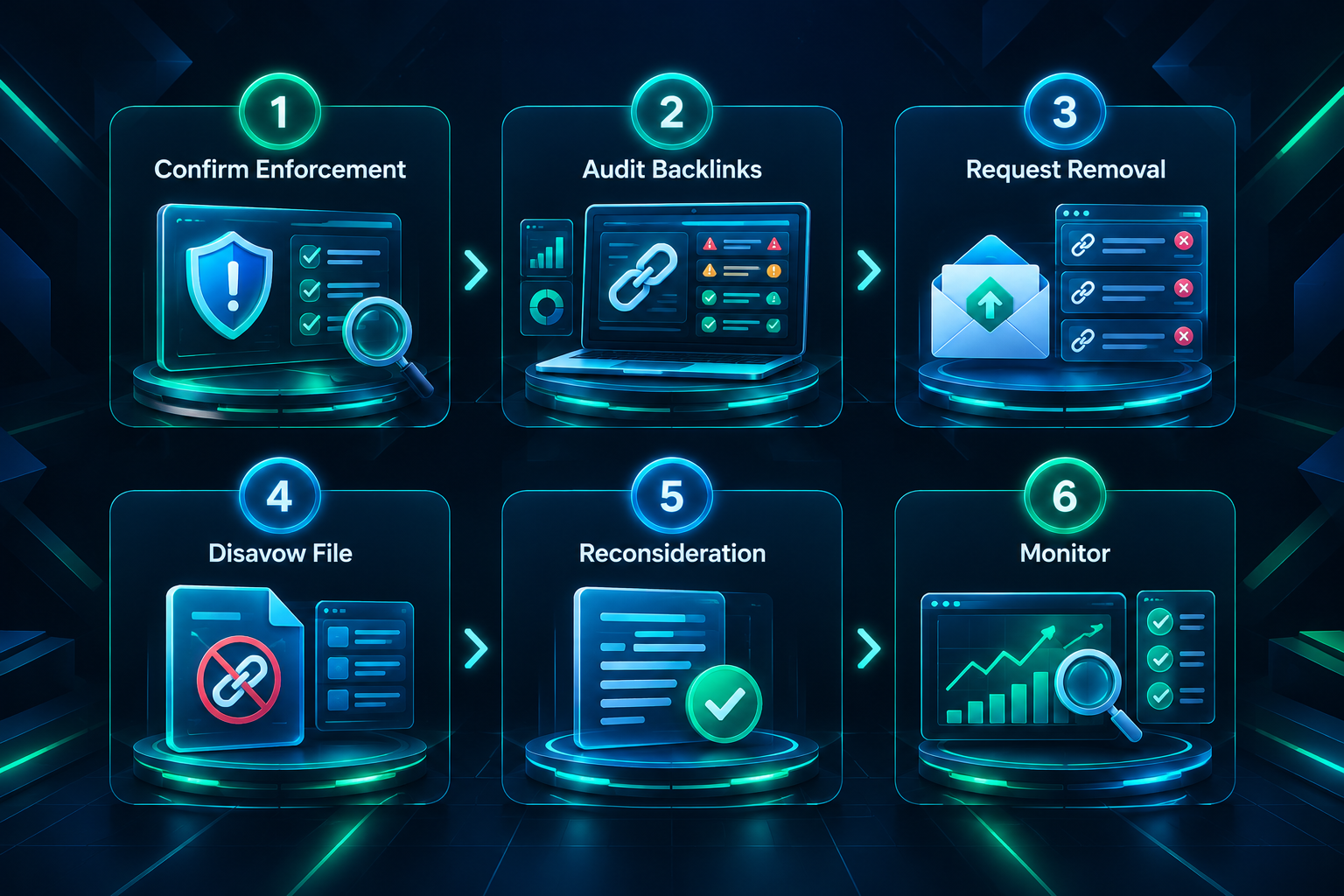
For sites dealing with a confirmed manual action, the recovery process generally follows this sequence, though the specific steps depend on the site’s situation:
- Confirm the enforcement type by checking Google Search Console for a manual action notification. If no manual action is present, assess whether the ranking decline correlates with a known algorithm update or another identifiable cause.
- Audit the backlink profile using tools such as Ahrefs, Semrush, or Majestic to identify the placements that may have contributed to the action. Assess each link’s characteristics, including the domain’s history, topical relevance, placement context, and anchor text.
- Attempt link removal for placements that can be addressed directly. Document all removal requests and responses.
- Prepare a disavow file for links that cannot be removed. The disavow file should be specific and well-documented, covering the domains or URLs that are most likely to have contributed to the action.
- Submit a reconsideration request through Search Console, including a clear explanation of the steps taken and evidence of the work completed. Avoid submitting a request before the remediation work is complete.
- Monitor Search Console and ranking data after submission. Google’s review process can take several weeks. If the request is approved, continue monitoring for ranking improvement. If denied, review the feedback and address any remaining issues before resubmitting.
Monitoring During and After Recovery
Ongoing monitoring is an important part of the recovery process and the period that follows. Google Search Console provides the most direct signal of manual action status and any changes to it. Ranking tracking tools can help identify whether specific pages are recovering, holding steady, or continuing to decline after the enforcement action is addressed.
Backlink monitoring tools such as Ahrefs or Semrush can alert site owners to new links being added to the profile, which is relevant if the site continues to receive PBN placements during the recovery period. Adding new links that resemble the ones that contributed to the original action while a reconsideration request is under review is likely to complicate the process.
It is also worth monitoring the broader competitive landscape during recovery. Understanding how competing pages are performing during the same period helps distinguish a genuine ranking recovery from a temporary fluctuation, and helps set realistic expectations for where the site may settle after the enforcement issue is resolved.
What Is Not Publicly Known About PBN Enforcement
Several aspects of Google’s enforcement approach for link-related issues are not publicly documented, and it is important to distinguish what is known from what is inferred or speculated.
Google has not published a specific threshold — in terms of number of links, percentage of the backlink profile, anchor text distribution, or network footprint characteristics — that triggers a manual action versus an algorithmic devaluation versus no action at all. The absence of a published threshold means that it is not possible to state with certainty that a specific number of PBN links will or will not result in a particular type of enforcement.
Google has also not published the specific signals used to identify PBN links algorithmically, the weighting applied to those signals, or the conditions under which a page-level action escalates to a sitewide action. Industry observations and practitioner reports provide useful context, but they are not equivalent to documented enforcement rules.
What Google has documented is that its spam policies address links intended to manipulate PageRank, and that manual actions can be issued for unnatural inbound or outbound links. The practical implications of those policies for any specific site depend on the site’s individual backlink profile, the characteristics of the specific placements involved, and the broader context of the site’s SEO history — none of which can be assessed without site-specific data.
Frequently Asked Questions
How long does it take Google to review a reconsideration request?
Google has stated that reconsideration requests are reviewed by a human reviewer and that the process can take several weeks. The exact duration is not guaranteed and can vary. Site owners are notified through Search Console when a decision has been made.
Can a site recover from a PBN-related manual action without removing every PBN link?
Google’s reconsideration process requires demonstrating that the site owner has made a genuine effort to address the unnatural links identified in the action. This typically involves a combination of removal requests and a disavow file for links that cannot be removed. Whether every individual PBN link must be addressed depends on the specific manual action and the reviewer’s assessment of the remediation work. A thorough and well-documented response is more likely to succeed than a partial one.
Does disavowing PBN links guarantee ranking recovery?
No. Disavowal is a signal to Google to discount specific links when assessing the site, but it does not guarantee that rankings will recover. Recovery depends on the overall backlink profile, the site’s content and technical quality, the competitive landscape, and whether the enforcement action is lifted. Disavowal is one step in the process, not a guaranteed outcome.
Is it possible to have a ranking decline from PBN links without a manual action?
Yes. Google’s systems may algorithmically assess certain links as unlikely to contribute ranking value without issuing a formal manual action. In this case, no notification appears in Search Console, and there is no reconsideration process. Distinguishing an algorithmic link devaluation from other causes of ranking decline requires careful analysis of timing, affected pages, and backlink profile changes.
How can I tell whether my ranking decline is related to PBN links or another cause?
Identifying the cause of a ranking decline requires correlating the timing of the decline with known algorithm updates, changes to the backlink profile, technical SEO changes, content changes, and competitor activity. A decline that coincides with a known link-quality update and affects pages with a high concentration of PBN placements may suggest a link-related cause, but this is an inference rather than a confirmed diagnosis. A thorough site audit is necessary before drawing conclusions.
Does the age or quality of the PBN domain affect recovery timelines?
The characteristics of the PBN placements involved — including domain history, topical relevance, placement context, and anchor text — may influence how Google assesses those links and how the enforcement action is framed. However, Google has not published specific rules about how domain age or third-party authority metrics affect enforcement decisions or recovery timelines. These factors are relevant to the overall assessment but do not determine the outcome on their own.
Assessing Your Recovery Situation Realistically
PBN penalty recovery timelines range from several weeks to many months, and the variation is driven by the type of enforcement, the scope of the action, the quality of the response, and factors outside the site owner’s direct control such as Google’s crawl schedule and reassessment cycles. A confirmed manual action with a well-prepared reconsideration response may resolve more quickly than an algorithmic adjustment with no formal process to accelerate it.
The most useful starting point is an accurate diagnosis: confirming whether a manual action is present, identifying which pages and links are involved, and assessing the backlink profile with the specificity needed to prepare a credible response. Assumptions about cause and timeline without site-specific data are unlikely to produce a reliable recovery plan.
If you are assessing a PBN-related enforcement situation or evaluating how your current link-building approach may affect your site’s risk profile, reviewing your backlink profile and placement quality with an experienced provider is a practical first step. PBN Backlinks Service can help you evaluate your current setup and discuss what a well-structured approach looks like for your specific goals and site history.