

Building a private blog network in 2026 is not a shortcut — it is an infrastructure decision. Done correctly, a PBN delivers controlled link equity to a money site with precision that no outreach campaign can match. Done poorly, it exposes your entire SEO investment to algorithmic or manual penalties.
This guide reflects operational experience managing PBN infrastructure across competitive verticals. Every section addresses a specific decision point that separates sustainable networks from networks that collapse within six months.
What Is a Private Blog Network (PBN) and How Does It Work
A private blog network is a controlled group of websites used to pass link equity to a target domain — commonly called the money site. Each PBN site operates as an independent asset designed to simulate the characteristics of an organic, editorially maintained website. The network owner controls every aspect of link placement, anchor text, and publishing cadence.
Search engines evaluate backlinks as trust signals. When a PBN site publishes content containing a contextual link pointing to the money site, the intent is to transfer domain authority and ranking power. The challenge is replicating the behavioral and structural patterns of naturally occurring backlinks convincingly enough to avoid algorithmic flagging.
PBN building is not simply registering domains and inserting links. A functional private blog network requires aged or expired domain assets with verified backlink profiles, diversified hosting infrastructure, unique content, and carefully managed outbound link ratios. Each component influences how search engines interpret the network’s relationship to the target site.

Mon-Fri: 09:00 AM – 06:00 PM
Do PBNs Still Work in 2026: Data-Driven Reality
PBN links continue to move rankings in 2026, particularly in competitive niches where organic link acquisition is slow and link authority is the primary ranking differentiator. According to Ahrefs’ study on ranking factors, referring domain count and domain authority remain among the strongest predictors of first-page positioning in competitive SERPs.
Effectiveness, however, is not universal. A PBN built on expired domains with Domain Rating between 30 and 60, clean backlink histories, and niche-relevant content can produce measurable ranking lifts within 60 to 90 days. The same network concept executed on low-DR domains with thin content and shared hosting produces minimal gain and significant risk.
Modern search algorithms prioritize editorial context, topical relevance, and link placement authenticity. A PBN link buried in AI-spun content on an off-topic site contributes almost nothing. A contextual backlink placed within well-structured, niche-specific content on an aged domain with genuine organic signals is a different proposition entirely. The gap between these two execution standards explains why PBN results vary so dramatically across the industry.
Risks, Penalties, and Detection Mechanisms
Using a private blog network to manipulate search rankings violates Google’s Webmaster Guidelines, and detection results in deindexing of PBN sites, manual penalties on the money site, or algorithmic devaluation of the links. Google’s spam team actively investigates unnatural linking patterns, and link schemes are explicitly listed as a violation under the Google Search Essentials documentation.
Risk factors that increase detection probability include:
- Shared hosting environments where multiple PBN sites share identical IP addresses or server configurations
- Repeated ownership signals such as identical WHOIS data, shared analytics codes, or common CMS installations
- Identical site structures, including matching WordPress themes, identical plugin sets, or uniform permalink configurations
- Artificial linking patterns where every PBN site links to the same money site with high-frequency exact-match anchors
The penalty threshold depends on footprint density. A network with five well-differentiated sites carries significantly less detection risk than a network of fifty sites hosted on three IP ranges with identical WordPress installations. Understanding where detection risk concentrates is fundamental to building a successful PBN.
Why Most PBN Networks Fail
Technical Footprints
Common hosting environments, CMS configurations, or analytics implementations create detectable patterns that search engines use to cluster related sites. When multiple PBN sites share a hosting provider’s IP block, use the same WordPress theme, or contain the same Google Analytics property ID, the network relationship becomes visible through standard crawl analysis. These technical footprints are the most common failure point in PBN building because they are easy to create accidentally and difficult to correct retroactively.
Low-Quality Domains
Expired domains with spam anchor text histories, link spikes from link farms, or previous manual actions significantly reduce the authority transfer capacity of a PBN site. Domain quality is the single largest determinant of link value. Many PBN owners attempt to buy domains at volume to reduce cost, which consistently produces networks dominated by weak or penalized assets. A private blog network built on ten high-quality aged domains with DR 40+ and clean backlink profiles outperforms a network of fifty low-DR domains in nearly every tested scenario.
Content Signals
Thin content, AI-generated text without editorial refinement, or duplicated articles across PBN sites reduce the perceived quality of PBN pages and suppress the link equity those pages can transfer. Google’s Helpful Content system and core algorithm updates since 2022 have increasingly targeted low-value content at the page level. A PBN site that fails to meet minimum content quality thresholds may be treated as a low-authority source regardless of the domain’s historical backlink profile.
What Google Actually Detects in PBN Structures

Hosting and IP Patterns
Clusters of PBN sites hosted on identical IP ranges are a primary detection signal that Google’s crawl infrastructure identifies through standard technical analysis. When a search engine crawls a domain and identifies that the same IP address or IP block hosts dozens of other sites, all of which link to a common money site, the network relationship is exposed. Distributing PBN sites across genuinely different hosting providers — not just different accounts on the same provider — is the baseline requirement for footprint protection.
Link Graph Anomalies
Unnatural outbound link patterns, such as every PBN site linking exclusively or disproportionately to a single money site, create algorithmic anomalies in the link graph that trigger review. Natural websites link to a variety of external domains based on editorial relevance. A PBN site that links to only one domain, or maintains a 10:1 ratio of outbound links pointing to a single target, does not resemble the linking behavior of legitimate editorial content.
Ownership and Metadata Signals
WHOIS registration data, CMS fingerprints embedded in page source code, and shared tracking infrastructure reveal ownership connections between PBN sites. Using the same registrar for all PBN domains, maintaining consistent name server configurations, or embedding identical Google Tag Manager containers across the network introduces ownership signals that are detectable through automated tools and manual review.
Step-by-Step PBN Setup Process
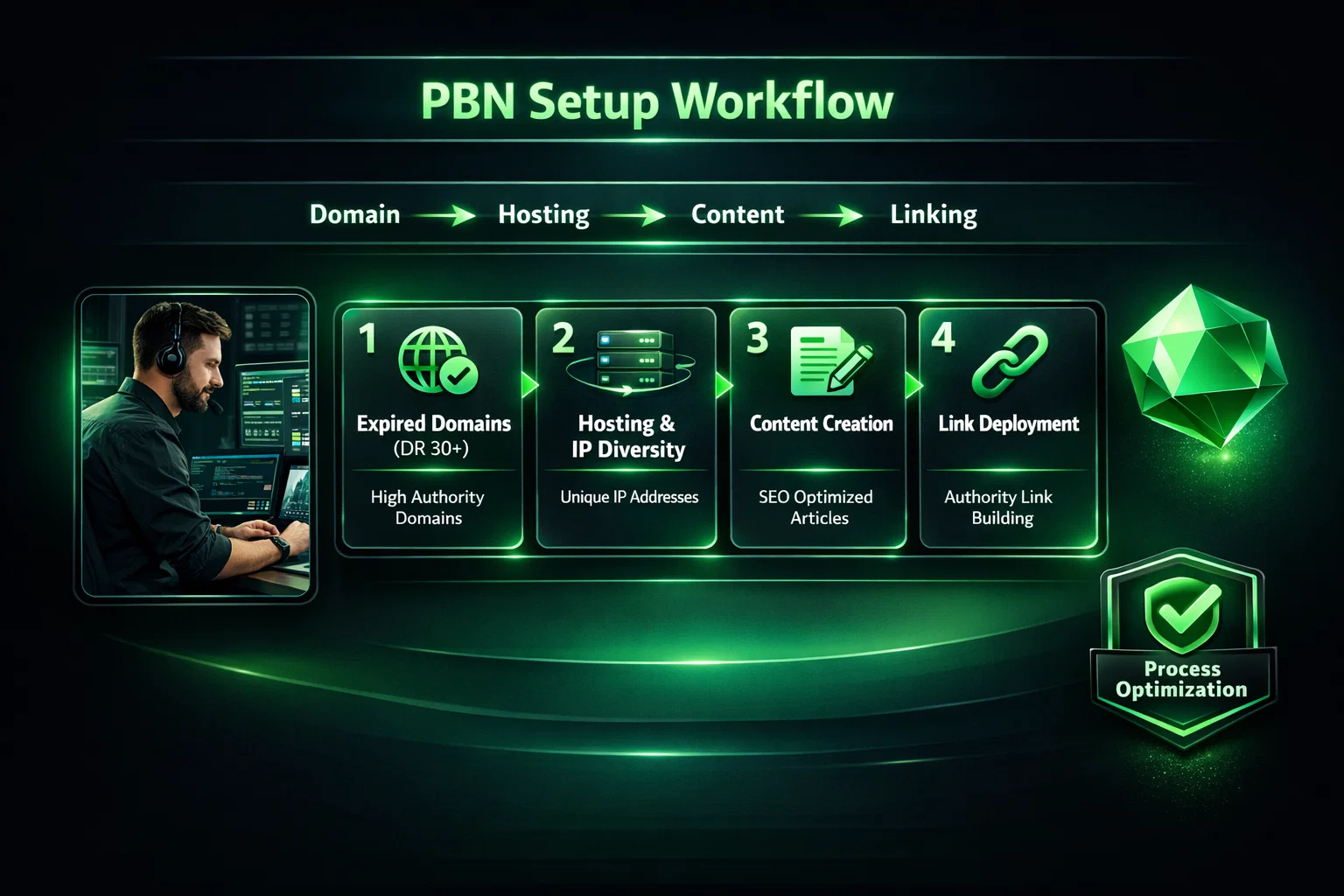
Step 1: Define Network Strategy and Scale
Before acquiring a single domain, define whether the private blog network will support a single money site or a portfolio of client sites, because this decision determines the acceptable risk concentration and infrastructure requirements. A PBN built for one project can be tightly themed and optimized for maximum link relevance. A network supporting multiple client sites requires stricter segmentation, separate hosting environments per client project, and isolated link flows to prevent cross-contamination of risk. Clarifying scale before investment prevents costly infrastructure redesigns after the fact.
Step 2: Acquire Expired or Aged Domains
Domain acquisition is the highest-leverage decision in the PBN setup process, and the evaluation criteria must be applied without compromise. Target expired domains that meet the following standards:
- Clean backlink history: No spam anchors in the anchor text profile, no links from known link farms, and no reference to previous manual actions
- Relevant niche authority: Referring domains from topically relevant sources that establish the domain’s subject matter context
- Existing organic signals: Historical organic search traffic, indexed pages, and cached content in the Wayback Machine, confirming the domain was genuinely active
- Minimum Domain Rating: DR 30 is a functional baseline; DR 45 to 70 represents the optimal range for high-competition PBN link building
Tools such as Ahrefs, Majestic, and SEMrush provide backlink profile data. Cross-reference each domain across at least two tools before purchase to identify discrepancies or hidden link manipulation.
Step 3: Configure Hosting and Infrastructure
Distributing PBN sites across different hosting providers with unique IP addresses is non-negotiable for maintaining a network that does not expose obvious footprints. The infrastructure setup should include:
- Different hosting providers for different PBN sites — not different plans under a single provider’s account
- Unique IP addresses, ideally from different IP class C ranges, for each PBN site
- Diverse DNS configurations using different registrars and nameserver providers
- Separate billing and account information to prevent account clustering at the hosting provider level
Bulk buy hosting from a single provider reduces cost but eliminates the IP diversity that makes a PBN structurally defensible.
Step 4: Build Sites with Unique Structures
Every PBN site must appear to be an independently built, standalone website with its own branding, visual identity, and information architecture. Using the same WordPress theme across the network creates an immediately detectable pattern. Each site should use a different theme, different plugin selection, different color scheme, and different navigation structures. The goal is that a human reviewer inspecting two sites from the same network cannot identify a shared owner based on visual or structural similarity.
Step 5: Publish Content Before Linking
PBN sites that publish their first link to a money site on the same day the site goes live create a signal pattern that closely resembles known link scheme behavior. Establishing the site with five to ten content articles published over a two to four-week period before inserting any outbound links significantly reduces this risk. Publishing a reasonable volume of content first creates a historical signal that the site operated as an editorial resource before any commercial linking activity occurred.
How to Choose the Right Expired Domain
Key Metrics to Evaluate
Domain selection criteria must be measurable and applied consistently across every acquisition in the network. The core evaluation metrics for PBN domains include:
- Referring domain quality: Evaluate the DR distribution of referring domains. A site with 200 referring domains where 80% are DR 10 or below provides less authority than a site with 50 referring domains averaging DR 40+
- Anchor text profile: The anchor text distribution should reflect natural editorial linking — branded anchors, generic phrases, and partial-match terms — not a profile dominated by commercial keyword anchors
- Historical niche relevance: Confirm through Wayback Machine and referring domain subject analysis that the domain operated in a niche related to the money site’s target vertical
Red Flags to Avoid
Certain domain characteristics disqualify a domain from PBN use regardless of its Domain Rating. Reject any domain showing:
- Spam anchor dominance: Casino, pharmaceutical, payday loan, or adult content anchors indicating the domain was previously used in link schemes
- Sudden link spikes: Artificial increases in referring domain count over a short period suggest purchased links or link scheme activity in the domain’s history
- Previous manual actions: Domains that received Google manual penalties retain that history even after expiration
Hosting, IP Diversity, and Footprint Management
Why IP Diversity Matters
Separate IP ranges reduce network detectability because search engine crawlers log server IP data during each crawl cycle, and clustering multiple PBN sites on the same IP or IP block creates a directly observable pattern. When a search engine detects that fifteen domains share the same IP address and all link to the same money site, the network relationship is established through technical data alone, independent of content quality or site structure.
Infrastructure Best Practices
A defensible PBN hosting infrastructure follows these operational standards:
- Mix hosting types: Combine shared hosting, VPS accounts, and cloud hosting instances across different providers to create a varied technical footprint
- Use different domain registrars: Register PBN domains across multiple registrars rather than consolidating registration under one account, which creates an ownership cluster
- Avoid centralized control panels: Managing all PBN sites through a single hosting control panel or reseller account introduces a shared infrastructure signal that experienced reviewers identify quickly
Content Strategy for PBN Sites
Content Quality Requirements
PBN site content must meet the editorial standards that would qualify it as a legitimate standalone resource, because low-quality pages reduce the link equity transfer capacity of the site regardless of domain authority. According to Google’s Search Quality Evaluator Guidelines, pages are evaluated on Expertise, Authoritativeness, and Trustworthiness (E-E-A-T). A PBN site with genuinely useful, well-structured content on a consistent topic passes quality thresholds that algorithmically suppress thin or AI-generated pages.
Topical Relevance and Structure
Each PBN site should maintain a consistent niche theme across all published content, because topical coherence builds semantic authority that strengthens the relevance signal of any outbound link. A site that covers financial planning exclusively passes more relevant link equity to a money site in the finance vertical than a generalist blog that covers unrelated topics. Topical clustering within PBN sites — publishing interconnected content around a core subject area — improves the site’s perceived editorial focus and the contextual relevance of placed links.
Link Placement and Anchor Strategy
Anchor Text Distribution
Anchor text selection directly influences both the ranking signal strength and the detection risk of a PBN link, making anchor text strategy one of the highest-impact decisions in the network management process. Maintain natural ratios across the link profile of the money site:
- Branded anchors (30–40%): The target brand name or website name used as the linking text
- Generic anchors (20–30%): Non-descriptive phrases such as “click here,” “learn more,” or “this resource”
- Partial-match anchors (20–25%): Phrases that include one or two target keywords without being exact-match
- Exact-match anchors (5–10%): Full target keyword phrases, used sparingly to avoid over-optimization signals
Linking Frequency and Patterns
Gradual link deployment from a PBN network simulates the organic growth pattern of a site earning links naturally over time, while compressed link velocity creates statistical anomalies that algorithmic review identifies. Adding five PBN links per month to a money site produces a more defensible link velocity profile than deploying fifty links in a single week. Establishing a conservative baseline link rate and increasing it gradually as the money site builds organic signals is standard operational practice for sustainable PBN link building.
Single PBN vs Multiple Networks
A single private blog network simplifies management and reduces operational cost, but concentrates systemic risk — if the network is identified, the entire link profile supporting the money site is compromised simultaneously. Multiple smaller networks, each serving a distinct segment of the money site’s link profile, reduce the impact of any single network detection event. If one sub-network of ten sites is deindexed, the remaining networks continue to provide ranking support while the compromised network is rebuilt or replaced.
Strategic segmentation across multiple networks also allows thematic differentiation, where different networks focus on different topical areas relevant to the money site’s keyword targets. This approach improves link relevance while distributing risk. The trade-off is management complexity and higher total infrastructure cost, which makes multiple-network structures most appropriate for high-competition, long-term campaigns where ranking protection justifies the investment.
How to Make PBN Sites Look Like Real Websites
Design and UX Signals
PBN sites that visually resemble abandoned placeholder pages fail the human review standard that Google’s quality rater process applies to suspicious linking sites. Making PBN sites appear as genuine standalone resources requires:
- Unique themes: Custom or heavily modified WordPress themes that do not repeat across the network
- Real navigation structures: About pages, contact pages, privacy policies, and category structures consistent with a real editorial site
- Functional internal linking: Articles that link to other articles on the same site, creating a real content ecosystem rather than isolated landing pages
Behavioral Signals
Adding measurable behavioral signals — such as real traffic, user engagement metrics, and regular content updates — strengthens the perceived legitimacy of PBN sites against both algorithmic and manual review. PBN sites that receive zero organic traffic and have not published new content in six months are structurally distinguishable from active editorial sites. Driving modest referral or social traffic to PBN sites, and maintaining a consistent publishing schedule, creates a behavioral profile that resembles real website activity.
Cost Structure of Building and Maintaining a PBN
Core Cost Components
The investment required to build a private blog network that produces measurable ranking results is substantially higher than most estimates suggest, because domain quality is non-negotiable and high-quality aged domains command significant acquisition cost. Core budget allocations per PBN site include:
| Component | Cost Range | Notes |
| Expired Domain | $50–$500+ | DR 30–60 with clean history |
| Hosting (monthly) | $5–$50 | Varies by hosting type |
| Content per article | $20–$200 | Editorial quality required |
| Theme and setup | $30–$150 | Unique per site |
| Domain registration | $10–$15/year | Per domain, per registrar |
A ten-site network at minimum viable quality standards requires an upfront investment of $1,500 to $5,000 for domain acquisition alone, plus $500 to $2,000 in setup and initial content costs.
Hidden Costs
PBN networks accumulate ongoing costs that are frequently underestimated during initial budget planning. These include:
- Maintenance: Software updates, security patches, and hosting account management across multiple providers
- Security: WordPress security plugins, SSL certificates, and bot traffic filtering to prevent the site from being identified as low-traffic or bot-dominated
- Domain renewals: Annual renewal fees across multiple registrars, which increase proportionally as the network grows
Common Mistakes in PBN Setup
Overlapping Infrastructure
Using identical hosting providers, CMS themes, or WordPress plugin sets across multiple PBN sites creates a directly observable infrastructure footprint that is detectable through automated crawl analysis. The most common version of this mistake is purchasing bulk reseller hosting and assigning each PBN site a subdirectory or account within the same reseller plan. Every site in this configuration shares the same IP address and hosting environment, making the network structure trivially identifiable.
Over-Optimization of Links
Deploying exact-match anchor text across the majority of PBN links to a money site creates an anchor text distribution that does not resemble natural editorial linking behavior and triggers algorithmic over-optimization signals. A money site that receives thirty PBN links all using the same target keyword phrase as anchor text shows an anchor profile that is statistically improbable for a legitimately linked resource. Anchor text diversification is not optional — it is a core risk management requirement.
Scaling Too Fast
Rapid PBN network expansion increases detection probability because deploying many new sites within a compressed timeframe creates a cluster of new domains with similar registration dates, similar technical configurations, and outbound links pointing to the same money site. Building a network incrementally — adding five to ten sites per quarter rather than launching fifty sites simultaneously — produces a staggered infrastructure profile that does not concentrate detection risk in a single point in time.
PBN vs Outreach and Guest Posting
Control vs Safety
Private blog networks provide full editorial control over link placement, anchor text selection, and publishing timing, while outreach and guest posting produce links that comply with search engine guidelines and carry no penalty risk. The control advantage of a PBN is significant: the operator decides exactly which page links to which target URL, using which anchor text, within which content context. Outreach links depend on the editorial decisions of external site owners who may modify anchor text, move content, or remove links without notice.
Cost vs Long-Term ROI
PBN link building requires substantial upfront capital for domain acquisition and infrastructure setup, with ongoing monthly costs for hosting and content, while outreach link building scales more sustainably as agency relationships and publisher networks develop over time. A PBN produces rapid ranking results but carries devaluation risk if the network is identified. Outreach-acquired links on legitimate editorial sites are durable, transferable between strategies, and do not create penalty exposure. The optimal strategy for most competitive campaigns combines both approaches: PBN links to accelerate authority in the short term, outreach links to build a durable, guideline-compliant backlink profile for long-term stability.
When to Use PBNs in 2026
Private blog network link building produces the strongest ROI in specific competitive scenarios where the speed of authority acquisition justifies the infrastructure investment and risk profile. Effective use cases include:
- Highly competitive niches: Verticals such as finance, legal services, insurance, and health where organic link acquisition is slow and competitors maintain high-DR backlink profiles
- Projects requiring rapid authority growth: New money sites entering established SERPs that need accelerated Domain Rating growth to compete within a defined timeframe
- Controlled SEO experiments: Testing the ranking impact of specific anchor text strategies or link velocity patterns in isolated projects before scaling to primary client campaigns
PBN link building is not appropriate for branded campaigns where penalty risk could damage a primary domain’s long-term organic performance. The decision to use PBNs should reflect the project’s risk tolerance, timeline, and competitive environment — not a default assumption that PBN links are universally superior to other link building methods.
Key Takeaways
PBN effectiveness in 2026 is determined entirely by execution quality — the concept of a private blog network is neither inherently powerful nor inherently flawed, but the implementation determines the outcome. Networks built on high-DR expired domains with clean backlink histories, distributed across genuinely diverse hosting infrastructure, populated with editorial-quality content, and managed with disciplined anchor text strategy continue to produce measurable ranking results in competitive SERPs.
Networks that fail do so for predictable, avoidable reasons: detectable infrastructure footprints, low-quality domain selection, thin content, aggressive link velocity, and over-optimized anchor text. Every failure mode in PBN building is a known variable that competent execution addresses before deployment. The agencies and operators who build successful PBNs treat the network as a long-term SEO asset — not a shortcut — and invest accordingly in domain quality, hosting diversity, content standards, and risk management.
Frequently Asked Questions About Building a Private Blog Network
The time to build a functional private blog network that produces measurable ranking results ranges from 60 to 120 days for a baseline setup of 10 PBN sites. That estimate covers domain acquisition, hosting configuration, initial content publication, and a conservative link deployment schedule. The first 30 days should focus entirely on infrastructure and content — adding outbound links before the sites have any publishing history creates an unnatural signal pattern that increases detection risk. Realistically, you should expect 8 to 12 weeks before your money site begins to reflect the authority transfer from a new network.
The success of your PBN depends far more on domain quality than raw site count — 10 PBN sites built on aged domains with Domain Rating between 35 and 60 consistently outperform networks of 30 to 50 low-quality sites. A common question across SEO communities is whether to start with fewer sites or scale fast. The answer is to start with 5 to 10 PBN sites that meet strict quality criteria, then expand once the infrastructure is validated. Spreading budget across too many weak domains dilutes link equity and multiplies management overhead without proportional ranking gains.
There is no fixed rule for how many PBN links to deploy, but a controlled approach of 3 to 5 links per month to a single money site represents a defensible baseline for most competitive niches. The decision on how many PBN links to use should factor in the money site’s current backlink velocity, the competitive landscape of the target keyword, and the Domain Rating of the PBN domains. Deploying 10 PBN links in a single week to a new money site creates an artificial velocity spike that is statistically anomalous compared to natural link acquisition patterns.
Content on your PBN sites must meet genuine editorial quality standards — 700 to 1,500 words per article, topically consistent with the site’s niche, and structured to provide real informational value to a reader. The question of what content to publish on PBN sites is one of the most underestimated decisions in PBN building. AI-generated content without editorial refinement, or thin articles under 300 words, reduces the link equity transfer capacity of that page. Each PBN site should publish 5 to 10 articles before any outbound links are added, establishing the site as an active editorial resource rather than a placeholder linking asset.
A dedicated PBN hosting provider simplifies infrastructure management and provides built-in IP diversity, but introduces a shared detection risk if that provider’s infrastructure is identified as a known PBN hosting environment. Services like Bulk Buy Hosting assign sites across different shared hosting accounts to create IP separation, which reduces the most basic footprint signals. Independent hosting setup — creating separate accounts across genuinely different providers such as SiteGround, A2 Hosting, and regional cloud providers — provides stronger footprint protection but requires significantly more management effort per site. For networks below 20 sites, independent hosting is manageable; above that threshold, a reputable PBN hosting provider reduces operational overhead while maintaining acceptable IP diversity.