

Reporting a private blog network to Google is a straightforward process on the surface, but the outcomes are far less predictable than most guides suggest. Google provides a public spam report form and a structured manual action review process, yet neither guarantees that a specific network will be deindexed, that a competitor’s rankings will drop, or that your own site will benefit from the report. Understanding what the process actually involves, what Google does with spam reports, and what limitations exist helps you make a realistic assessment before investing time in a complaint.
Key Takeaways
- Google accepts public spam reports through its Search Console spam report form, but does not confirm individual outcomes or notify reporters of enforcement decisions.
- A spam report triggers a review by Google’s webspam team, not an automatic penalty against the reported site or network.
- Google distinguishes between manual actions, algorithmic link devaluation, and deindexation — these are separate outcomes with different scopes and effects.
- Reporting a PBN used by a competitor does not guarantee that competitor’s rankings will fall, and the timeline for any enforcement action is not publicly disclosed.
- The practical value of a spam report depends heavily on the quality of evidence provided and the nature of the network being reported.
What Google’s Spam Reporting System Is Designed to Do
Google’s spam reporting system is a public feedback channel, not an enforcement trigger. When a user submits a spam report, the information is routed to Google’s webspam team for review. Google has stated publicly that it uses these reports to improve its spam detection systems and to investigate specific cases where algorithmic detection may have missed a pattern. The report itself does not automatically result in a manual action, a ranking change, or deindexation of any site or network.
Google’s spam policies cover link schemes, including networks of sites created primarily to pass PageRank to other pages. A private blog network that exists solely to manufacture backlinks pointing to a target site would fall within the scope of what Google describes as a link scheme under its spam policies. However, Google does not publish a precise definition of what constitutes a PBN for enforcement purposes, and the webspam team applies judgment based on the specific evidence available during a review.
It is important to separate Google’s stated policies from enforcement behavior. Google’s documentation describes what it considers spam; it does not publish detection thresholds, review timelines, or enforcement rates for spam reports. The gap between policy and observed enforcement is real, and any claim about how quickly or reliably Google acts on a specific type of report should be treated as an industry estimate rather than a documented fact.
How to Submit a Spam Report to Google
Google provides a spam report form accessible through its Search Central documentation. The form allows anyone to report a site or network that appears to violate Google’s spam policies. To submit a report about a suspected PBN, you would typically navigate to the Google Search spam report page and complete the available fields, which generally ask for the URL or URLs involved, the type of spam being reported, and any supporting details.
When reporting a suspected link network, the most useful information to include is specific evidence rather than a general accusation. Useful details may include:
- The URLs of sites you believe form part of the network.
- The target site or sites receiving links from the network.
- Observable patterns such as identical site structures, shared ownership signals, or unusually similar content across multiple domains.
- Anchor text patterns that appear coordinated across multiple linking domains.
- Backlink data from tools such as Ahrefs, Semrush, or Majestic that shows the linking pattern.
Google does not require you to have a Google account to submit a spam report, though being logged in may allow you to provide more structured information in some versions of the form. After submission, Google does not send a confirmation of action. The webspam team reviews reports internally, and the outcome of that review is not communicated to the person who submitted the report.
What Google Does After Receiving a Spam Report
After a spam report is submitted, Google’s webspam team may review the reported URLs and the evidence provided. The review process is not public, and Google has not published a standard timeline for how quickly reports are assessed. In practice, the outcome of a spam report can range from no visible action to a manual action issued against one or more sites in the reported network.
A manual action is a specific enforcement measure applied by a human reviewer at Google. Manual actions related to link schemes can be page-level or sitewide, and they affect how Google treats the links from or to the affected site. A manual action against a PBN site would typically affect the value of links that site passes, rather than automatically removing the target site from search results. The distinction matters: a manual action against a linking domain is not the same as a penalty against the site receiving those links.
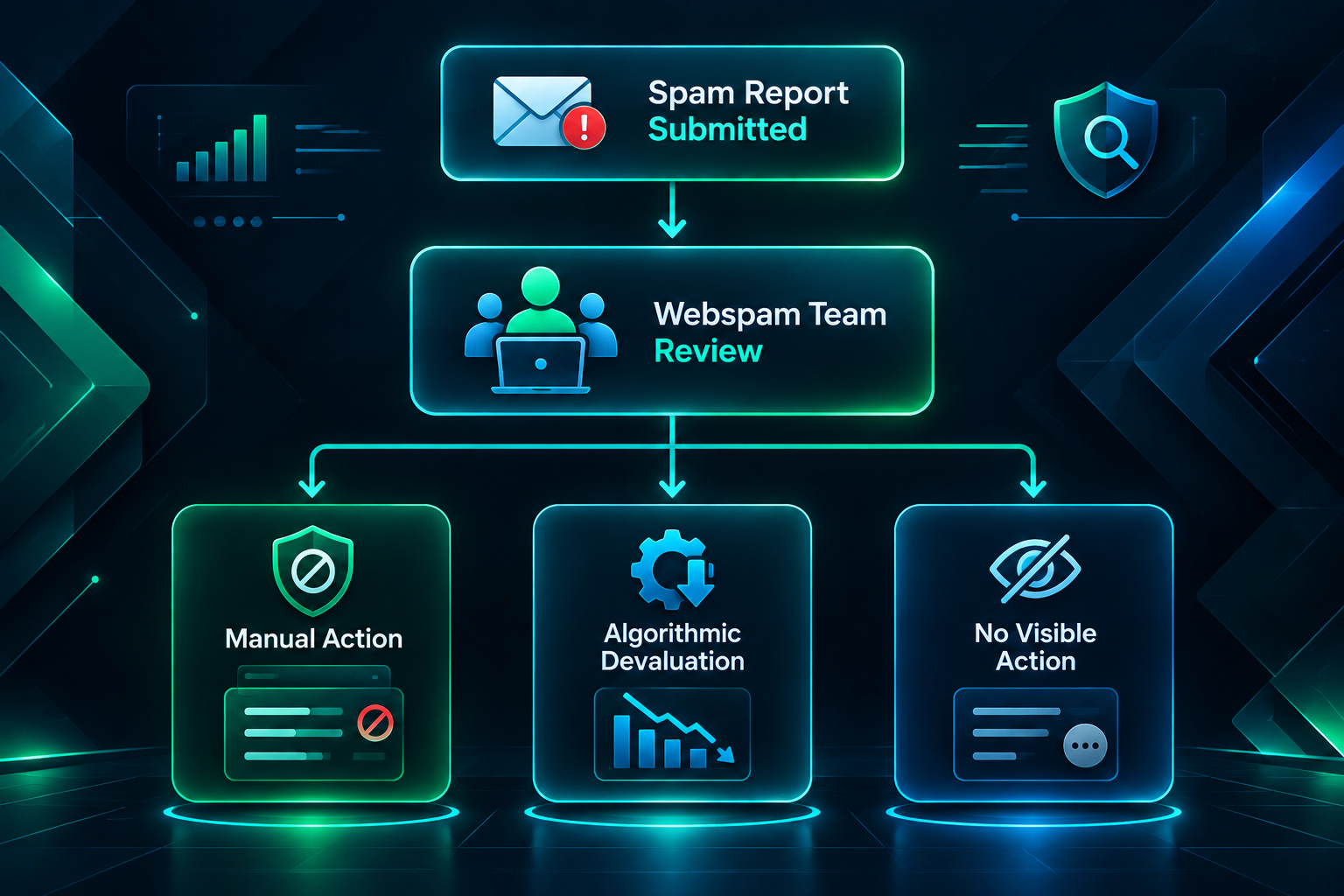
Google’s systems may also respond algorithmically, meaning that links from a detected network may be devalued without a formal manual action being issued. Algorithmic devaluation and manual actions are separate mechanisms. A link that Google algorithmically ignores does not produce a manual action notification in Search Console, and a site can lose ranking value from a network without any formal enforcement record appearing in its Search Console account.
Deindexation — the removal of a site from Google’s index entirely — is a more severe outcome and is not a guaranteed result of a spam report. Google may deindex sites that are found to exist solely for link manipulation, but this is not the standard outcome for every reported network, and the threshold for deindexation is not publicly documented.
What Outcomes Are Realistic to Expect
The realistic outcomes of reporting a PBN to Google depend on several factors, including the quality of evidence provided, the scale and visibility of the network, and whether the network’s patterns are detectable by Google’s existing systems. Understanding these factors helps set appropriate expectations.
If the network being reported is already detectable by Google’s algorithms, a spam report may have limited additional effect because the links may already be discounted. Google’s link spam detection systems are designed to identify coordinated link patterns, and a network with obvious footprints — such as shared hosting infrastructure, identical CMS configurations, or thin templated content — may already be receiving reduced weight in Google’s link graph. In this scenario, a spam report may prompt a manual review but may not change the practical ranking impact of those links.
If the network is more sophisticated and has not been algorithmically detected, a detailed spam report with specific evidence may prompt a manual review that leads to enforcement. However, even in this case, the enforcement action would be against the network’s sites, not necessarily against the target site receiving the links. A competitor whose rankings are supported by a PBN may see a ranking change if the network is actioned, but this is not guaranteed, and the timeline is unknown.
Reporting a PBN as a competitive tactic — with the goal of reducing a competitor’s rankings — is a recognized practice in some SEO circles, but its effectiveness is inconsistent. Google’s webspam team is aware that spam reports can be submitted for competitive reasons, and the team applies judgment rather than acting automatically on every report received.
The Difference Between Reporting a PBN and Disavowing PBN Links
Reporting a PBN to Google and disavowing links from a PBN are two distinct actions with different purposes and different effects on your own site. Reporting is an outward action directed at a network you believe is violating Google’s spam policies, typically a network used by a competitor. Disavowal is an inward action you take to tell Google to ignore specific links pointing to your own site.

If your own site has received links from a PBN — whether intentionally or through negative SEO — and you are concerned about those links, the relevant tool is the Google Search Console disavow tool, not the spam report form. The disavow tool allows you to submit a file listing domains or specific URLs whose links you want Google to ignore when assessing your site. Google has stated that the disavow tool is intended for situations where a site has received a manual action for unnatural links or where the site owner has reason to believe that low-quality links are harming rankings.
Google has also noted that its systems are generally capable of ignoring links it identifies as manipulative, and that disavowal is not necessary in most cases where links are already being algorithmically discounted. The decision to disavow should be based on a careful review of the backlink profile and, where relevant, any manual action notifications in Search Console — not on the presence of PBN links alone.
Negative SEO, PBNs, and Spam Reports
One context in which spam reports about PBNs arise is negative SEO, where a third party builds low-quality or manipulative links to a competitor’s site with the intention of triggering a penalty. If you believe a competitor or third party has pointed PBN links at your site without your knowledge, the appropriate response involves reviewing your backlink profile using tools such as Ahrefs, Semrush, or Majestic, identifying the suspicious links, and assessing whether a disavowal submission is warranted based on any manual action in Search Console.
Submitting a spam report in a negative SEO scenario — reporting the PBN that was used against your site — may alert Google to the network, but it does not substitute for managing your own backlink profile. Google’s guidance on negative SEO suggests that its systems are designed to ignore links that appear to be part of a manipulation attempt against a site, but the effectiveness of this protection is not guaranteed in every case, and monitoring your backlink profile remains a practical step.
It is worth noting that Google does not publicly confirm whether a specific negative SEO attack has been detected or neutralized. If you have received a manual action notification in Search Console citing unnatural links, the reconsideration request process — which involves documenting your link cleanup and disavowal efforts — is the formal channel for addressing that specific enforcement outcome.
Limitations of the Spam Reporting Process
Several practical limitations affect the usefulness of reporting a PBN to Google, and understanding them helps calibrate expectations before investing time in the process.
No confirmation of outcome. Google does not notify reporters of the result of a spam review. You will not receive an email, a Search Console notification, or any other confirmation that a report was reviewed or acted upon. The only observable signal would be a change in the reported site’s indexing status or a competitor’s ranking movement, neither of which can be reliably attributed to a specific spam report.
No guaranteed timeline. Google does not publish a service level agreement for spam report reviews. Some reports may be reviewed quickly; others may take weeks or may not result in visible action. The webspam team prioritizes reports based on internal criteria that are not disclosed publicly.
Algorithmic detection may already apply. If the network being reported has obvious footprints, Google’s algorithms may already be discounting its links. In this case, a spam report may not change the practical effect of those links on rankings.
Evidence quality matters. A report that provides specific URLs, observable patterns, and supporting data from backlink analysis tools is more useful than a general complaint. Vague reports with no supporting evidence are less likely to prompt a detailed manual review.
Enforcement scope is not predictable. Even if Google takes action following a spam report, the scope of that action — whether it affects individual pages, specific domains, or a broader network — is determined by Google’s review and is not controlled by the reporter.
Frequently Asked Questions
Does reporting a PBN to Google guarantee that a competitor’s rankings will drop?
No. A spam report triggers a review, not an automatic enforcement action. Even if Google takes action against a reported network, the effect on a competitor’s rankings depends on how much of their ranking was supported by those links, whether Google’s action affects the links’ value or the sites’ indexing, and how quickly any enforcement takes effect. There is no guaranteed outcome from submitting a spam report.
Can I report a PBN anonymously?
Google’s spam report form does not require you to be logged into a Google account, and Google does not publicly disclose the identity of spam reporters. However, if the evidence you provide includes data that could identify you — such as access to private backlink data or internal information about a competitor — that information would be visible to Google’s review team.
How long does Google take to review a spam report?
Google does not publish a timeline for spam report reviews. The webspam team reviews reports based on internal prioritization criteria. Some reports may be reviewed within days; others may take considerably longer or may not result in visible action. There is no public service level agreement for this process.
What is the difference between a manual action and algorithmic devaluation?
A manual action is applied by a human reviewer at Google and appears as a notification in Google Search Console for the affected site owner. Algorithmic devaluation means Google’s systems have identified and discounted specific links without issuing a formal manual action. The two outcomes have different scopes and different visibility. A site can have its PBN links algorithmically discounted without any manual action appearing in Search Console.
Should I use the disavow tool if I find PBN links pointing to my site?
Not necessarily. Google has stated that its systems are generally capable of ignoring links it identifies as manipulative. The disavow tool is most relevant when a site has received a manual action for unnatural links or when there is specific reason to believe that identified links are causing ranking harm. A backlink profile review and, where applicable, a review of any Search Console manual action notifications should inform the decision rather than the presence of PBN links alone.
Can a competitor report my site’s backlinks to Google?
Yes. Anyone can submit a spam report to Google. However, Google’s webspam team is aware that reports can be submitted for competitive reasons and applies judgment rather than acting automatically. A report submitted by a competitor does not guarantee enforcement action against your site or its backlink profile.
Does Google’s spam report form accept backlink data from third-party tools?
Google’s spam report form accepts descriptive information and URLs. You can reference data from tools such as Ahrefs, Semrush, or Majestic in your report description, but the form is not designed to accept file uploads of backlink exports. Providing specific URLs and observable patterns in the report text is the most practical way to include supporting evidence.
What to Consider Before Submitting a Spam Report About a PBN
Submitting a spam report to Google is a low-cost action, but it is worth approaching it with realistic expectations and a clear understanding of what you are trying to achieve. If the goal is to address a competitor’s rankings, a spam report is one available option, but its effectiveness depends on the quality of evidence, the nature of the network, and Google’s internal review process — none of which you control after submission.
If the goal is to protect your own site from links you did not build, the more direct path involves monitoring your backlink profile regularly using tools such as Ahrefs or Semrush, reviewing any manual action notifications in Google Search Console, and making a considered decision about whether disavowal is appropriate based on the specific links and any enforcement signals present. A spam report about the network that built those links may be a useful supplementary step, but it is not a substitute for managing your own backlink profile.
For website owners and SEO practitioners evaluating their link-building strategy more broadly, understanding how Google’s spam reporting and enforcement systems work is a useful part of assessing the risk profile of any link-building approach. If you are reviewing your current backlink profile or considering a PBN-based link-building campaign and want to understand how placement quality, network footprint, and domain selection affect the risk profile of specific links, discussing your requirements with an experienced provider is a practical starting point. PBN Backlinks Service can help you assess placement quality and campaign fit based on your site’s specific situation.