

Managing user-generated content (UGC) on private blog network sites requires a different level of attention than managing it on a standard editorial website. Because PBN sites are built to pass link equity and support ranking goals, any content that appears on those sites — whether written by the site owner or submitted by a third party — directly affects the network’s quality signals, footprint risk, and the value of the links it provides. Getting UGC management right on a PBN site means understanding how comments, forum posts, guest submissions, and other user contributions interact with the site’s authority, crawlability, and link profile.
Key Takeaways
- User-generated content on PBN sites can dilute topical relevance and introduce uncontrolled outbound links if left unmoderated, both of which may affect the site’s link equity and footprint.
- Comment sections, contact forms, and open submission areas are the most common UGC entry points on PBN sites and each requires a specific moderation approach.
- Applying the
rel="nofollow"orrel="ugc"attribute to user-submitted links is a standard technical measure that limits unintended link flow from PBN pages. - Topical consistency is one of the most important quality signals for a PBN site; UGC that introduces off-topic content or low-quality text can weaken that consistency.
- Disabling or tightly controlling UGC features is a legitimate and often practical choice for PBN sites where the primary purpose is controlled contextual link placement rather than community engagement.
Why UGC Management Matters on PBN Sites
A private blog network site functions differently from a community platform or a publication that actively solicits reader contributions. The site’s primary role is to host well-placed, contextually relevant content that supports the link-building goals of a campaign. When user-generated content enters that environment without adequate controls, it can introduce several problems that undermine the site’s usefulness as a link source.
The most immediate concern is outbound link control. A comment section or open submission form that allows users to include URLs can quickly populate a PBN page with links pointing to unrelated, low-quality, or even harmful destinations. Search engines evaluate the outbound link profile of a page as part of assessing its quality and relevance. A PBN page that links out to a mix of spam sites, unrelated niches, or link farms alongside its intended contextual placements sends a weaker and less coherent signal than a page with a clean, controlled outbound profile.
Topical relevance is the second major concern. PBN sites are most effective when their content, internal linking, and outbound links all reinforce a consistent subject area. User-generated content that drifts off-topic — whether through comments, forum threads, or submitted articles — dilutes that topical focus. Over time, a site that started as a tightly themed resource in one niche can become a mixed-topic property if UGC is not actively managed, reducing its value as a contextual link source.
There is also a footprint dimension. Networks that allow open comment sections, trackbacks, or pingbacks without moderation can accumulate patterns that make individual sites easier to associate with each other or with the network as a whole. Shared spam comment patterns, identical plugin configurations for comment management, or uniform UGC policies applied across many sites without variation can contribute to detectable similarities between network properties.
Types of User-Generated Content Found on PBN Sites
Not all UGC on a PBN site takes the same form, and the appropriate management approach depends on which type is present. Understanding the specific entry points helps site owners apply the right controls without over-engineering the setup.
Blog Comments
Blog comments are the most common form of UGC on WordPress-based PBN sites. By default, WordPress enables comments on posts, which means a newly built PBN site may begin receiving comment spam almost immediately after it is indexed. Comment spam typically includes keyword-stuffed usernames, low-quality text, and URLs pointing to unrelated or low-quality destinations. Even a small number of approved spam comments on a PBN page can introduce uncontrolled outbound links and reduce the perceived quality of the page’s content environment.
Trackbacks and Pingbacks
Trackbacks and pingbacks are automated notifications that one site sends to another when it links to its content. On a PBN site, enabling trackbacks and pingbacks can result in a stream of automated link notifications from other sites, many of which may be spam or low-quality properties. These notifications can appear in the comments section and, if approved, add uncontrolled outbound links and off-topic references to the page.
Guest Post Submissions
Some PBN operators accept guest post submissions as a way to add content volume to their sites without writing everything in-house. While this can reduce content production costs, it introduces significant quality control challenges. A guest submission that is off-topic, thin, or written primarily to insert the submitter’s own links can damage the site’s topical coherence and introduce outbound links that were not part of the original placement plan. Guest submissions also raise questions about who controls the anchor text and destination URLs on the page, which is a critical consideration for a site whose link placements are meant to serve specific campaign goals.
Forum and Discussion Board Content
A smaller number of PBN sites are built on forum or discussion board platforms rather than standard blog CMS setups. In these cases, user-generated content is the primary content type, and moderation requirements are substantially higher. Forum threads can introduce large volumes of uncontrolled text, links, and off-topic discussions that are difficult to manage at scale without dedicated moderation resources.
Contact Form and Registration Spam
Contact forms and user registration systems are not content in the traditional sense, but they are UGC entry points that can affect site performance. Spam submissions through contact forms can consume server resources, and open user registration without verification can result in fake accounts that post spam content once approved. Both issues are worth addressing as part of a broader UGC management plan for a PBN site.
Technical Controls for UGC on PBN Sites
The most reliable way to manage UGC on a PBN site is to apply technical controls that limit what users can submit, how submissions are processed, and what appears on the site without manual review. Several standard options are available for WordPress-based PBN sites.
Disabling Comments Entirely
For most PBN sites, disabling comments entirely is the simplest and most effective approach. WordPress allows site administrators to turn off comments globally through the Discussion settings, which prevents new comments from being submitted on any post or page. This eliminates the need for ongoing comment moderation and removes the risk of spam comments introducing uncontrolled outbound links. A PBN site that does not rely on community engagement for its content strategy has little practical reason to keep comments enabled, and disabling them reduces both management overhead and footprint risk.
Requiring Manual Approval for All Comments
If comments are kept enabled — for example, to make a site appear more like an active editorial publication — requiring manual approval before any comment appears is the minimum acceptable moderation standard. WordPress supports this through the Discussion settings, where the administrator can require that every comment be held for review before publication. This prevents spam from appearing automatically and gives the site owner full control over which comments, if any, are approved.
Applying rel=”ugc” and rel=”nofollow” to User Links
When user-submitted links do appear on a PBN site — whether in approved comments or in submitted content — applying the rel=”ugc” attribute signals to search engines that the link was contributed by a user rather than editorially placed by the site owner. The rel=”nofollow” attribute instructs search engines not to follow the link for ranking purposes. WordPress applies nofollow to comment links by default, but site owners should verify that this setting is active and has not been overridden by a plugin or theme. For submitted articles or guest posts, manually reviewing and attributing link attributes before publication is necessary, since WordPress does not automatically apply ugc or nofollow to links within post body content.
Disabling Trackbacks and Pingbacks
Trackbacks and pingbacks can be disabled in WordPress through the Discussion settings. Turning these off prevents automated link notifications from appearing in the comments section and eliminates a common source of spam on PBN sites. This is a straightforward setting change that most PBN site operators should apply as a default configuration step.
Using CAPTCHA and Spam Filtering Plugins
For PBN sites that keep comment sections or contact forms active, adding a CAPTCHA challenge or a spam filtering tool reduces the volume of automated submissions that reach the moderation queue. Akismet and similar comment spam filters can automatically flag or block known spam patterns before they require manual review. These tools reduce moderation workload but do not replace the need for manual approval of comments that pass automated filters.
Restricting or Removing User Registration
If a PBN site does not require user accounts for any functional purpose, disabling user registration entirely removes a potential entry point for spam accounts. WordPress allows administrators to turn off open registration through the General settings. For sites that do require user accounts — for example, forum-based PBN properties — implementing email verification and limiting new account permissions until accounts are manually reviewed reduces the risk of spam content being published without oversight.
Content Quality Standards for UGC on PBN Sites
Technical controls address the structural side of UGC management, but content quality standards address the editorial side. Even when UGC passes technical filters and receives manual approval, it still needs to meet a minimum quality threshold to avoid weakening the site’s topical relevance and overall content environment.
For a PBN site, the relevant quality standard is not the same as the standard for a major editorial publication. The practical question is whether the approved UGC supports or undermines the site’s topical focus and whether it introduces any outbound links or content signals that conflict with the site’s intended purpose. A comment that adds a relevant observation to a post on a gardening PBN site is unlikely to cause problems. A comment that introduces links to unrelated commercial pages, uses keyword-stuffed anchor text, or contains thin machine-generated text is a different matter.
Guest post submissions require a more detailed quality review. Before approving a submitted article, the site owner or network manager should assess whether the content is genuinely relevant to the site’s niche, whether the writing quality is consistent with the site’s existing content, whether any links in the submission are appropriate and do not conflict with the site’s existing outbound link profile, and whether the submission introduces any anchor text patterns that could create an unintended footprint across the network.
In practice, many PBN operators find that the editorial overhead of reviewing and approving guest submissions is not justified by the content volume benefit, particularly when the primary goal is controlled link placement rather than content diversity. Producing content in-house or through a managed content service gives the site owner full control over topical relevance, link placement, and anchor text — which are the variables that matter most for a PBN site’s effectiveness as a link source.
Footprint Considerations When Managing UGC Across a Network
When UGC management decisions are applied across multiple sites in a private blog network, the consistency of those decisions can itself become a footprint signal. A network where every site uses the same comment plugin with identical settings, the same CAPTCHA configuration, and the same moderation message text presents a more uniform pattern than a network where each site has been configured individually to reflect its apparent editorial identity.
Varying UGC settings across network sites — for example, disabling comments on some sites, enabling moderated comments on others, and using different spam filtering approaches across the network — reduces the uniformity that could make individual sites easier to associate with each other. This does not mean introducing unnecessary complexity, but it does mean treating each PBN site as a distinct editorial property with its own configuration rather than applying a single template across the entire network.
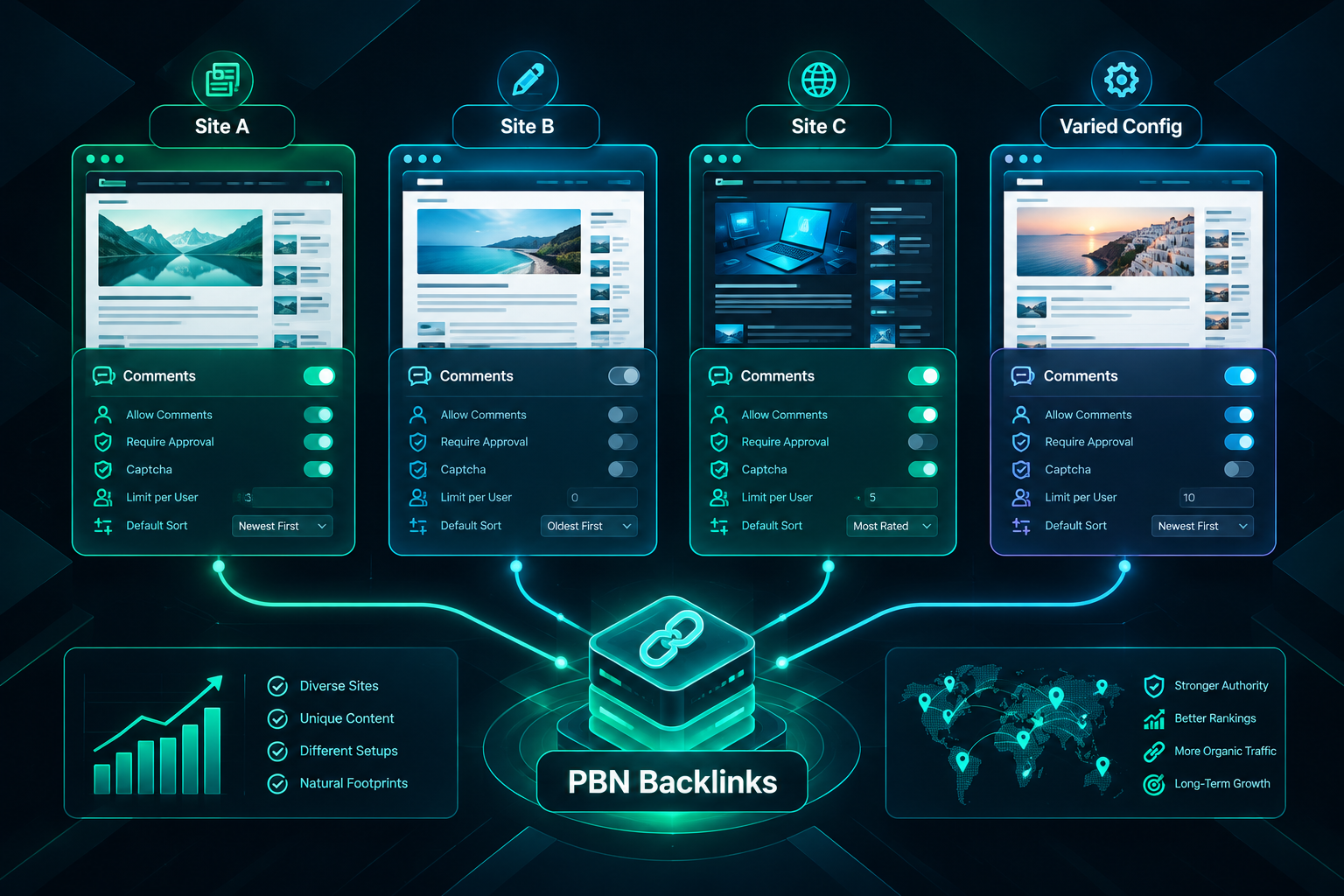
The same principle applies to how approved UGC content looks across the network. If every site in a network approves comments with identical formatting, identical response patterns from the site owner, or identical comment counts, those patterns may be more noticeable than a network where each site’s comment section reflects its individual editorial character. For most PBN operators, the simplest way to avoid this issue is to disable comments entirely on most or all network sites, which eliminates the footprint risk associated with comment section patterns while also reducing moderation overhead.
Monitoring UGC and Maintaining Site Quality Over Time
UGC management is not a one-time configuration task. Even after technical controls are in place, PBN sites require periodic review to confirm that no unintended content has appeared, that spam filters are functioning correctly, and that the site’s outbound link profile remains clean and controlled.
A practical monitoring routine for a PBN site with any UGC features enabled might include reviewing the comment moderation queue at regular intervals, checking the site’s outbound links using a crawl tool to identify any unexpected URLs that have appeared in approved content, and reviewing the site’s indexed pages to confirm that no UGC content has been indexed that conflicts with the site’s topical focus or introduces unwanted outbound links.
For networks managed at scale, automating parts of this monitoring process — for example, using a scheduled crawl to flag new outbound links on network sites — reduces the manual effort required while maintaining visibility into changes across the network. Backlink analysis tools can also be used to monitor whether any new links pointing to the PBN site itself have appeared, which may indicate that the site has been identified and linked to by other properties in ways that were not intended.
When a quality issue is identified — for example, a spam comment that was approved in error, or a guest submission that introduced off-topic content — addressing it promptly by removing the content and reviewing the moderation process that allowed it through is more effective than allowing the issue to accumulate over time. A single low-quality page on a PBN site is unlikely to cause a significant problem, but a pattern of uncontrolled UGC across multiple pages or multiple network sites can gradually degrade the network’s overall quality and the value of the links it provides.
Frequently Asked Questions
Should PBN sites have comments enabled at all?
For most PBN sites, disabling comments is the most practical choice. Comments add moderation overhead, introduce the risk of uncontrolled outbound links, and can create footprint patterns across a network. If comments are kept enabled to make a site appear more like an active publication, requiring manual approval for every comment is the minimum necessary control.
What does rel=”ugc” do and should I use it on PBN sites?
The rel=”ugc” attribute signals to search engines that a link was contributed by a user rather than placed editorially by the site owner. Using it on user-submitted links in comments or submitted content is a standard technical practice. WordPress applies nofollow to comment links by default, but site owners should verify this is active and consider adding ugc as well for any approved user-submitted links.
Can accepting guest posts on a PBN site cause problems?
Accepting guest posts without careful editorial review can introduce off-topic content, uncontrolled outbound links, and anchor text patterns that conflict with the site’s intended link profile. Many PBN operators find that producing content in-house gives them better control over the variables that affect link quality and topical relevance. If guest submissions are accepted, a detailed review process covering topic relevance, content quality, and outbound link appropriateness is necessary before publication.
How does UGC affect the topical relevance of a PBN site?
Topical relevance is one of the most important quality signals for a PBN site. UGC that introduces off-topic text, off-topic links, or content that does not align with the site’s niche can dilute the site’s topical focus over time. This can reduce the contextual strength of the links the site provides, since a page that covers multiple unrelated topics sends a weaker topical signal than a page that consistently addresses one subject area.
Is it necessary to use a spam filter on every PBN site?
If comments or contact forms are enabled on a PBN site, a spam filter reduces the volume of automated submissions that reach the moderation queue. However, spam filters are not a substitute for manual review of approved content. For sites where comments are disabled entirely, spam filters for the comment section are not necessary, though contact form spam protection may still be worth implementing to protect server resources.
How often should I review UGC on PBN sites?
The appropriate review frequency depends on how much UGC activity the site receives. For sites with active comment sections or submission forms, a weekly review of the moderation queue and a monthly check of the site’s outbound link profile is a reasonable baseline. For sites where comments are disabled and no submissions are accepted, a quarterly review of indexed content and outbound links is generally sufficient to catch any unexpected changes.
Building a UGC Management Approach That Fits Your PBN Strategy
The right approach to user-generated content on PBN sites depends on the specific goals of the network, the scale at which it operates, and the level of editorial control the site owner wants to maintain. For most PBN operators focused on controlled contextual link placement, the practical answer is to minimize UGC entry points, disable features that introduce uncontrolled content or links, and apply manual review to anything that does reach the site. This keeps the site’s outbound link profile clean, its topical relevance intact, and its management overhead manageable.
For operators who want PBN sites to appear more like active editorial publications — with comment sections, reader engagement, and occasional guest contributions — the additional editorial work required to maintain quality standards is significant. Every piece of approved UGC needs to be assessed for topical relevance, link quality, and consistency with the site’s content environment before it is published. The benefit of this approach is a site that may present a more convincing editorial identity; the trade-off is the ongoing time and attention required to maintain that standard across a network of sites.
Whichever approach fits your network’s goals, the underlying principle is the same: every piece of content that appears on a PBN site, whether written by the site owner or contributed by a user, affects the quality signals that determine how useful that site is as a link source. Treating UGC management as a core part of network maintenance — rather than an afterthought — helps preserve the value of the placements the network provides over time.
If you are evaluating how to structure a PBN campaign, assess placement quality, or review the content standards across an existing network, PBN Backlinks Service can help you think through the practical requirements for your specific goals and link-building strategy.