

Key Takeaways
- Content quality, not domain authority alone, determines how much link equity a PBN site can pass to your money site.
- Each PBN site needs a coherent topical focus, a realistic content mix, and a believable site identity to avoid footprint detection.
- Thin content, static publishing patterns, and over-optimized anchor text are the three most common causes of deindexation risk.
- A practical content-to-link ratio of roughly 4:1 (supporting articles to money-site-linking articles) helps maintain a natural outbound link profile.
- Google’s SpamBrain system is increasingly effective at identifying coordinated link schemes through content pattern analysis, not just backlink graphs.
Why Content Decisions Define PBN Performance
Most PBN builders spend the majority of their budget acquiring expired domains with strong backlink profiles, then publish minimal content and hope the domain’s historical authority carries the link weight. This approach made sense in 2012. It is increasingly unreliable in 2025. Google’s SpamBrain system evaluates content signals alongside link signals, meaning a poorly constructed PBN article can actively reduce the value of the link it contains rather than passing it cleanly.
The practical implication is straightforward: the content strategy for a PBN site matters almost as much as the domain selection itself. Getting the content right means understanding what types of articles to publish, how many, how often, and what signals make a site look like a legitimate editorial property rather than a link vehicle. This guide addresses each of those decisions with actionable specifics rather than abstract principles.
What Types of Content to Publish on PBN Sites
A realistic PBN site should mirror the content mix of an independently operated niche blog or small editorial publication. That means publishing several distinct content formats rather than a uniform stream of keyword-optimized articles that all happen to link to the same destination.
Informational Blog Posts
Informational posts that answer genuine questions within the site’s niche form the backbone of any believable PBN content strategy. These articles do not need to link to the money site at all. Their job is to establish niche relevance, generate internal linking opportunities, and demonstrate topical breadth to crawlers. A site covering home improvement, for example, should publish posts explaining how different insulation types compare, what permits a homeowner typically needs for a loft conversion, and how to read a damp survey — articles that a real blog in this space would naturally produce.
Listicles and Roundup Posts
Listicles perform well for content variety because they are a format that genuinely diverse publishers use. A “10 tools every woodworker needs” post or a “7 questions to ask before hiring a roofer” article adds topical depth without triggering suspicion. These posts also create natural opportunities for outbound links to third-party resources, which helps establish natural outbound link patterns that look editorially motivated rather than commercially driven.
Opinion and Commentary Posts
Short opinion pieces, editorial takes, or commentary on recent developments in the niche add a human editorial layer that algorithmic content rarely replicates convincingly. A site in the personal finance niche might publish a short post reacting to an interest rate announcement. These posts are typically shorter (400–700 words) and link to nothing commercially sensitive, making them useful spacers between money-site-linking articles.
How-To Guides and Tutorials
Longer how-to guides (1,200–2,000 words) demonstrate topical authority more effectively than any other format. They also provide the most credible context for a contextual link placement — a link embedded in a detailed, useful guide reads more naturally than one placed in a thin 300-word post. When an article in this format links to the money site, the surrounding content justifies the reference. A how-to guide on choosing outdoor lighting that links to a specific product category page is a plausible editorial recommendation. A thin article that does nothing except introduce and link to a money site is not.
News Updates and Industry Roundups
Publishing occasional news-style updates or monthly industry roundups signals that a site is actively maintained by someone paying attention to the niche. These posts are typically short and reference recent events, product launches, or regulatory changes within the topic area. Even two or three news-style posts per year contribute meaningfully to the impression of an editorially active publication and support an irregular publishing cadence that mimics organic behavior.
How Much Content Does a PBN Site Need?
There is no single universal threshold, but practical experience across the industry points to a minimum of 15–25 published articles before a PBN site should be used to host a link to a money site. Sites with fewer than ten posts present an obvious thin content signal to crawlers and provide insufficient internal linking structure to distribute link equity naturally.
A workable content-to-link ratio is approximately four supporting articles for every one article that contains a money site link. This means a PBN site hosting five links to the money site should contain at least 20 additional articles that serve topical, informational, or editorial purposes without a commercial outbound link. This ratio helps maintain natural outbound link patterns and reduces the probability that the site reads as a purpose-built link vehicle.
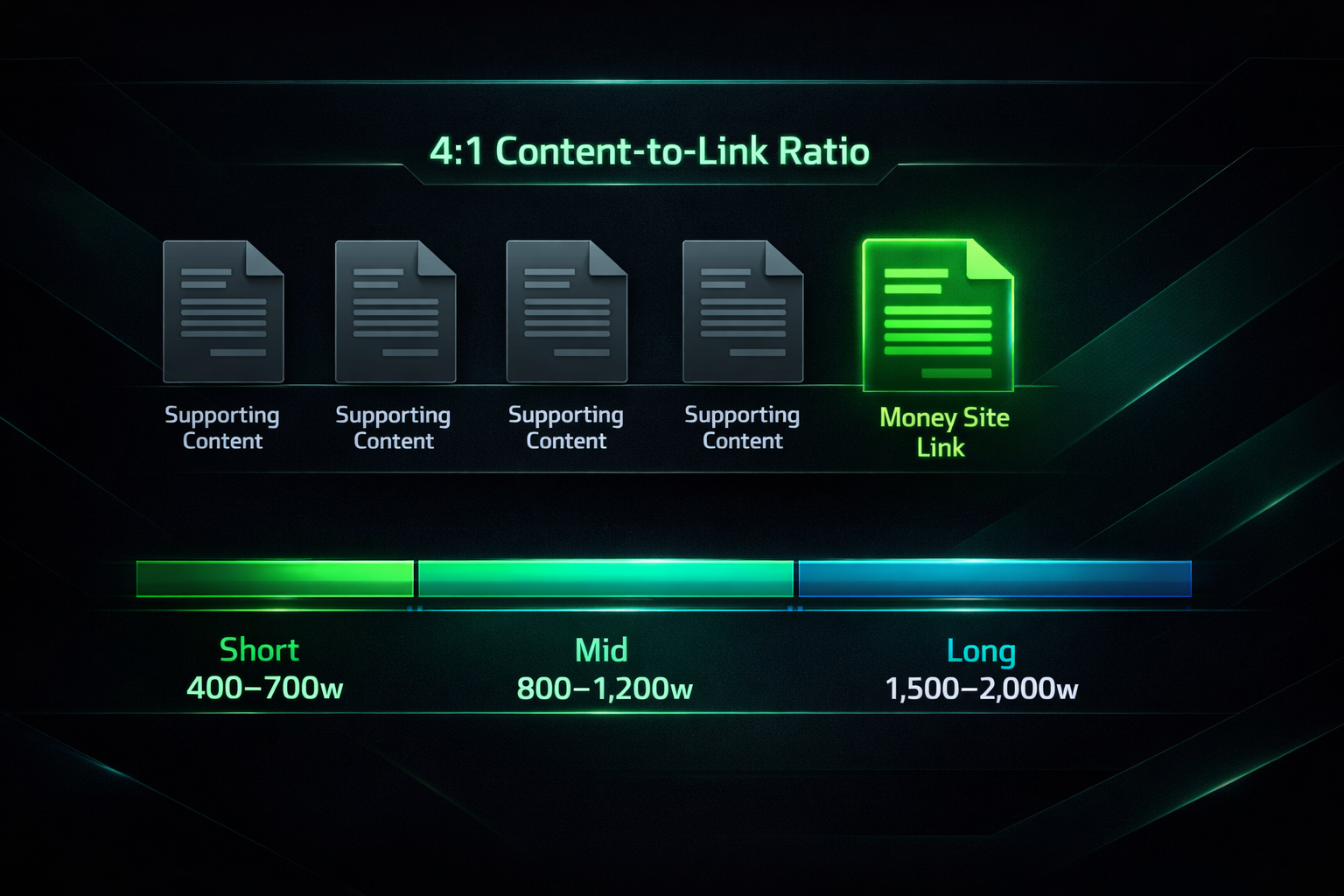
Content length should vary across posts in the same way it would on a genuine editorial site. Mix shorter pieces of 400–700 words with mid-length articles of 800–1,200 words and occasional longer guides of 1,500–2,000 words. Uniform article length across an entire site is itself a footprint detection signal — it suggests templated production rather than genuine editorial judgment.
How Often Should You Publish on PBN Sites?
An irregular publishing cadence is more natural and more defensible than a rigid schedule. Real blogs do not publish exactly one article every Tuesday. They publish a burst of posts when the owner has time, go quiet for a few weeks, and pick up again when something interesting happens in the niche. Mimicking this pattern reduces the likelihood that a manual reviewer or algorithmic filter identifies a coordinated network.
A practical approach for maintaining a PBN site is to publish an initial batch of eight to twelve articles when the site is set up, then add two to four articles per month on an irregular basis. Avoid posting on identical days of the week across multiple PBN sites within the same network, as synchronized publishing schedules are a well-documented footprint that can connect sites algorithmically.
Static sites — domains that received an initial content dump and were never updated — are one of the clearest deindexation risk factors. Google’s crawl activity on a page decreases over time if no new content is added or updated. Regular content additions, even modest ones, maintain crawl engagement and signal that the site is actively managed.
Building Topical Authority on a PBN Site
Topical authority on a PBN site is built through topical clustering: grouping related articles around a central subject so that the site demonstrates depth within a defined area rather than scattered coverage across unrelated topics. A PBN site registered on an expired domain that previously covered gardening should publish content that naturally extends that topic — plant care, garden design, seasonal maintenance, tool reviews — rather than pivoting to an unrelated niche just because the money site operates in a different space.
This alignment between domain history and current content is important for two reasons. First, it preserves the topical signals that made the expired domain valuable in the first place. Second, it makes the site’s content feel coherent to any reviewer who examines it. Content migration inconsistency — a domain with a strong gardening history suddenly publishing articles about financial services — is a pattern that manual reviewers are trained to identify.
Internal linking within a PBN site should reflect the topical clustering structure. A cornerstone how-to guide should receive links from the shorter informational posts covering related subtopics. This internal link architecture is both a topical authority signal and a practical tool for distributing crawl equity across the site.
Anchor Text Strategy for PBN Content
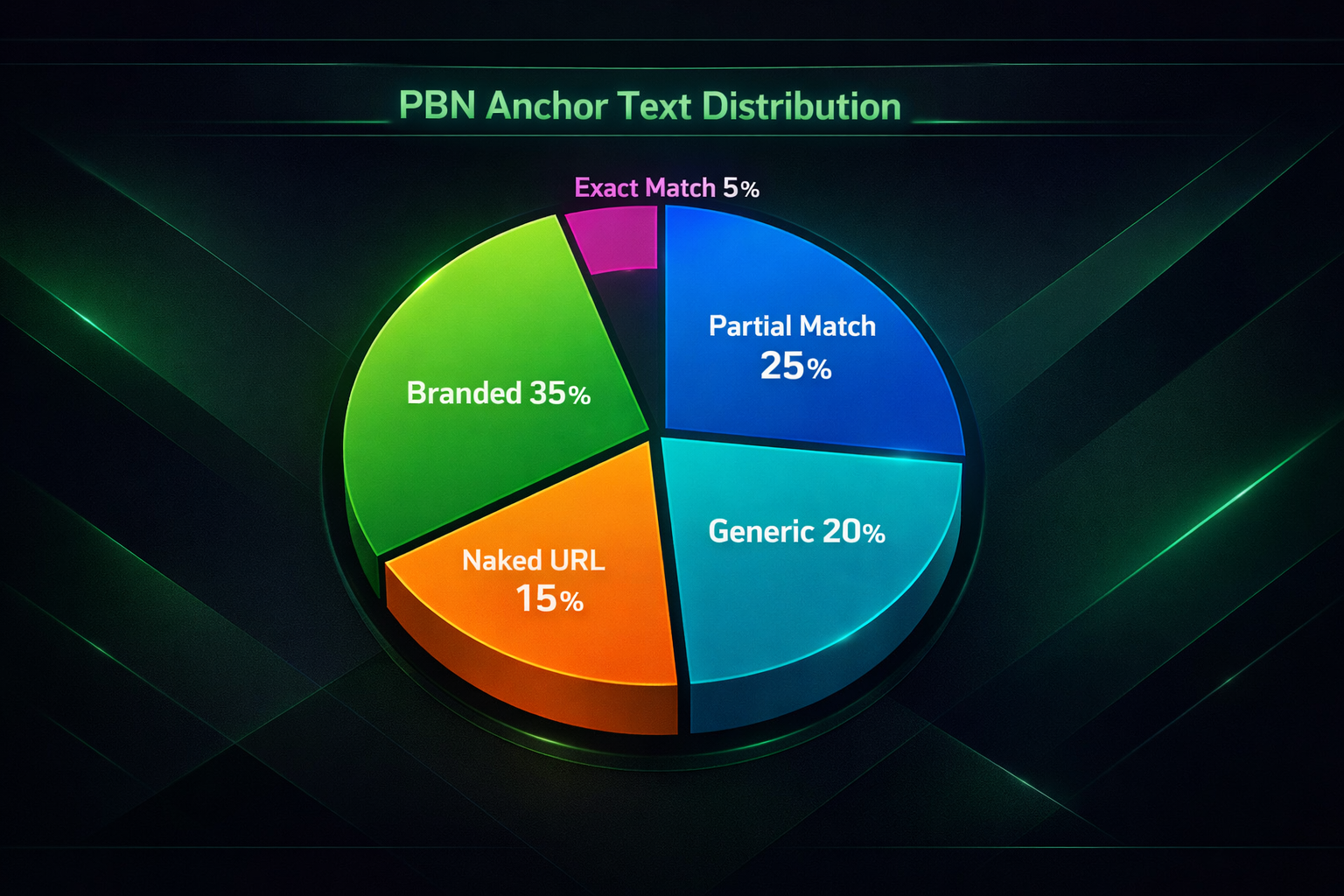
Anchor text diversity is one of the most important and most frequently mismanaged elements of PBN content strategy. Over-reliance on exact-match anchors remains a primary signal that a link is part of a coordinated link scheme rather than a genuine editorial recommendation. A natural link profile mixes branded anchors, partial-match phrases, naked URLs, generic terms such as “read more” or “this guide”, and exact-match phrases used sparingly.
A broadly cited benchmark for anchor text distribution in PBN contexts is: exact-match anchors accounting for no more than 5–10% of links to any given money site page, partial-match anchors covering 20–30%, branded anchors covering 30–40%, and the remainder split between naked URLs and generic terms. These figures are approximate and should be adjusted based on the anchor text profile already present on the money site’s existing backlink portfolio.
The placement of the link within the article also matters. Contextual link placement — embedding the link naturally within a relevant paragraph of substantive content — passes more link equity and looks more credible than footer links, sidebar links, or links placed in the first or last sentence of a thin post. The surrounding text should justify the link’s existence without making the reference feel forced.
How to Make PBN Sites Look Natural to Google
Site identity signals are the collection of on-site elements that distinguish a genuine editorial publication from a purpose-built link host. Every PBN site should have a completed About page that describes the site’s stated purpose and, where appropriate, references an author persona. Contact information — even a simple contact form — adds legitimacy. A privacy policy page is both a legal requirement in many jurisdictions and a credibility signal to automated review systems.
An author persona is more than a name attached to articles. A convincing author bio includes a brief professional background relevant to the niche, a consistent writing voice across published articles, and optionally a profile image. The persona does not need an extensive social media presence, but a minimal LinkedIn or social profile linked from the author bio page adds a layer of verifiability that purely anonymous authorship lacks.
Multimedia elements — featured images, embedded graphics, or occasional short videos — contribute to the impression of editorial investment. Pages that consist entirely of unformatted text look different from pages produced by someone genuinely trying to communicate useful information. Even basic image use, with descriptive alt text and relevant visual content, improves the site’s editorial appearance significantly.
AI-Generated Content on PBN Sites: Practical Considerations
AI writing tools have made it faster and cheaper to produce PBN content at scale, but they have also introduced a new detection risk that many practitioners underestimate. SpamBrain and related Google systems are trained on patterns that include the structural and linguistic regularities common in AI-generated text. Content that reads as clearly machine-produced — uniform sentence rhythms, predictable transitions, generic phrasing, absence of specific examples — is increasingly identifiable regardless of whether it passes standard plagiarism checks.
Using AI assistance for PBN content is not inherently disqualifying, but the output should be treated as a draft requiring substantive human editing. Specific niche details, concrete examples, varied sentence structure, and an identifiable editorial voice all reduce the probability that content is flagged as low-quality or coordinated. Publishing AI-generated content with no editing across an entire PBN network — where every article follows the same structural template — creates a cross-site footprint that is detectable at scale.
YMYL (Your Money Your Life) niches, including health, finance, and legal topics, receive closer algorithmic scrutiny. PBN sites operating in these categories face a higher bar for content quality because Google applies stricter editorial quality standards to sites that could influence consequential decisions. Thin content in a YMYL niche carries a higher deindexation risk than equivalent content in a lower-stakes category such as hobbies or lifestyle.
Content Refresh: Why Static PBN Sites Lose Value Over Time
A content refresh strategy is rarely discussed in PBN guides but is one of the more practical tools available for maintaining long-term link value. Articles published two or three years ago and never updated attract progressively less crawl attention as Google’s systems deprioritize stale pages. Refreshing a PBN article — updating statistics, adding a new section, revising the introduction — signals to crawlers that the page is maintained and relevant.
A reasonable refresh cycle for a PBN site is to revisit each article that contains a money site link approximately once every twelve to eighteen months. Updates do not need to be extensive. Revising the introduction, correcting outdated references, and adding a paragraph that addresses a development in the niche is usually sufficient to re-engage crawl activity and maintain the page’s indexation status.
What NOT to Publish on PBN Sites
Understanding what to avoid is as important as knowing what to include. Several content patterns reliably increase deindexation risk and should be avoided regardless of the domain’s authority metrics.
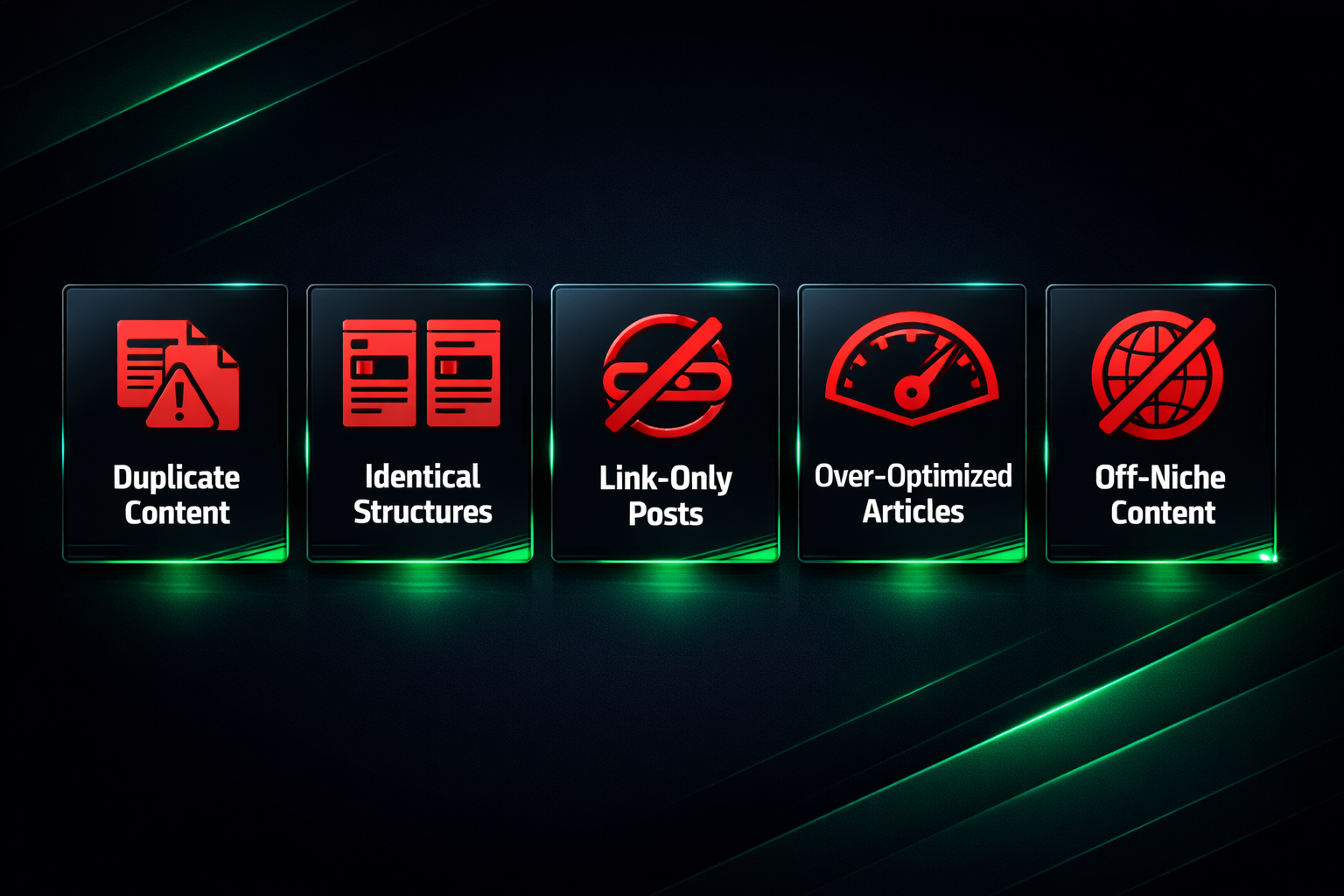
- Duplicate or near-duplicate content: Publishing spun versions of the same article across multiple PBN sites is one of the oldest and most reliably detected footprint signals.
- Identical article structures across the network: If every site in a network uses the same heading hierarchy, introduction formula, and link placement position, the structural similarity itself becomes a fingerprint.
- Articles that exist solely to host the outbound link: A post with no substantive content beyond the paragraph containing the money site link provides no credible editorial context for the link and offers an obvious signal to reviewers.
- Over-optimized posts: Articles where the target keyword appears in the title, every heading, the first paragraph, and the anchor text of the outbound link simultaneously create an over-optimization pattern that looks artificial.
- Unrelated content on a topically established domain: Publishing articles outside the domain’s historical niche without a credible editorial reason breaks topical consistency and weakens the topical authority signals the domain was selected for.
Frequently Asked Questions
How many articles should a PBN site have before adding a money site link?
A practical minimum is 15–20 published articles that establish the site’s topical focus and create a believable editorial identity. Adding a money site link to a site with fewer than ten posts significantly increases deindexation risk because there is insufficient content to justify the site’s existence as a genuine publication.
Should every article on a PBN site link to the money site?
No. A content-to-link ratio of approximately 4:1 — four supporting articles without money site links for every one article that contains a link — is a broadly used benchmark. A site where every article links to the same destination provides an unmistakable signal of coordinated link building.
How long should PBN articles be?
Content length should vary across the site. A realistic mix includes short posts of 400–700 words, mid-length informational articles of 800–1,200 words, and occasional longer guides of 1,500–2,000 words. Uniform article length across an entire site is itself a footprint signal.
Is AI-generated content safe to use on PBN sites?
AI-assisted content can be used, but unedited AI output published at scale across a network creates detectable structural and linguistic patterns. Substantive human editing, specific niche detail, and varied editorial voice reduce the risk of algorithmic flagging.
How often should PBN sites be updated?
An irregular publishing cadence of two to four new articles per month, combined with periodic content refresh of existing articles every twelve to eighteen months, maintains crawl engagement and avoids the static site signals associated with dormant PBN properties.
What is the biggest content mistake PBN builders make?
Publishing thin content — short, generic articles with no topical depth and a visible money site link — remains the single most common cause of PBN site deindexation. The link is only as valuable as the editorial context surrounding it.
Building a PBN Content Strategy That Holds Up Over Time
The most durable PBN content strategy is one that treats each site as a genuine editorial property rather than a link container. That means establishing a clear topical focus aligned with the domain’s history, publishing a realistic mix of content formats on an irregular schedule, maintaining a believable author persona and site identity, and embedding money site links within substantive contextual content rather than thin placeholder posts.
SpamBrain and Google’s link spam updates from 2022 onward have raised the minimum viable standard for PBN content considerably. Sites that would have passed undetected in earlier years are now more likely to be algorithmically identified, devalued, or subjected to manual review. The practical response is not to abandon the PBN model but to invest proportionally in content quality — treating the content budget as a core part of the network’s infrastructure rather than an afterthought following domain acquisition.
Anchor text diversity, niche relevance, topical clustering, content refresh cycles, and realistic site identity signals are not optional refinements. They are the operational baseline for a PBN network that continues to pass meaningful link equity to a money site across a period of years rather than months. Getting the content right from the start is considerably cheaper than rebuilding a deindexed network after the fact.