

Buying backlinks has always been one of the most debated topics in search engine optimization. Yet despite Google’s official warnings, millions of SEO professionals, affiliate marketers, and agencies continue to acquire paid links as a core part of their growth strategy. The reason is straightforward: high-authority backlinks remain one of the strongest ranking signals in modern search algorithms, and earning them purely through organic outreach is slow, expensive, and increasingly competitive in 2025.
This guide explains how to buy quality backlinks safely, what separates high-quality backlinks from harmful ones, which link types deliver the best ROI, and how to build a paid link strategy that improves search rankings without triggering penalties. Written from the operational perspective of an agency that manages its own link infrastructure and publisher network, this content reflects real-world SEO practice — not theoretical advice.
Key Takeaways
- What makes a backlink high quality: topical relevance, real organic traffic, editorial placement, and a clean referring domain.
- Safest link types to buy: guest posts, niche edits, and contextual placements on real-content websites.
- Biggest risks: Google penalties, over-optimized anchors, link farms, and irrelevant domains.
- Typical pricing range: $80–$2,000+ per link, depending on domain strength, organic traffic, niche, and placement quality.
- Best evaluation tools: Ahrefs, Semrush, Moz, Google Search Console, and Screaming Frog.
- Core strategy principle: combine paid placements with organic link earning and diversified anchor text.

Mon-Fri: 09:00 AM – 06:00 PM
What Does Buying Backlinks Mean in SEO?
Buying backlinks refers to paying a website owner, publisher, agency, or marketplace to place a hyperlink on their domain pointing to your target URL. In search engine optimization, this practice is sometimes called paid link building, link acquisition, or — depending on the method — sponsored link placement. The transaction may involve direct payment, content creation fees, product exchange, or a service barter arrangement.
Not all paid backlinks are created equal. The term covers everything from a $5 bulk package of forum spam links to a $1,500 editorial placement in a high-traffic industry publication. Understanding the difference between these extremes is the foundation of any responsible backlink investment strategy.
Paid Links vs. Editorial Link Building
Editorial link building refers to backlinks earned without direct payment — a journalist cites your research, a blogger recommends your tool, or a resource page curates your guide. Google considers these the gold standard because they reflect genuine, unsolicited endorsement.
Paid links, by contrast, involve a commercial transaction. The placement is arranged rather than earned organically. Within this category, quality varies dramatically:
- A paid guest post on a real, editorially maintained website with genuine organic traffic is fundamentally different from a directory submission or a private blog network link built purely for PageRank manipulation
- A niche edit placed within an aged, high-authority article delivers different value than a footer link buried across a templated site
- A sponsored article on a relevant industry publication carries more SEO weight and credibility than a bulk link package delivered overnight
The operational reality is that most competitive industries cannot rely solely on organic link earning. According to Ahrefs backlink research, pages ranking in the top three positions for competitive keywords consistently carry significantly more referring domains than lower-ranked competitors — and acquiring that volume through pure outreach alone can take years.
Why Businesses Still Invest in Backlinks
Businesses invest in buying backlinks because the SEO return can be substantial and measurable. For competitive commercial keywords — financial services, legal, E-commerce, SaaS, health — organic traffic represents enormous revenue potential. A single top-three ranking can generate hundreds of thousands of annual visitors, and backlinks remain one of the primary levers for achieving those positions.
Key reasons SEO professionals and businesses continue to buy links include:
- Speed to results — Managed link-building services with existing publisher relationships, compressing acquisition timelines significantly compared to cold outreach
- Competitive parity — If competitors are acquiring authoritative backlinks through paid placements, organic-only strategies operate at a structural disadvantage
- Scalability — Outreach campaigns are unpredictable and resource-intensive; paid placements allow predictable volume planning
- Targeting precision — Paid link strategies allow targeting specific topical clusters, anchor text distributions, and domain authority ranges with accuracy
Google’s Position on Paid and Manipulative Links
Google’s official stance, documented in its Search Essentials guidelines, is that buying or selling backlinks that pass PageRank violates its link scheme policies. Google categorizes paid links that manipulate rankings as webspam, and the Search Quality team does issue manual actions against sites participating in obvious link schemes.
However, enforcement is inconsistent and heavily dependent on signal quality. Links placed on real websites with genuine traffic, relevant content, and natural anchor text are far less likely to trigger review than obvious spam networks or exact-match anchor manipulation. Practical risk scales with link quality and footprint visibility.
Google also acknowledges that sponsored content and paid placements exist legitimately — the technical requirement is that paid links carry rel=”sponsored” or rel=”nofollow” attributes. Many publishers and agencies use these attributes to remain compliant while still building commercially valuable relationships.
What Makes a Backlink High Quality?
Not all backlinks contribute equally to search rankings. High-quality backlinks share a consistent set of measurable attributes that distinguish them from low-quality or spammy links. Understanding these attributes is essential before purchasing any link placement.
Topical Relevance Between the Linking Site and Your Page
Topical relevance is the degree to which the linking website’s subject matter aligns with the content of your target page. A backlink from a cybersecurity blog pointing to a software review page carries significantly more ranking signal than the same link from a cooking website pointing to the same page.
Google’s algorithms assess topical authority at both the domain and page level. A contextually relevant backlink signals to search engines that your content is recognized as authoritative within its niche. Relevance is arguably more important than raw domain authority metrics when evaluating whether a backlink will positively influence rankings.
Real Organic Traffic and Audience Signals
A website with genuine, consistent organic traffic demonstrates that Google already trusts and indexes that domain. High-quality backlinks come from sites generating real visitors through search results — not sites maintained purely as link vessels with no human readership.
Key organic traffic signals to check before acquiring a backlink:
- Monthly organic visits (minimum 500–1,000 for meaningful value)
- Traffic trend — stable or growing, not in sharp decline
- Geographic traffic distribution that matches real audience behavior
- Multiple ranking keywords across diverse topics (not one inflated page)
Domain Authority, Domain Rating, and Their Limits
Domain Authority (DA) from Moz and Domain Rating (DR) from Ahrefs are third-party metrics that estimate the overall link strength of a domain. These metrics are useful directional indicators, but are not Google ranking factors.
| Metric | Provider | What It Measures | Limitation |
| Domain Rating (DR) | Ahrefs | Strength of a domain’s backlink profile | Can be manipulated via bulk link acquisition |
| Domain Authority (DA) | Moz | Predicted ranking ability based on links | Does not reflect content quality or traffic |
| URL Rating (UR) | Ahrefs | Strength of a specific page’s backlink profile | Page-level only |
| Trust Flow (TF) | Majestic | Proximity to trusted seed sites | Less frequently updated |
Never evaluate a backlink based on DR or DA alone. A domain with DR 60 and no organic traffic provides far less value than a DR 35 site with 10,000 monthly visitors and topical relevance.
Editorial Placement Within Relevant Content
Editorial placement means the backlink appears within the natural body of a relevant article — not in a sidebar, footer, author bio, or widget. Editorial links carry more weight because they reflect a contextual decision to reference your content as a resource.
Search engines evaluate link placement position within a document. Links embedded within the primary content area of a well-structured article, surrounded by semantically relevant text, deliver stronger ranking signals than links placed in peripheral page zones.
Natural Anchor Text and Contextual Link Placement
Anchor text is the clickable text that contains the hyperlink. Natural anchor text distribution across your backlink profile includes a mix of:
- Branded anchors (your company or domain name)
- Partial match phrases (containing one target keyword)
- Generic anchors (“read more,” “this article,” “here”)
- Naked URLs (the raw domain or page URL)
- Exact match keywords (used sparingly — maximum 10–15% of total profile)
Over-optimization of anchor text — particularly using exact-match commercial keywords repeatedly — is one of the most common triggers for Google’s Penguin algorithm and manual link scheme reviews.
Clean Backlink Profile of the Referring Domain
Before acquiring a backlink, inspect the referring domain’s own backlink profile. A site that itself receives links primarily from spam networks, low-quality foreign directories, or link farms carries those negative associations into any link it provides.
Signals of a clean referring domain backlink profile:
- Links coming from diverse, topically relevant domains
- No sudden spikes in link acquisition (indicating purchased bulk links)
- Reasonable ratio of dofollow to nofollow links
- No links from known spam networks or link farms
- Stable referring domain count over time
Benefits of Buying Quality Backlinks
When executed with proper vetting and strategy, buying high-quality backlinks delivers measurable SEO benefits that compound over time.
Faster Authority Growth for Competitive Keywords
Organic link earning through content marketing and outreach is a long-term strategy. Buying quality backlinks from authoritative, relevant websites accelerates the domain authority accumulation needed to compete for high-value keywords. In competitive niches, the difference between ranking on page one versus page three can represent thousands of monthly visitors — and targeted paid link acquisition can close that gap faster than organic methods alone.
Improved Search Visibility for Priority Pages
Not all pages on a website require the same level of link investment. Strategic paid link building allows SEO professionals to direct authority toward specific URLs — commercial landing pages, category pages, product listings, or pillar content — that drive the most business value. This precision is difficult to achieve through purely organic link earning.
Referral Traffic From Relevant Publications
High-quality backlinks from websites with genuine audiences deliver direct referral traffic in addition to SEO ranking benefits. A contextual link placed within a popular industry article can drive consistent referral visits for months or years after placement. This dual value — ranking signal plus direct traffic — makes quality placements in trafficked publications particularly valuable.
Support for Content, Service Pages, and E-commerce Categories
Link-building strategy varies by page type:
| Page Type | Link Building Goal | Best Link Type |
| Blog and pillar content | Build topical authority and rankings | Guest posts, digital PR |
| Service pages | Improve rankings for commercial terms | Niche edits, guest posts |
| E-commerce category pages | Increase organic visibility for product searches | Contextual insertions, editorial placements |
| E-commerce product pages | Support conversion-focused rankings | Niche edits, resource links |
| Local landing pages | Build local authority signals | Niche edits, local citations |
Risks of Buying Backlinks
The risks of buying backlinks are real and must be managed deliberately. Understanding what creates risk — and why — is as important as understanding the benefits.
Google Penalties and Manual Actions
Google’s Search Quality team issues manual actions against websites that violate link scheme policies. A manual action for unnatural inbound links can suppress rankings across an entire domain, sometimes dramatically. Recovery requires identifying and disavowing harmful links, then submitting a reconsideration request — a process that can take months.
Algorithmic penalties from Google’s Penguin system are a second risk. Penguin evaluates link profile quality algorithmically and can suppress rankings without a manual review notification. Unlike manual actions, algorithmic demotions resolve only when the algorithm re-crawls and reassesses the link profile after disavowal.
Link Farms, PBNs, and Artificial Networks
Link farms are networks of websites created specifically to sell backlinks with no genuine content or audience. These sites exist purely as link-passing infrastructure. Links from link farms carry significant footprint risk because Google has become adept at identifying sites with:
- No organic search traffic
- Templated content across many pages
- Identical hosting and registration patterns
- Excessive outbound links to commercial domains
- No topical consistency
Private Blog Networks (PBNs) operate differently from link farms — quality PBNs are built on aged domains with real backlink histories, host original content, and maintain hosting diversification to minimize footprint. However, low-quality PBNs operated carelessly share many characteristics with link farms and carry equivalent risk.
Over-Optimized Anchor Text
Using commercial exact-match anchor text across a high volume of paid placements is one of the most reliable ways to attract algorithmic or manual scrutiny. Over-optimization signals to Google that a link profile is artificially constructed rather than the result of organic editorial decisions.
Signs of dangerous anchor text patterns:
- More than 15–20% of backlinks using exact-match commercial anchors
- Identical anchor text repeated across multiple referring domains
- Sudden spikes in keyword-rich anchors following a paid link campaign
- No variation between branded, generic, and partial-match anchors
Cheap Bulk Link Packages
Cheap bulk backlink packages — often sold for $20–$100 for hundreds of links — represent the highest-risk category of paid link acquisition. These packages typically consist of:
- Forum profile links
- Web 2.0 property spam
- Low-quality directory submissions
- Blog comment spam
- Irrelevant article directory placements
Not only do cheap bulk packages rarely improve rankings, but they also actively damage backlink profile quality and can trigger Google’s spam detection systems. The axiom “quality over quantity” is not a suggestion in link building — it is a survival principle.
Irrelevant Websites With Inflated SEO Metrics
Some websites artificially inflate their DR or DA through reciprocal link schemes or bulk link purchases, then sell placements at premium prices based on those metrics. A domain with DR 50 and zero topical relevance to your niche provides minimal ranking benefit and may introduce negative associations into your backlink profile.
How to Buy Quality Backlinks Step by Step
A systematic approach to buying backlinks minimizes risk and maximizes return. The following process reflects the methodology used by professional link-building agencies managing campaigns across multiple clients and niches.
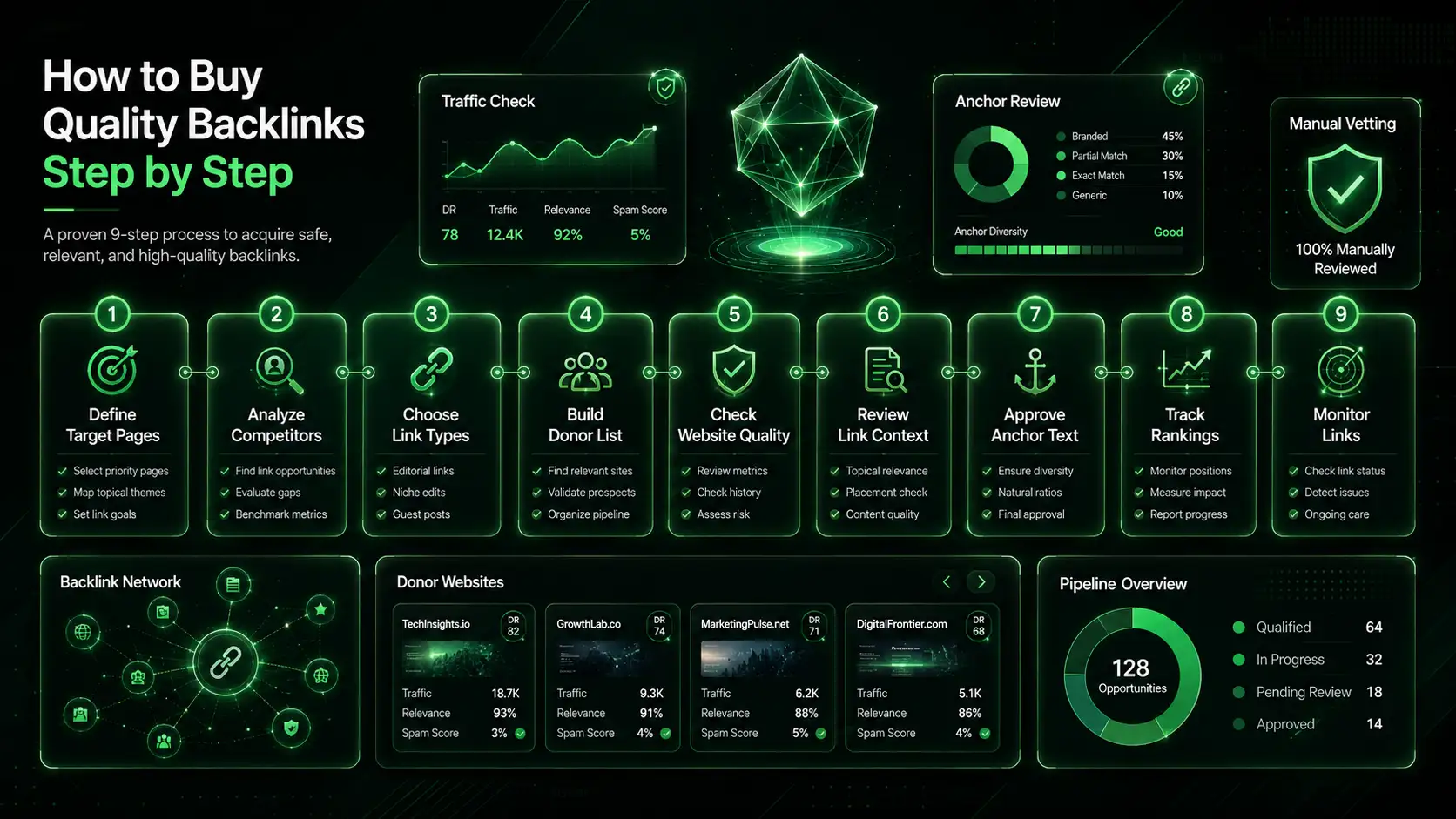
Step 1. Define the Pages That Need Backlinks
Before acquiring any link, identify which URLs on your website are the priority targets. Consider:
- Pages targeting competitive commercial keywords with high conversion potential
- Pages are currently ranking on page two or three with a clear ranking opportunity
- New pages requiring initial authority to enter competitive SERPs
- E-commerce category or product pages driving direct revenue
Document a prioritized URL list with target keywords, current rankings, and traffic potential before beginning any outreach or placement process.
Step 2. Analyze Competitors’ Backlink Profiles
Use Ahrefs, Semrush, or Moz to examine the backlink profiles of pages currently ranking above your target URLs. This analysis reveals:
- Which domains are linking to competitors but not to you (link gap opportunities)
- What types of links competitors are acquiring (guest posts, niche edits, editorial placements)
- The approximate domain authority range of referring domains
- Anchor text patterns competitors are using for target keywords
- Content types that attract the most links in your niche
Competitor backlink analysis is the most efficient research method for identifying realistic and relevant link targets.
Step 3. Choose Suitable Link Types
Select link types based on your goals, budget, and risk tolerance:
| Link Type | Best For | Risk Level | Average Cost |
| Guest posts | Authority building, new domains | Low–Medium | $150–$800 |
| Niche edits | Established sites, faster results | Low–Medium | $80–$500 |
| Sponsored articles | Brand awareness + SEO | Low | $200–$1,500 |
| Digital PR | High-authority editorial links | Low | $500–$3,000+ |
| Resource page links | Educational or tool-based content | Low | $50–$300 |
| PBN links | Aggressive ranking campaigns | High | $30–$200 |
Step 4. Build a List of Relevant Donor Websites
Compile a prospecting list of websites that meet your topical relevance, authority, and traffic criteria. Sources for prospecting include:
- Competitor backlink profiles (exported from Ahrefs or Semrush)
- Google search operators targeting niche blogs and publications
- Guest posting networks and publisher marketplaces
- Industry directories and association member websites
- Content hubs and roundup sites in your niche
Aim for a minimum prospecting list of 50–100 domains for every 10–15 links you intend to acquire, accounting for rejection, non-response, and quality disqualification.
Step 5. Check Website Quality Before Placement
For every prospective donor domain, conduct a structured quality check:
- Organic traffic: Minimum 500 monthly visits via Ahrefs or Semrush Site Explorer
- Domain Rating / Domain Authority: DR 20+ as a baseline; higher for competitive niches
- Indexing status: Confirm the domain is fully indexed in Google
- Spam score: Moz Spam Score below 5%
- Traffic trend: Stable or growing — not in multi-month decline
- Content quality: Original, human-authored articles with editorial standards
- Outbound link ratio: No more than 2–5 commercial outbound links per article
Step 6. Review Content Quality and Link Context
Before approving a placement, review the specific article or page where your link will appear. The surrounding content should:
- Be topically relevant to your target page
- Contain original, well-written prose (not spun or AI-generated filler)
- Include the backlink naturally within the body text, not forced or awkward
- Not contain excessive outbound links to competing commercial domains
- Be indexed and ranking for at least some organic keywords
A high-quality backlink in a low-quality article delivers diminished value. The content context matters almost as much as the domain itself.
Step 7. Approve Anchor Text and Landing Pages
Before any placement is confirmed, review and approve:
- The exact anchor text to be used
- The landing page URL the link points to
- Whether the anchor text fits naturally within the surrounding sentence
- Whether the anchor text aligns with your overall anchor distribution strategy
- Whether a dofollow or nofollow/sponsored attribute is appropriate
Never allow a vendor to choose anchor text without your review. Anchor text decisions are strategic and must align with your full backlink profile, not just the individual placement.
Step 8. Track Indexing, Rankings, and Traffic Changes
After placement, monitor the following over a 30–90 day window:
- Indexing: Confirm the page containing your link is indexed in Google Search Console
- Ranking movement: Track target keyword positions using Semrush, Ahrefs, or Google Search Console
- Organic traffic: Monitor traffic to your target URL via Google Analytics
- Referral traffic: Check Google Analytics for visits from the referring domain
Step 9. Monitor Backlink Quality Over Time
Backlink profiles require ongoing maintenance. Links can be removed, sites can be penalized, and donor domains can decline in quality after placement. Establish a monthly audit process using Ahrefs or Google Search Console to:
- Confirm links remain live and indexed
- Identify any new links pointing to your domain (positive or negative)
- Disavow newly discovered toxic or spammy links
- Track changes in referring domain authority or traffic levels
Best Types of Backlinks to Buy
Understanding the characteristics of each link type allows for smarter investment decisions based on your specific SEO goals and niche context.
Guest Post Backlinks
Guest post backlinks are links placed within original articles written specifically for a third-party website. The content is created by the agency or client, published under an author byline, and includes one or more contextual links to target URLs.
Guest posts are among the most widely used paid link types because:
- They allow full control over content quality and link context
- They are placed within new, original content rather than existing articles
- They can be optimized for topical relevance to the target page
- They typically receive dofollow attributes on real publishing websites
The best guest posting services vet their publisher networks, maintain editorial standards, and provide placement on websites with verifiable organic traffic.
Niche Edits and Contextual Links
Niche edits involve inserting a backlink into an existing, already-indexed article on a donor website. Rather than creating new content, the link is added to content that Google has already evaluated and indexed.
Key advantages of niche edits:
- The page already has established authority and indexing history
- The link benefits from the existing page’s ranking signals immediately
- Placement within well-trafficked, aged articles can drive consistent referral traffic
- Often faster to acquire than full guest posts
Sponsored Articles
Sponsored articles are clearly labeled paid content placements on legitimate publications. These placements provide brand exposure alongside SEO value, particularly when placed on high-traffic industry websites.
Many publishers now attach rel=”sponsored” attributes to these links, meaning they technically pass no PageRank under Google’s current guidelines. However, sponsored placements on high-authority sites still drive referral traffic, brand signals, and indirect SEO benefits through increased branded search and content amplification.
Digital PR Mentions
Digital PR links are acquired through proactive media outreach — press releases, expert commentary, data studies, and link-worthy content campaigns. These links appear in genuine editorial contexts within news sites, industry publications, and authority domains.
Digital PR represents the cleanest form of paid link building because the links are editorially placed by journalists and editors, not purchased directly. The investment is in the PR effort, not the link itself. These links tend to carry the highest authority and the lowest penalty risk of any paid link type.
Resource Page Links
Resource page links appear on curated lists of tools, guides, or recommended websites compiled by niche websites. A link on a relevant resource page signals topical authority and can drive both direct referral traffic and ranking improvements.
Resource page link building involves identifying pages that already link to similar resources and requesting inclusion — sometimes through direct payment, content contribution, or mutual value exchange.
Link Insertions in Existing Relevant Content
Link insertions (a broader category that includes niche edits) involve adding your link to existing content that already covers a relevant topic. The insertion should appear natural — adding context or resource value to the existing article rather than being forced into unrelated content.
Where to Buy Quality Backlinks
Understanding where to buy quality backlinks is as important as understanding what to buy. The source of the link determines transparency, quality control, and the level of risk involved.
Specialized Link Building Agencies
Professional link-building agencies manage publisher relationships, conduct domain vetting, handle content creation, and provide campaign reporting. A quality agency operates with transparent processes, vetted publisher networks, and measurable deliverables.
What to expect from a reputable agency:
- Publisher lists with traffic and authority data available for review
- Manual vetting of every placement (not automated bulk delivery)
- Anchor text and landing page approval at each step
- Indexed link confirmation and ranking change reporting
- Experience in specific niches with demonstrable case studies
Guest Posting Services
Guest posting services specialize in placing client content on third-party websites within their publisher network. Quality guest posting services maintain networks of real, organically trafficked websites across multiple niches, with editorial standards enforced at the content level.
Avoid services that:
- Deliver placements within 24–48 hours without vetting
- Cannot share domain traffic data for their network
- Offer unlimited links at flat monthly rates
- Use the same small pool of websites across all clients
Manual Outreach Campaigns
Link building outreach involves directly contacting website owners, editors, and publishers to negotiate link placements. This approach gives the most control over placement quality but requires significant time and expertise.
Manual outreach is most effective when:
- Your content genuinely adds value to the publisher’s audience
- You have a clear value proposition (unique data, expert commentary, complementary content)
- You target publications that already cover your niche topics
- You maintain a professional, personalized outreach process
Publisher Marketplaces
Publisher marketplaces such as Adsy, WhitePress, and Collaborator connect buyers with website owners offering link placements. These platforms provide DR, DA, and traffic filters but require careful manual vetting beyond platform-provided metrics, as marketplace sites vary widely in quality and authenticity.
Direct Partnerships With Website Owners
Building direct relationships with website owners and editors in your niche is the most sustainable long-term link acquisition strategy. Direct partnerships eliminate marketplace fees, allow for recurring placements, and build genuine editorial relationships that can evolve into authentic brand endorsements over time.
How Much Do Quality Backlinks Cost?
Backlink pricing varies significantly based on multiple quality and market factors. Understanding the cost structure helps SEO professionals allocate budgets effectively and avoid overpaying for low-value placements.
Factors That Influence Backlink Pricing
| Factor | Impact on Price |
| Domain Rating / Domain Authority | Higher DR/DA = higher price |
| Organic monthly traffic | More traffic = higher price |
| Topical relevance to your niche | More relevant = higher price |
| Publication type (blog vs. media outlet) | Industry publications cost more |
| Content creation requirement | Guest posts cost more than insertions |
| Anchor text and dofollow status | Dofollow placements typically priced higher |
| Niche competitiveness | Finance, legal, health links cost more |
Cost Difference Between Guest Posts and Niche Edits
| Link Type | Typical Price Range | Why the Difference |
| Niche edits / link insertions | $80–$400 | No new content required; faster to place |
| Guest posts (standard blogs) | $150–$600 | Includes content creation and editorial review |
| Guest posts (high-traffic media) | $500–$2,000+ | Premium placement, large audience, high authority |
| Sponsored articles | $300–$1,500 | Labeled placements on real publications |
| Digital PR editorial | $500–$3,000+ | Journalist-placed, high authority, unpredictable |
Why Cheap Backlinks Usually Create SEO Risk
Cheap backlinks — typically priced below $30–$50 — almost universally originate from link farms, automated networks, or low-quality directories. These links fail to deliver ranking improvements and frequently introduce toxic signals into the backlink profile that require disavowal and remediation.
The cost of recovering from a Google penalty — lost rankings, traffic, and revenue — far exceeds the short-term savings of cheap link packages. In link building, price is not the only quality indicator, but extremely low price is almost always a disqualifier.
How to Estimate Link Value Before Purchase
Before purchasing a backlink, estimate its potential value using this framework:
- Traffic value estimate: What is the monthly organic traffic of the donor site worth in paid search (Ahrefs Traffic Value metric)?
- Keyword ranking potential: How competitive are the target keywords the link is intended to support?
- Topical alignment score: How closely does the donor site’s content align with your niche?
- Anchor text opportunity: Does the proposed anchor text support an underrepresented keyword in your profile?
- Referral traffic likelihood: Is the donor page likely to send actual clicks, or only passing link equity?
How to Evaluate a Website Before Buying a Backlink
Proper due diligence before each placement is what separates professional link-building from reckless spending. The following evaluation framework applies to every prospective donor domain.
Check Organic Traffic Trends
Use Ahrefs Site Explorer or Semrush Domain Overview to review 12–24 months of organic traffic history. A domain with stable or growing organic traffic demonstrates sustained Google trust. A domain showing a sharp traffic decline — particularly one coinciding with a known Google core update — may have been algorithmically penalized.
Red flags in traffic data:
- 50%+ traffic drop within a single month
- Near-zero organic traffic despite high DR/DA
- Traffic exclusively from one country that doesn’t match the site’s apparent audience
- Sudden traffic spikes followed by collapse (indicating manipulation)
Review Keyword Rankings of the Donor Site
A genuinely authoritative website ranks for hundreds or thousands of keywords across diverse topics. Check the donor site’s keyword distribution in Ahrefs or Semrush — a site ranking for only two or three keywords while showing a high DR is exhibiting signs of metric manipulation.
Analyze Topical Relevance
Evaluate whether the donor site’s core content themes align with your niche. A fitness website linking to a cybersecurity page provides minimal topical relevance signal. Topical relevance should be evaluated at both the domain level and the specific page level where your link will appear.
Inspect Outbound Link Patterns
Review how many outbound links the donor site’s articles contain and what types of sites they link to. Warning signs include:
- Articles containing 10+ outbound commercial links
- Links to gambling, pharmaceutical, or adult content from unrelated sites
- Outbound links all pointing to the same cluster of commercial domains
- Obvious link exchange patterns between the donor site and its outbound targets
Review Content Quality and Publishing Frequency
A real, editorially maintained website publishes content regularly, maintains consistent quality, and covers topics with genuine depth. Signs of a legitimate publication include:
- Original author bylines with verifiable identities
- Published content across multiple months or years
- Varied content formats (articles, guides, news, opinion)
- Active social sharing or comments on published content
- No obvious machine-generated or spun article content
Check Spam Signals and Indexing Status
Use Moz’s Spam Score checker, Google Search Console (if you have access), and a manual Google site: search to verify the domain’s indexing status and spam profile. A domain with Moz Spam Score above 10% warrants detailed investigation before any placement is made.
How to Choose a Reliable Backlink Provider
The quality of your link-building outcomes depends heavily on the provider managing your placements. The following criteria distinguish professional providers from unreliable vendors.
Transparent Website Lists and Metrics
A reputable backlink provider shares verifiable data about their publisher network. Before committing to a campaign, request:
- A sample publisher list with domain names, DR, DA, and traffic data
- Evidence of organic traffic through Ahrefs or Semrush screenshots
- Sample placements from previous campaigns
Any provider unwilling to share this information before purchase should be disqualified from consideration.
Manual Vetting Instead of Automated Packages
Professional agencies manually review every placement rather than delivering links through automated systems. Automated packages cannot account for topical relevance, content quality, anchor text context, or outbound link patterns — all of which determine link value.
Clear Reporting and Placement Approval
A reliable provider delivers:
- Pre-placement approval of anchor text and target URLs
- Post-placement URLs for every link acquired
- Indexed link confirmation within 30–60 days
- Optional ranking and traffic tracking in campaign reports
Experience in Your Industry or Niche
Link building strategy differs meaningfully by niche. A provider with experience in your specific industry understands the relevant publishers, content standards, and topical relevance requirements that apply to your domain.
Safe Anchor Text and Link Velocity Planning
A professional provider plans anchor text distribution and link velocity across your full campaign rather than placing links haphazardly. This includes:
- Reviewing your existing backlink profile before making anchor text recommendations
- Pacing link acquisition to avoid unnatural velocity spikes
- Maintaining a diversified mix of anchor types across all placements
Best Practices for Buying Backlinks Safely
Implementing these practices consistently minimizes risk while maximizing the ranking impact of your paid link investment.
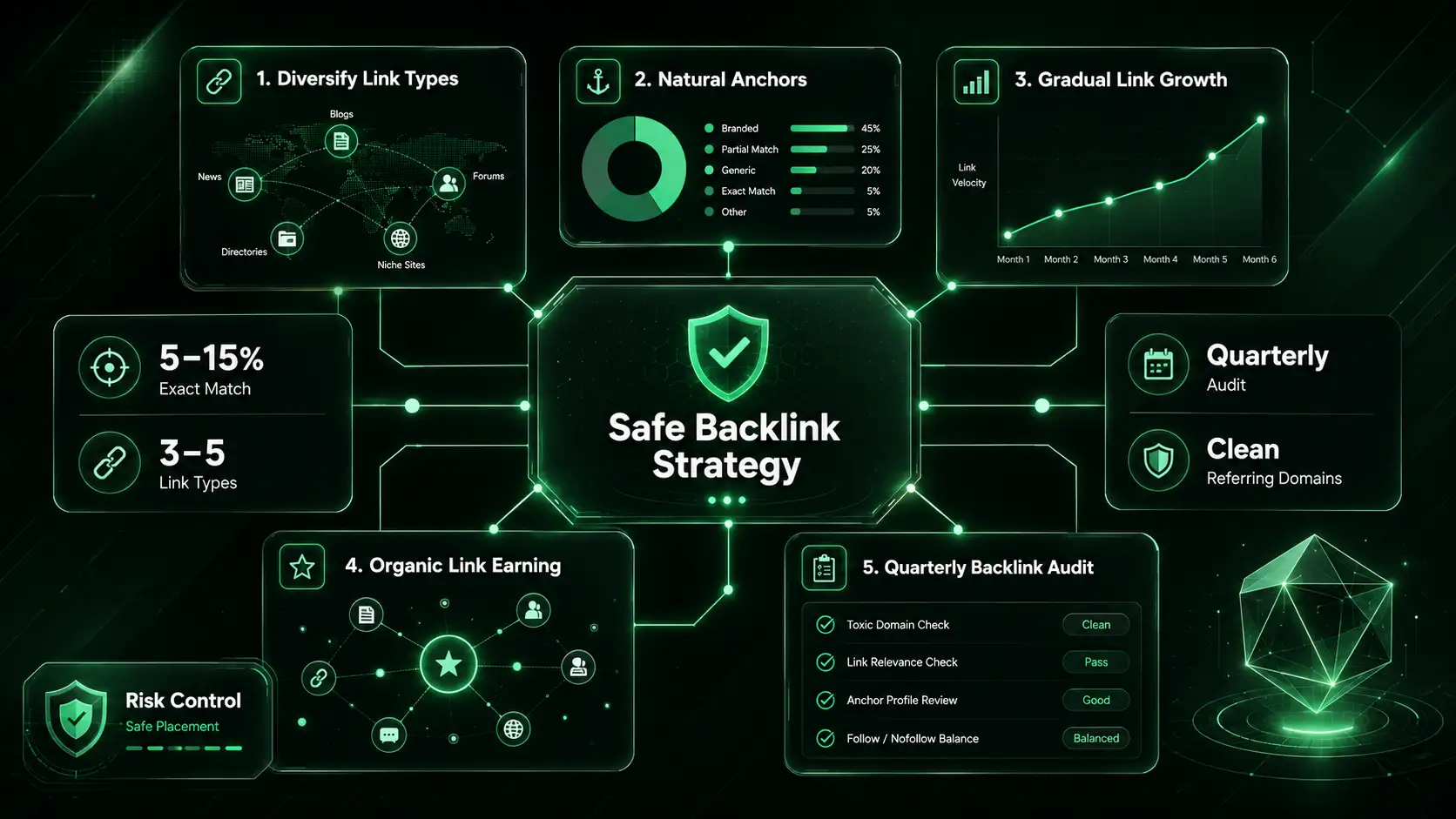
Diversify Link Types and Referring Domains
A natural backlink profile contains links from diverse sources — guest posts, niche edits, editorial mentions, resource pages, digital PR. Over-reliance on a single link type creates patterns that algorithmic systems can identify as artificial.
Aim for a minimum of 3–5 different link types across each campaign cycle and prioritize unique referring domains over multiple links from the same source.
Use Natural Anchor Text Distribution
Maintain a diversified anchor text profile across all paid and organic backlinks:
- Branded anchors: 30–40% (your company name or domain)
- Generic anchors: 20–30% (“click here,” “read more,” “this guide”)
- Partial match: 15–25% (one target keyword in a natural phrase)
- Naked URLs: 10–15% (the raw URL)
- Exact match: 5–15% maximum (commercial target keyword only)
Never concentrate exact-match anchor text across multiple placements in a short timeframe.
Build Links Gradually
Link velocity — the rate at which new backlinks are acquired — is an algorithmic signal. A sudden acquisition of 50 links within a week from a domain that previously grew slowly will draw algorithmic attention. Build links at a pace consistent with your domain’s historical acquisition rate, scaling gradually as authority grows.
Combine Paid Placements With Organic Link Earning
The most resilient backlink profiles combine paid placements with genuinely earned editorial links. Publish original research, data studies, and high-value guides that attract organic citations from industry publications. Use paid placements to supplement this organic base, not replace it.
Avoid Exact-Match Anchors at Scale
Using exact commercial keywords as anchor text across dozens of paid placements is one of the clearest signals of artificial link building. Limit exact-match anchors to no more than 10–15% of your total backlink profile and distribute them across time rather than concentrating them in a single campaign.
Maintain a Backlink Audit Process
Schedule quarterly backlink audits using Ahrefs or Google Search Console to:
- Identify and disavow newly discovered toxic or irrelevant links
- Confirm paid placements remain live and indexed
- Track changes in referring domain authority and traffic
- Update your anchor text distribution analysis
- Identify new link gap opportunities from competitor profiles
Common Mistakes to Avoid When Buying Backlinks
Even experienced SEO professionals make avoidable mistakes in paid link acquisition. These are the most common and costly errors.
Buying Links Only Based on DR or DA
Domain Rating and Domain Authority are useful starting filters, not final quality criteria. Many high-DR domains have achieved their scores through historical bulk link acquisition, reciprocal linking, or network participation — not genuine editorial authority. Always verify organic traffic and content quality independently of metric scores.
Ignoring Website Traffic Quality
A website with 10,000 monthly visitors from bot traffic or low-quality international sources provides no meaningful referral value and limited SEO benefit. Verify that organic traffic is genuine by checking geographic distribution, traffic sources, and keyword ranking patterns in Ahrefs or Semrush.
Placing Links on Irrelevant Domains
Irrelevant backlinks dilute topical authority signals and contribute to a mixed link profile that fails to reinforce your niche expertise. A cybersecurity website that acquires backlinks from fashion blogs, recipe sites, and entertainment portals sends a contradictory topical signal to search algorithms.
Using the Same Anchor Text Too Often
Repeating the same anchor text across multiple paid placements is one of the fastest ways to create a manipulative link pattern. Even if each individual link comes from a legitimate, high-quality site, consistent anchor repetition signals artificial coordination to Google’s algorithms.
Buying Large Link Packages Without Review
Bulk link packages — 10, 20, or 50 links sold as a single product — almost always prioritize volume over quality. Without individual review of each placement, you cannot verify topical relevance, content context, outbound link patterns, or anchor text suitability. Review every placement individually, regardless of package structure.
Tools for Checking Backlink Quality
Professional SEO tools are essential for evaluating backlink quality before purchase and monitoring performance after placement.
| Tool | Main Purpose | Key Features for Backlink Evaluation | Best Used For |
| Ahrefs | Backlink profile analysis and donor domain evaluation | Site Explorer for donor domain analysis; backlink filtering by DR, traffic, and anchor text; Content Explorer for link-worthy content opportunities; alerts for new and lost backlinks | Checking backlink strength, referring domains, anchor text distribution, and organic traffic estimates |
| Semrush | Backlink analytics, competitor research, and SEO auditing | Competitor backlink gap analysis; toxic link identification; disavow file creation; keyword rank tracking after link placements; full-site SEO auditing | Comparing competitor backlink profiles, finding link gaps, and monitoring ranking changes |
| Moz | Domain Authority and spam risk evaluation | Domain Authority analysis; Link Explorer backlink data; anchor text analysis; Spam Score filtering across the full link profile | Detecting potentially harmful referring domains and checking spam signals before placement |
| Google Search Console | First-party backlink and indexing data from Google | Monitoring newly acquired links; checking indexing status; identifying manual actions; submitting disavow files; tracking ranking changes | Understanding how Google sees the website’s backlink profile and managing toxic link remediation |
| Screaming Frog | Technical SEO crawling and backlink context analysis | Detection of indexing issues; internal link structure review; page authority distribution analysis; content quality checks; redirect chain and broken link detection | Auditing donor websites, checking technical issues, and evaluating link placement context |
Final Thoughts on Buying Quality Backlinks
Buying backlinks remains a central strategy in competitive SEO — used by agencies, in-house teams, and individual practitioners across virtually every industry. The practice is not inherently risky. The risk comes from doing it carelessly: choosing vendors based on price alone, ignoring topical relevance, over-optimizing anchors, or purchasing bulk packages without individual review.
A professional approach to paid link building is systematic, transparent, and built around quality signals that matter — organic traffic, topical relevance, editorial placement, and anchor text diversity. When these principles guide acquisition decisions, paid backlinks deliver measurable, sustainable improvements to search rankings and organic traffic.
The agencies and SEO professionals who benefit most from paid link building treat each placement as an investment decision, not a commodity purchase. They vet domains rigorously, monitor placements consistently, and combine paid acquisition with genuine content marketing and organic link-earning strategies.
The result is a backlink profile that improves rankings over time, withstands algorithmic updates, and builds genuine domain authority — not a fragile spike that collapses at the next Google core update.
Frequently Asked Questions About Buying Quality Backlinks
Buying backlinks is safe when done with proper vetting, topical relevance, and natural anchor text distribution. High-quality backlinks from organically trafficked, editorially maintained websites carry significantly lower risk than bulk packages or link farm placements. Safety scales directly with placement quality and the professionalism of the process used to acquire links.
The optimal volume depends on your domain’s current authority, niche competitiveness, and historical link acquisition rate. A new domain building initial authority may benefit from 5–15 quality links per month, while an established domain competing in a high-competition niche may require 20–40 monthly placements. Link velocity should always match the natural growth pattern of your domain.
A quality backlink from a vetted, organically trafficked domain typically costs between $100 and $800 for standard placements, with premium editorial and sponsored placements in high-authority publications reaching $1,500–$3,000+. Any placement offered for less than $30–$50 should be treated with significant skepticism regarding quality.
Guest post backlinks remain one of the most effective paid link types in 2025 when placed on real websites with genuine organic traffic and editorial standards. The combination of content context, topical relevance, and dofollow link placement makes quality guest posts a strong investment for authority building and competitive keyword rankings.
Yes — paid backlinks from topically relevant, high-authority domains consistently improve organic search rankings for target keywords when combined with sound on-page SEO and a diversified anchor text strategy. According to Semrush ranking factor research, referring domain count and backlink authority remain among the strongest correlating factors with top-three search rankings.
Most high-quality backlinks begin influencing rankings within 4–12 weeks of placement, though results vary based on domain age, keyword competitiveness, crawl frequency of the donor site, and the current authority of the target URL. Links placed on highly trafficked donor sites tend to be indexed and pass equity faster than links on low-traffic domains. Full ranking impact from a sustained link-building campaign is typically measurable within 3–6 months.