

Link-building outreach is one of the most operationally demanding and strategically rewarding activities in professional SEO. When executed correctly, a well-structured outreach campaign produces the kind of high-authority backlinks that close ranking gaps, strengthen backlink profiles, and build lasting publisher relationships. When executed carelessly, it burns time, damages the sender’s reputation, and delivers nothing measurable.
This guide covers the full process — from understanding what link-building outreach is, to deploying proven outreach email templates, to avoiding the mistakes that kill most campaigns before they gain momentum. Whether you manage outreach for SEO clients or you are building your own site’s link profile, the strategies here reflect real operational experience.
Key Takeaways
- Link-building outreach is the process of contacting website owners, editors, and content managers to earn contextual backlinks from relevant, editorially credible pages.
- The most effective link-building outreach strategies in 2026 include broken link-building, editorial link insertions, resource page outreach, and contributed article placement — each requiring a different email approach and prospect qualification standard.
- Personalized outreach emails significantly outperform generic mass-send campaigns, with reply rates for highly personalized pitches typically ranging between 8% and 18% compared to under 3% for templated cold outreach.
- Outreach results depend on three variables more than anything else: the quality of your linkable asset, the relevance of your prospect list, and the specificity of your pitch.
- Tools like Ahrefs, Hunter.io, NeverBounce, and BuzzStream make prospecting, contact discovery, and campaign management more efficient at scale.
- A single polite follow-up email sent five to seven business days after the original message is standard practice and often responsible for more than half of all campaign responses.

Mon-Fri: 09:00 AM – 06:00 PM
What is link-building Outreach?
Link-building outreach is the practice of proactively contacting website owners, editors, bloggers, and publishers to request or earn backlinks from their content to your target pages. Unlike passive link acquisition — where sites link to you organically because your content is strong — outreach is a deliberate, contact-driven process. You identify relevant pages, locate the right person responsible for content decisions, write a compelling personalized pitch, and follow up until you get a reply.
Outreach sits at the intersection of content marketing, relationship building, and technical SEO. According to Ahrefs’ analysis of organic ranking factors, the number and quality of referring domains remains one of the strongest predictors of page-level ranking position across competitive search results — which is precisely why link-building outreach campaigns remain a foundational SEO investment.
Why Outreach Still Works for SEO
Google’s ranking systems are built to reward links earned through editorial merit rather than purchased or manufactured at scale. Contextual backlinks from topically relevant, high-authority pages continue to carry more ranking weight than almost any other off-page signal. Outreach-acquired links — when earned from genuinely credible sites — carry full editorial authority and tend to be far more stable over time than links built through automated schemes.
The reason outreach still works is a simple alignment of interests. Most websites have published content that could benefit from additional external references, and most editors are open to improving that content if approached respectfully and with something genuinely useful to offer. link-building outreach serves both parties simultaneously — the editor gets better content, and the link builder gets a relevant, editorially placed backlink that search engines treat as a genuine endorsement.
link-building Outreach vs. Buying Backlinks
The operational difference between outreach and paid link acquisition is significant and worth understanding clearly before building any campaign strategy.
| Factor | link-building Outreach | Buying Backlinks |
| Acquisition method | Editorial pitch and value exchange | Direct commercial payment |
| Editorial endorsement | Yes — editor chooses to link | Depends on site quality |
| Average cost per link | Time-intensive, lower financial cost | Higher financial cost, faster |
| Risk level | Low when done correctly | Varies by site quality |
| Scalability | Moderate — limited by outreach capacity | Higher — can be ordered in volume |
| Link stability | High — editorial links rarely removed | Moderate — depends on agreement |
Understanding the quality backlink criteria that define a strong acquisition regardless of method helps you evaluate every link opportunity consistently across both approaches.
Main link-building Outreach Strategies
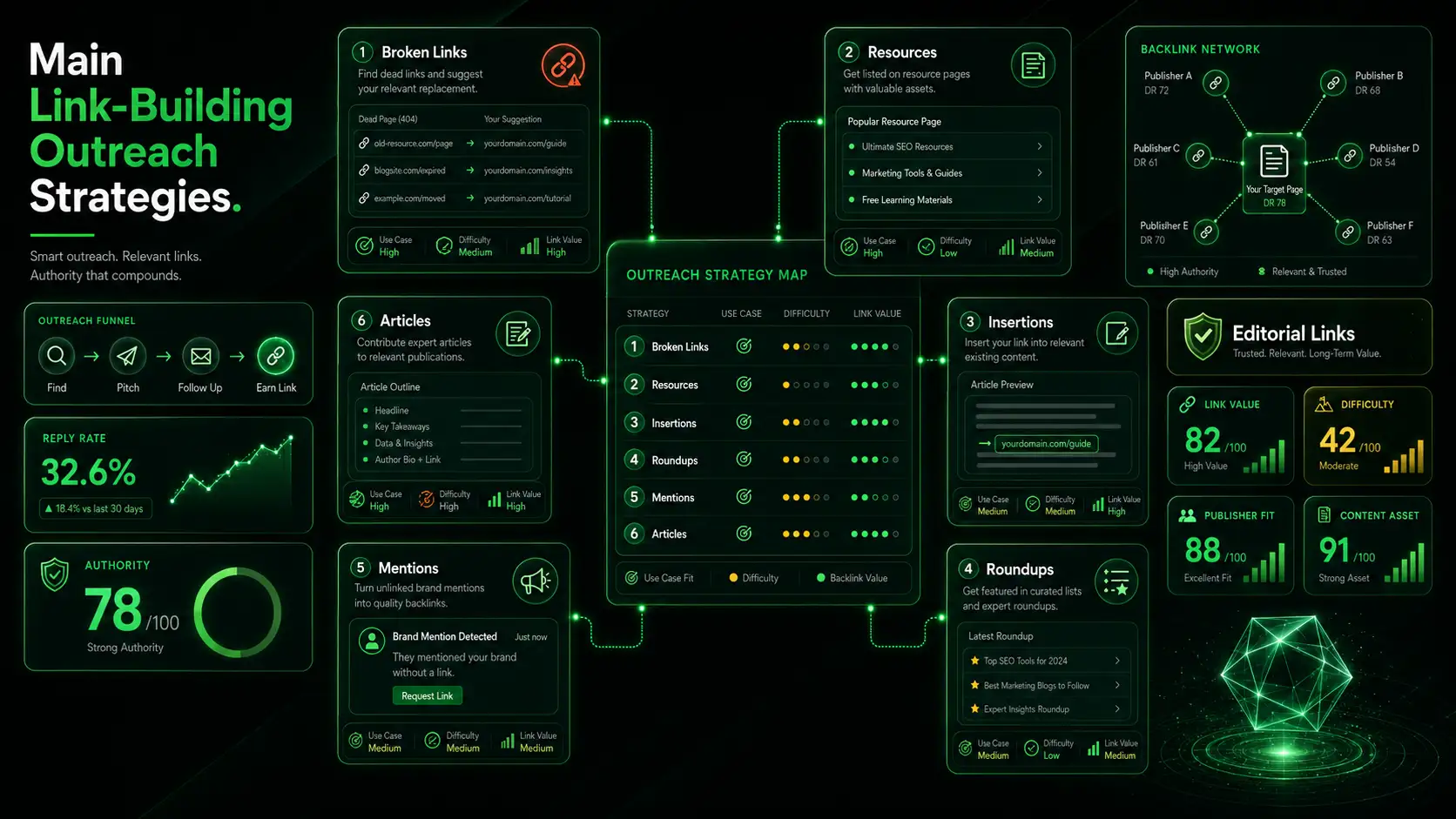
Not every outreach approach suits every situation. The strategy you choose should align with your linkable asset, your target pages, and the type of publisher you are approaching. The following table summarizes the key differences between the main outreach strategies before each is covered in detail.
| Strategy | Best For | Average Reply Rate | Difficulty |
| Broken link-building | Pages with strong existing content | 8–18% | Low–Medium |
| Resource page outreach | Guides, tools, data assets | 5–12% | Medium |
| Link insertion outreach | Specific topic pages | 6–14% | Medium |
| Listicle and roundup outreach | Products, tools, services | 4–10% | Medium |
| Unlinked brand mention outreach | Established brands | 10–20% | Low |
| Contributed article outreach | New referring domains | 5–15% | High |
Broken link-building
Broken link-building is the process of identifying dead external links on relevant pages and contacting the site owner to suggest your content as a working replacement. The value proposition is immediate and easy to communicate: you are helping the editor fix a real problem while providing a relevant, live resource to fill the gap left by the dead URL.
Ahrefs Site Explorer’s broken outbound links report allows you to identify dead links across competitor domains, resource pages, and industry publications at scale. The strongest broken link opportunities share these characteristics:
- The host page still generates meaningful organic traffic
- The broken link points to content your resource genuinely replaces
- The page was last updated within the past two years
- The site has a Domain Rating above 30 and real editorial content
Resource Page Outreach
Resource pages are curated collections of external links on a specific topic — industry reading lists, tool directories, expert reference roundups, or further reading sections. These pages exist specifically to link out to useful content, making them naturally receptive outreach targets.
Resource page outreach works best when your content genuinely belongs in the collection — not when it is forced into a page that only loosely matches your topic. Before reaching out, review the existing linked resources and confirm your asset complements rather than duplicates what is already listed. Editors who maintain resource pages receive dozens of generic requests every week — a pitch that references specific gaps in their list stands out immediately.
Link Insertion Outreach
Link insertion outreach — sometimes called niche edit outreach — involves identifying published articles where your resource would fit naturally as an in-context reference, then contacting the editor to suggest adding your link to a specific passage. Link insertions add measurable value to content that is already live, indexed, and generating traffic, without asking the editor to create anything new.
For e-сommerce backlinks specifically, link insertions into existing buyer guides and product comparison articles can be among the highest-converting placements available. The pitch needs to reference the exact section being targeted and explain precisely what additional context your resource provides for readers.
Listicle and Roundup Outreach
Many industries maintain regularly updated roundup articles aggregating recommendations for their readers — “best tools for [category],” “top [service] options in 2026,” and similar commercial-informational formats. Getting included provides a contextual backlink alongside brand exposure and positioning inside content that often ranks well for high-intent keywords.
Roundup inclusion outreach requires framing your pitch entirely around what your resource offers readers. Editors choose inclusions based on content quality and audience relevance, and they identify self-serving pitches within seconds. Position your asset as a genuinely competitive addition to the list, not as a link opportunity for your own site.
Unlinked Brand Mention Outreach
When a site mentions your brand name, product, or content title without hyperlinking to the original source, that mention represents a low-friction backlink opportunity. Converting unlinked brand mentions into active backlinks is one of the easiest wins in any outreach campaign because editorial intent already exists — the publisher already chose to reference your brand.
Ahrefs Alerts and targeted Google Search operators can identify unlinked brand mentions at scale. The outreach ask is minimal: you are not requesting that an editor add something new, just that they make an existing reference clickable. For established brands with meaningful search visibility, this strategy can consistently produce multiple new backlinks per week with very little prospecting effort.
Contributed Article Outreach
Contributed article outreach — more commonly called guest posting — is the practice of pitching original, editorial-quality articles to relevant publishers in exchange for a contextual backlink within the content. When executed at genuine editorial quality, contributed articles produce backlinks from topically relevant, high-authority domains that are difficult to acquire through any other outreach method.
The difference between effective guest posting and low-value link placement comes down to editorial standards, content quality, and host site credibility. Professional guest posting services place contributed articles on established publications with real organic traffic, genuine audiences, and editorial review processes. Your pitch should include a specific article title, a clear content angle, and a brief outline demonstrating that you understand the site’s audience well enough to write something genuinely useful.
How to Do Link-Building Outreach Step by Step
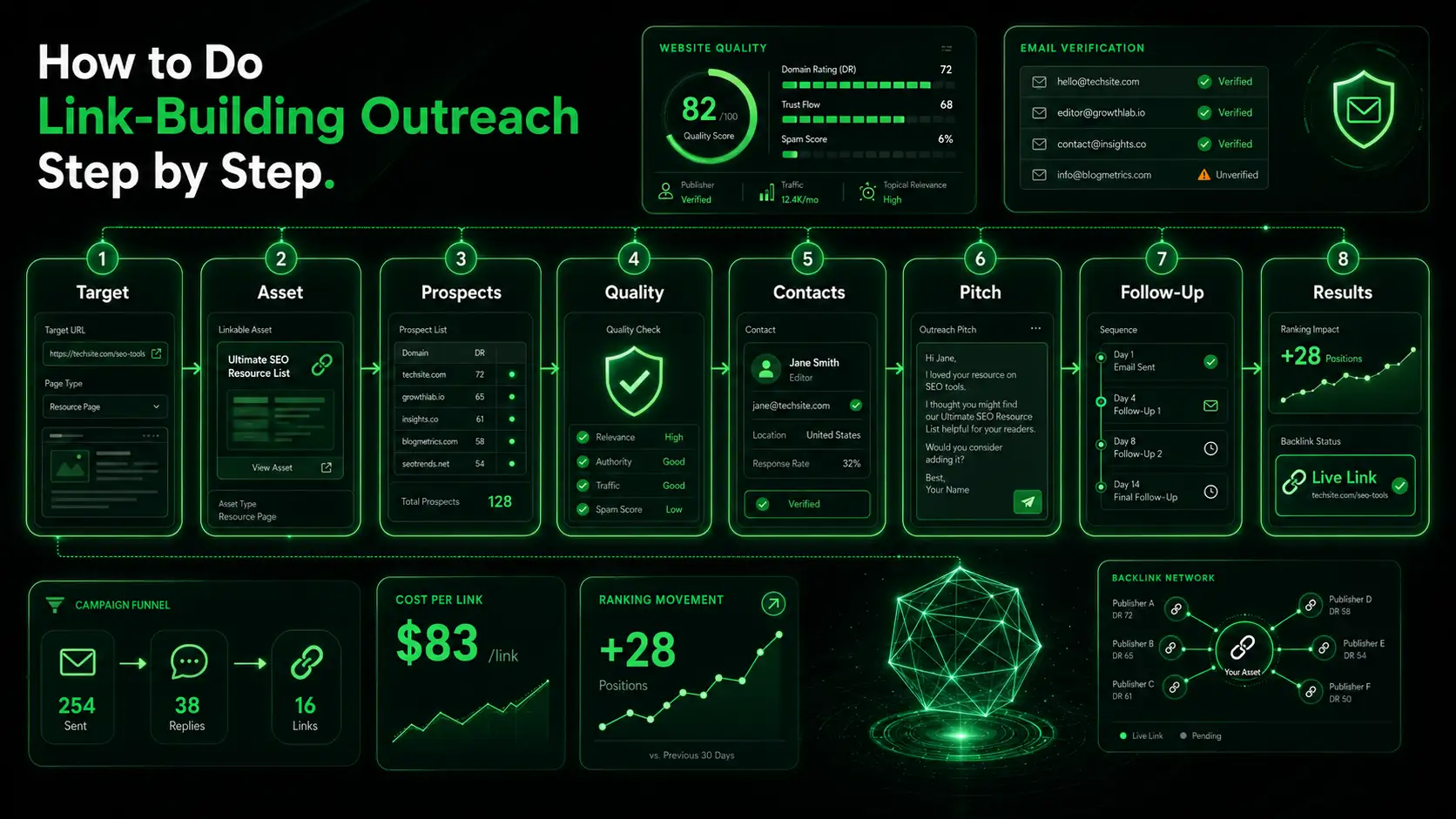
A systematic process is what separates link-building campaigns that generate consistent results from outreach efforts that burn resources and produce nothing. Every effective link-building outreach campaign follows a defined sequence from goal setting through to tracking and optimization.
Step 1. Define the Target Pages and Keywords
Before identifying a single prospect, establish which pages you are building links to and which keywords you are targeting. Your link-building goal determines everything downstream — which content assets to promote, which types of sites to approach, and which outreach strategies are most appropriate. Pages sitting in positions 4–15 for target keywords often need only a small number of high-quality backlinks to break into top-three positions, making them the highest-ROI targets for focused outreach campaigns.
Step 2. Create or Choose a Link-Worthy Asset
Outreach succeeds when you have something genuinely worth linking to. A thin product page or an underdeveloped article is not a linkable asset — it will not earn editorial placements regardless of how well the outreach email is written. High-quality resources that consistently attract editorial links share these characteristics:
- Original research, data, or documented case studies
- Comprehensive guides that solve a specific user problem in full
- Free tools, calculators, or interactive resources
- Expert commentary with verifiable credentials behind it
- Content that is measurably more detailed than what already ranks
Step 3. Find Relevant Outreach Prospects
Prospect research is the foundation of every effective link outreach campaign. Relevance is the first and non-negotiable criterion — a backlink from a domain in the same or adjacent topical category carries significantly more authority weight than a link from an unrelated site with higher metrics. Use competitor backlink analysis in Ahrefs, Google Search operators targeting specific page types, and niche research to build a prospect list anchored in topical fit before any quality filtering begins.
Step 4. Check Website Quality and Relevance
Not every site that appears in prospect research is worth contacting. Before reaching out, verify the target site against these disqualifying signals:
- Zero or declining organic traffic in Ahrefs or Semrush
- Mass-produced thin content with no identifiable editorial team
- Excessive monetized outbound links to unrelated commercial pages
- No visible site history, author bios, or real About page
- Domain registered within the past 12 months with no backlink history
Sites that fail these checks are link farms. Backlinks from them carry no SEO value and may create risk signals in your backlink profile that require future cleanup.
Step 5. Find the Right Contact Person
Sending an outreach email to a generic info@ address rarely produces results. Identifying the specific person responsible for content decisions — the editor, content manager, blog owner, or digital marketing lead — is one of the highest-impact improvements you can make to outreach reply rates. Author bios, LinkedIn profiles, team pages, and contact pages are the primary sources for identifying the right contact at each prospect site.
Step 6. Write a Short Personalized Pitch
Your outreach email should demonstrate that you have read the target page, understand the site’s audience, and have a specific reason for reaching out. An effective link-building outreach email follows this structure:
- Open with a specific reference to the target page or content
- Identify the exact gap or problem your resource addresses
- Present your URL with a one-sentence value explanation
- Make a single, clear request — nothing more
- Close professionally and keep the entire email under 150 words
Generic link-building emails are identifiable in seconds. Editors delete them without reply. Specificity is the only reliable differentiator in competitive outreach environments.
Step 7. Send One Follow-Up Email
Most replies to link-building outreach come after at least one follow-up. Editors are busy, inboxes are crowded, and even genuinely interested recipients lose track of initial emails. A single polite follow-up sent five to seven business days after the original email is standard professional practice — not aggressive, and not spam. Keep the follow-up short: reference your original message briefly, restate the value clearly, and include your URL. If there is still no reply after one follow-up, move on.
Step 8. Track Replies, Links, and SEO Results
Every outreach contact, reply, placed link, and rejection should be logged consistently. Tracking allows you to:
- Measure campaign performance and cost-per-link accurately
- Identify which email templates produce the best reply rates
- Refine prospect qualification criteria based on conversion data
- Maintain organized relationship records for future outreach
- Report accurately on link-building ROI to clients or stakeholders
Without tracking, outreach campaigns become impossible to evaluate, optimize, or scale.
link-building Outreach Email Templates
These templates are designed to be adapted, not copied verbatim. The most effective link-building outreach emails add specific personalized context on top of a clean structural framework — the template provides the skeleton, and your research provides the substance that makes each email feel individually crafted for the recipient.
Broken link-building Template
Subject: Broken link on your [Topic] page
Hi [Name],
I was reading your article on [Topic] and noticed that one of the links no longer works:
[Broken URL]
This resource may be a useful replacement:
[Your URL]
It covers [Brief Value] and could help readers replace the broken reference.
Best, [Your Name]
Resource Page Outreach Template
Subject: Resource suggestion for [Page Name]
Hi [Name],
I found your resource page about [Topic] and noticed that it includes helpful references for [Audience].
This guide may be a relevant addition:
[Your URL]
It explains [Brief Value] and could support readers looking for [Specific Benefit].
Best, [Your Name]
Link Insertion Outreach Template
Subject: Useful reference for your article on [Topic]
Hi [Name],
I read your article about [Topic] and found the section on [Specific Section] especially useful.
This resource may add more context to that part:
[Your URL]
It covers [Brief Value] and could be helpful for readers who want more detail.
Best, [Your Name]
Unlinked Brand Mention Template
Subject: Quick update to your mention of [Brand]
Hi [Name],
Thank you for mentioning [Brand] in your article:
[Article URL]
Could you add a link to the brand name so readers can find the original source more easily?
Suggested URL:
[Your URL]
Best, [Your Name]
Contributed Article Outreach Template
Subject: Article idea for [Website Name]
Hi [Name],
I noticed that [Website Name] publishes content about [Topic].
I would like to suggest an original article idea:
[Proposed Title]
The article would cover:
- [Point 1]
- [Point 2]
- [Point 3]
It would be practical, non-promotional, and written for your audience.
Best, [Your Name]
Follow-Up Template
Subject: Re: [Original Subject]
Hi [Name],
Just following up on my previous email about [Short Context].
The suggested resource is here:
[Your URL]
It may be useful for your section on [Topic] because [Brief Reason].
Best, [Your Name]
Tools for link-building Outreach
Choosing the right tools reduces manual effort, improves data accuracy, and gives link-building campaigns a measurable operational advantage. The table below compares the primary tools used in professional outreach workflows.
| Tool | Primary Function | Best Used For |
| Ahrefs | Backlink analysis and prospecting | Competitor research, broken links, DR filtering |
| Semrush | Backlink gap analysis | Finding prospects competitors have, you don’t |
| Hunter.io | Email discovery | Finding contact emails from domain names |
| NeverBounce | Email verification | Removing invalid emails before sending |
| ZeroBounce | Email verification and scoring | Deliverability protection at scale |
| BuzzStream | Outreach CRM | Managing campaigns, replies, and relationships |
| Google Sheets | Manual tracking | Small campaigns, client reporting |
Ahrefs or Semrush for Prospect Research
Ahrefs and Semrush are the two primary tools used for link-building prospect research at a professional level. Ahrefs Site Explorer provides competitor backlink profiles, broken outbound link reports, and Content Explorer searches that together cover the full spectrum of outreach prospect discovery. Semrush’s Backlink Gap tool identifies referring domains linking to multiple competitors but not yet linking to your site — one of the most efficient ways to build a qualified outreach target list quickly.
Hunter.io for Email Discovery
Hunter.io finds professional email addresses associated with any domain, using a combination of public data sources and pattern recognition. Entering a target domain into Hunter.io returns the most likely email format used by that organization, along with any publicly verified addresses for specific team members. For link-building outreach campaigns targeting dozens or hundreds of sites, Hunter.io reduces contact research time significantly compared to manual investigation of each site individually.
NeverBounce or ZeroBounce for Email Verification
Email bounces damage sender reputation and reduce deliverability across entire outreach campaigns. NeverBounce and ZeroBounce both validate email addresses before sending, identifying hard bounces, role-based addresses, and spam trap risks that would otherwise harm your domain’s sending reputation. Running every prospect email through a verification tool before launching a campaign is standard practice in professional link-building outreach operations.
BuzzStream or Google Sheets for Outreach Tracking
BuzzStream functions as a purpose-built CRM for link-building outreach, allowing teams to manage prospect lists, track reply status, schedule follow-ups, and log placed links in one centralized system. For campaigns targeting more than 50 prospects, BuzzStream reduces management overhead significantly compared to manual spreadsheet tracking. For smaller campaigns or solo SEOs with limited budgets, a well-structured Google Sheets template with columns for prospect URL, contact name, email, outreach date, reply status, and link placement date provides sufficient tracking capability.
Common Link-Building Outreach Mistakes
Most link-building outreach campaigns underperform for predictable, avoidable reasons. Understanding the most common mistakes is as valuable as understanding the best strategies.
Sending Generic Mass Emails
Generic outreach emails — identical pitches sent to hundreds of sites without any personalization — produce reply rates below 2% and frequently trigger spam filters that reduce deliverability for all future emails sent from that domain. Every outreach email should reference something specific about the target page, whether that is a particular section, a specific claim that your resource supports, or a gap in the content that your asset addresses.
Targeting Irrelevant Websites
Sending link-building outreach to sites that have no topical connection to your content wastes both your time and the recipient’s. Backlinks from topically irrelevant domains contribute minimal ranking value regardless of the host site’s Domain Rating. Build prospect lists around subject matter relevance first, and filter by quality metrics second — not the other way around.
Asking for a Link Without Offering Value
An outreach email that simply says “please link to my page” with no clear explanation of why that link serves the editor’s readers will be ignored or deleted. Every effective outreach pitch answers one question from the editor’s perspective: why would my readers benefit from this link? Lead with that answer, and the request follows naturally.
Using Repetitive Anchor Text
Over-optimized anchor text — using the same exact-match keyword phrase in every link placement — creates an unnatural backlink profile that search engines identify as manipulative. A healthy anchor text distribution for a link-building outreach campaign looks something like this:
- 40–50% branded anchors (company name, domain name)
- 20–30% natural anchors (click here, read more, this article)
- 15–25% partial match anchors (related to the keyword but not exact)
- 5–10% exact match anchors (the precise target keyword)
Staying within these ranges keeps your backlink profile looking editorially natural across campaigns.
Following Up Too Aggressively
Sending three or more follow-up emails within a week, or continuing to contact editors who have not responded after two touchpoints, damages both deliverability and professional reputation. One follow-up email is standard outreach practice. Two is the absolute maximum in most situations. Beyond that, you are generating spam complaints — not backlinks.
Final Thoughts on link-building Outreach
link-building outreach remains one of the most durable and effective strategies in SEO precisely because it is built on a genuine value exchange rather than a technical workaround. When you approach outreach with a strong linkable asset, a qualified prospect list, personalized email copy, and a disciplined tracking process, the results compound over time — not just in backlinks acquired, but in publisher relationships that continue generating link opportunities across future campaigns.
The fundamentals have not changed significantly in 2026: relevance matters more than volume, personalization outperforms automation, and editorial link quality beats raw link quantity at every stage of competitive ranking. What has changed is the operational tooling available to implement those fundamentals more efficiently, and the sophistication required to evaluate prospect quality accurately enough to protect backlink profiles from low-value placements.
Build your outreach campaigns on these principles, refine your process based on real reply and conversion data, and treat every publisher relationship as a long-term asset — and link-building outreach will continue to deliver compounding SEO returns regardless of how search algorithms evolve.
Frequently Asked Questions About Link-Building Outreach
Link-building outreach is the process of contacting website owners, editors, and publishers to earn contextual backlinks from their content to your target pages. It is a proactive, relationship-driven strategy that produces editorially placed backlinks — the type that search engines like Google treat as genuine endorsements of content quality and topical authority.
An effective link-building outreach email is short, specific, and leads with value for the recipient rather than a request. Reference a specific section of the target page, explain precisely how your resource adds value to their content or their readers, make a single clear request, and keep the entire message under 150 words. Personalization based on real page context is the single most important factor in improving reply rates.
A good link-building outreach reply rate ranges between 5% and 15%, depending on niche, prospect quality, and the level of email personalization. Highly targeted outreach to pre-qualified prospects with genuinely personalized emails can reach 15–20% reply rates. Generic mass-send campaigns typically fall below 3% and are often flagged as spam before they reach the recipient’s inbox.
One follow-up email is standard practice in professional link-building outreach. Send the first follow-up five to seven business days after the original email, keep it brief, and restate the value clearly. Sending more than two follow-ups to a non-responsive prospect generates diminishing returns and risks spam complaints that damage your domain’s sender reputation.
The best link-building outreach strategy depends on your linkable asset and your target site type. Broken link-building produces the highest reply rates for sites with strong existing content assets. Contributed article outreach generates the most new referring domains. Unlinked brand mention outreach requires the least prospecting effort for established brands. Most professional link-building campaigns combine two or three strategies simultaneously to maximize outreach results.
The most effective combination of tools for a professional link-building outreach campaign includes Ahrefs or Semrush for prospect research and competitor backlink analysis, Hunter.io for email address discovery, NeverBounce or ZeroBounce for email verification before sending, and BuzzStream or Google Sheets for campaign tracking and relationship management. Each tool addresses a distinct operational stage — using all of them together eliminates the most common points of failure in outreach campaign execution.