

E-commerce websites compete in some of the most aggressive search engine environments online. Without a structured e-commerce link-building program, even technically sound stores struggle to rank for commercial keywords. Backlinks remain one of Google’s strongest ranking signals — and for e-commerce SEO, building a diversified, high-quality backlink profile is non-negotiable.
Key Takeaways
- E-commerce link building must target product and category pages, not just the homepage
- High-quality backlinks from domains with DR 40+ drive the strongest ranking improvements
- Guest posting, digital PR, product reviews, and contextual placements produce the best results
- Use a tool like Ahrefs or Semrush for competitor analysis and backlink monitoring
- Anchor text diversity and link velocity control prevent algorithmic penalties
- Backlinks compound over time — organic authority built today generates revenue for years
What Is E-Commerce Link Building?
E-commerce link building is the process of acquiring external hyperlinks pointing to your online store — including product pages, category pages, blog posts, and the homepage. Each backlink signals editorial trust to search engines. According to Ahrefs’ backlink research, the number of unique referring domains correlates more strongly with rankings than raw backlink volume.
How Backlinks Support E-commerce SEO
Backlinks transfer link equity from external sites to your e-commerce pages, increasing Google’s trust in your content. They also accelerate crawling and indexing of new product pages. Strong backlink profiles compress the time between product launch and first-page visibility.

Mon-Fri: 09:00 AM – 06:00 PM
Why Product and Category Pages Need Authority Signals
Category pages target high-competition transactional keywords. Without direct external backlinks, even well-optimized product pages cannot outrank competitors with stronger referring domain profiles. Internal links alone cannot compensate for missing external authority on commercial URLs.
Difference Between Backlinks, Internal Links, and External Links
| Link Type | Direction | SEO Function |
| Backlinks | External → Your site | Transfer authority from third parties |
| Internal links | Page → Page (same site) | Distribute existing authority internally |
| External links | Your site → Other sites | Establish topical context; use nofollow where needed |
Why Backlinks Matter for e-commerce Websites
e-commerce brands that consistently win in organic search maintain structured, ongoing link acquisition programs. Backlinks serve four core functions:
Improving Rankings for Product and Category Pages
Product pages with five or more high-quality referring domains from topically relevant websites rank measurably higher than pages with no external links — particularly in competitive product verticals.
Building Topical Authority in Competitive Niches
When an e-commerce store earns links consistently from sites within the same niche, Google recognizes it as a topically authoritative entity. New product pages then launch with faster indexing and stronger baseline authority.
Increasing Referral Traffic From Relevant Websites
High-quality backlinks from niche publishers drive qualified referral visitors with purchase intent. A single product review on a high-traffic blog can generate hundreds of monthly clicks long after publication.
Supporting Long-Term Organic Revenue Growth
Unlike paid search, backlinks generate compounding returns. A link acquired today may improve rankings and drive traffic for three to five years. According to Moz’s search ranking factors research, link signals remain a dominant factor in Google’s algorithm across all major updates.
Best Types of Backlinks for E-commerce SEO
The best backlinks for e-commerce SEO are links that combine topical relevance, real organic traffic, and a natural placement within useful content. For online stores, the strongest results usually come from backlinks that support commercial pages directly, including product pages, category pages, buying guides, and brand-focused content.
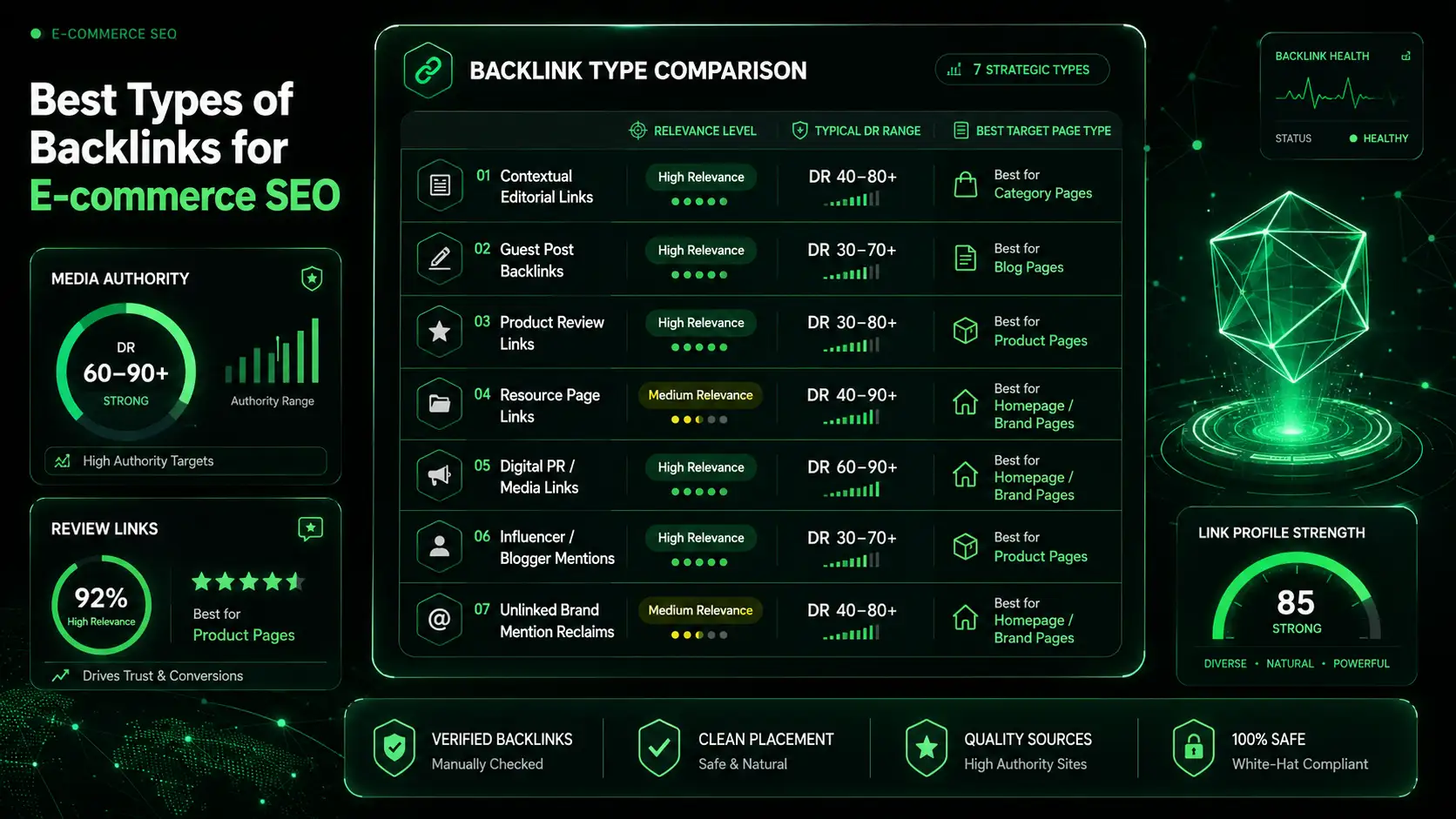
| Backlink Type | Relevance Needed | Typical DR | Best Target Page |
| Contextual editorial links | High | 30–80+ | Category & product pages |
| Guest post backlinks | High | 25–70 | Blog & commercial pages |
| Product review links | Medium–High | 20–60 | Product pages |
| Resource page links | Medium | 20–60 | Category & guide pages |
| Digital PR / media links | High | 50–90+ | Homepage & brand pages |
| Influencer / blogger mentions | Medium | 10–50 | Product pages & brand |
| Unlinked brand mention reclamation | N/A | Varies | All page types |
Contextual Backlinks From Relevant Articles
Links embedded within relevant article body text carry the highest per-link authority. Surrounding content gives Google semantic context that reinforces topical relevance between the donor site and your e-commerce category pages.
Guest Post Backlinks on Niche Websites
Guest posting gives you control over anchor text, target URL, and content context. Effective e-commerce link building outreach focuses on websites whose audience matches your target buyers — not generic article directories.
Product Review Backlinks
Earned when bloggers or journalists review your products and link to the product page. These combine commercial relevance with editorial credibility — one of the strongest link types for product page authority.
Resource Page Backlinks
Curated niche resource lists pass targeted link equity from pages already ranking for informational queries. Getting listed alongside relevant brands signals topical authority to search engines.
Digital PR and Media Mentions
Media backlinks from outlets with DR 60+ deliver the highest per-link authority in e-commerce SEO. One placement in a major publication can outperform dozens of mid-tier guest posts. Effective triggers include original research, product data studies, and newsworthy brand stories.
Influencer and Blogger Mentions
Micro-influencers with niche blogs often produce higher-quality backlinks than large generalist accounts. Authentic editorial mentions within how-to content or product roundups carry strong algorithmic trust signals.
Unlinked Brand Mentions
Existing editorial mentions without hyperlinks are the fastest link reclamation opportunity. Use Ahrefs Content Explorer or Google Alerts to surface mentions, then pitch site owners to add the link.
Best Strategies to Get Backlinks for an E-commerce Website
Create Linkable Assets Around Your Products
Develop content that earns links passively:
- Sizing and measurement guides with original data
- Material or ingredient comparison charts
- Manufacturing process explainers
- Original product benchmark studies
Publish Informational Blog Content for Commercial Niches
Blog content attracts editorial links that internally flow authority to product pages. A sporting goods store publishing training guides earns links from fitness publications — those links elevate the entire domain and support category page rankings.
Use Guest Posting on Relevant Industry Websites
Guest posting provides precise control over anchor text and target URL. Follow a proven guest posting for e-commerce websites framework to build a consistent monthly pipeline of placements across niche-relevant domains.
Turn Product Reviews Into Backlink Opportunities
- Identify bloggers in your niche with DR 20+ sites
- Ship products with a brief editorial brief
- Follow up after 2–3 weeks to confirm publishing
- Request a link to the specific product page if not included
Find and Reclaim Unlinked Brand Mentions
- Search Ahrefs Content Explorer for your brand name
- Filter by pages without links to your domain
- Sort by DR to prioritize high-value targets
- Send a brief, personalized outreach requesting the link addition
Analyze Competitor Backlink Profiles
Export referring domains from the top five organic competitors. Filter for:
- DR 30+
- Relevant topical coverage
- Active organic traffic
- Multiple competitor links (highest-priority targets)
Use Broken Link Building for Product Guides and Resources
Find broken external links on niche sites using Ahrefs or Screaming Frog. Pitch your e-commerce resource as a replacement — outreach opens with a genuine value proposition (fixing a broken page) rather than a cold request.
Build Relationships With Bloggers and Influencers
Long-term relationships generate recurring coverage: product roundups, seasonal gift guides, and launch reviews. Start with genuine engagement — comment on content, share articles — before pitching product collaborations.
Create Infographics and Visual Assets
Embed-ready infographics attract passive backlinks. Effective topics for e-commerce:
- Supply chain and sourcing visualizations
- Product care and maintenance guides
- Category comparison matrices with original data
Get Listed in Relevant Brand and Product Directories
Niche directories provide foundational topical relevance and referral traffic. Prioritize directories that:
- Already list your direct competitors
- Maintain editorial standards and regular updates
- Have genuine organic traffic and domain authority
Launch Affiliate or Partner Programs
Affiliate programs convert external publishers into active link builders with financial incentive. Even nofollow affiliate links generate brand mentions, referral traffic, and some editorial follow links from affiliates who genuinely endorse your products.
Use Digital PR Campaigns for Newsworthy Products
Earn high-authority media backlinks by developing genuinely newsworthy content:
- Original consumer research or survey data
- Product innovation or breakthrough material stories
- Industry trend analysis with proprietary data
Combine earned media with structured, high-quality backlinks for e-commerce to build a comprehensive link acquisition strategy.
Step-by-Step e-commerce Backlink Building Process
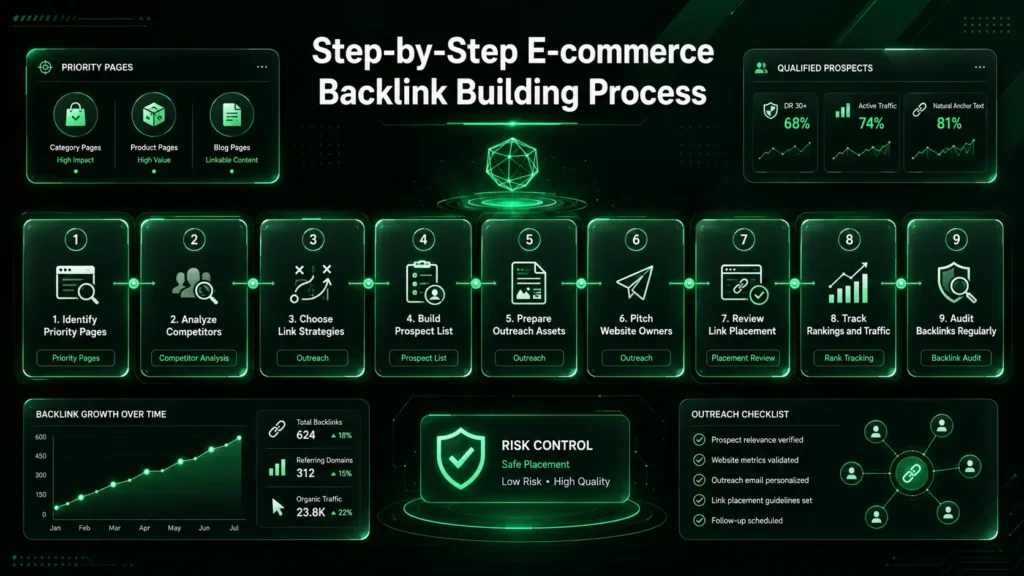
Step 1. Identify Priority Product, Category, and Blog Pages
Classify pages into tiers:
| Tier | Page Type | Priority Criteria |
| Tier 1 | Category pages | High volume, positions 4–15 |
| Tier 2 | Product pages | Strong conversion rate, DR gap vs. competitors |
| Tier 3 | Blog pages | Support Tier 1–2 via internal links |
Step 2. Analyze Competitors’ Referring Domains
- Export referring domains for top 5 organic competitors via Ahrefs or Semrush
- Filter: DR 30+, active traffic, topical relevance
- Flag domains linking to 3+ competitors as highest-priority targets
Step 3. Choose the Most Relevant Backlink Strategies
Match strategy to page type:
| Target Page | Best Strategies |
| Category pages | Resource pages, buying guides, editorial mentions |
| Product pages | Reviews, guest posts, influencer placements |
| Blog pages | Contextual editorial links, broken link building |
Step 4. Build a Prospect List of Niche Websites
Qualify prospects against these criteria:
- DR 25+ with real organic traffic
- Relevant topical coverage (not multi-niche spam)
- Active publishing schedule with original authored content
- No excessive advertising or thin-content indicators
Step 5. Prepare Outreach Assets and Content Ideas
- Guest post: 3–5 tailored topic pitches per prospect cluster
- Product review: brand brief + product sample + target page list
- Resource page: one-paragraph pitch explaining your listing’s value
- Broken link: screenshot of broken link + replacement URL
Step 6. Pitch Website Owners, Bloggers, and Editors
Structure every outreach email:
- Personal opener referencing recent content from the recipient
- Clear pitch with specific context for the request
- Value statement explaining what their audience gains
- Simple CTA — one action, no multiple options
Follow up once after 7 days. Do not follow up more than twice.
Step 7. Review Link Placement Quality Before Approval
Confirm before going live:
- Link appears within body content (not sidebar or footer)
- Anchor text reads naturally in context
- Surrounding content is topically relevant
- Target URL is the most appropriate page on your e-commerce site
Step 8. Track Rankings, Traffic, and Referral Leads
- Monitor keyword ranking changes weekly for the first 90 days post-placement
- Track referral sessions in Google Analytics per referring domain
- Document which domain types produce the strongest ranking movements
Step 9. Audit New and Existing Backlinks Regularly
Run a full audit every 90 days:
- Identify and investigate lost links for reclamation
- Flag toxic or spammy new links for disavow
- Cross-reference Ahrefs data with Google Search Console link reports
How to Build Backlinks to e-commerce Category Pages
Use Buying Guides and Comparison Content
Pitch your category page as a resource within “best of” and buying guide articles. Buying guides targeting transactional keywords are the highest-converting external link placements for category pages.
Add Category Pages to Relevant Resource Lists
Identify niche resource pages listing competitor brands. Submit your category page with a brief, specific pitch explaining what distinguishes your product selection.
Support Category URLs With Blog-to-Category Internal Links
Publish informational blog posts targeting adjacent keywords, then internally link to the category page. This funnels external link equity — earned by the blog post — directly to the commercial URL.
Earn Mentions From Niche Publishers and Review Sites
Proactively pitch niche publishers with:
- Category-specific product roundups
- Seasonal buying guides relevant to your product range
- Trend articles where your category is a natural reference point
How to Build Backlinks to E-commerce Product Pages
Send Products to Bloggers and Reviewers
A targeted product seeding campaign across 10–15 niche bloggers typically produces 6–10 published reviews with direct product page backlinks within 4–6 weeks.
Use Expert Roundups and Product Comparisons
Pitch your products for inclusion in expert roundups and “best product” comparison articles. These generate direct product page links from high-intent content that also drives referral conversions.
Promote Unique Product Data, Studies, or Use Cases
Original data — durability test results, performance benchmarks, user study outcomes — gives journalists and bloggers a reason to cite and link to specific product pages as the data source.
Avoid Overusing Exact-Match Commercial Anchors
Maintain a healthy anchor text distribution:
| Anchor Type | Recommended Share |
| Brand name | 30–40% |
| Natural phrase / partial match | 25–35% |
| Generic (click here, read more) | 10–20% |
| Exact-match commercial keyword | 5–15% |
| Naked URL | 5–10% |
Common E-commerce Link Building Mistakes to Avoid
Buying Low-Quality Bulk Backlinks
Bulk backlink packages from link farms produce short-term gains followed by algorithmic penalties. Low-quality backlinks from sites with no organic traffic and DR below 10 dilute your profile without contributing ranking improvement.
Getting Links From Irrelevant Websites
A backlink from a cooking blog to a B2B software e-commerce site carries minimal topical relevance and may confuse rather than support your authority signals. Relevance is a prerequisite for link value.
Ignoring Content Quality on Donor Sites
Links from sites with thin, auto-generated, or plagiarized content are high-risk. Always review the quality of surrounding content before approving a link placement.
Using Repetitive Anchor Text
Over-optimizing with the same exact-match anchor text triggers Penguin-related penalties. Use the distribution table above as a guideline and vary phrasing naturally across placements.
Building Links Only to the Homepage
Homepage-only link building misses the pages that generate e-commerce revenue. Distribute link acquisition across category pages, product pages, and blog content for maximum impact on organic revenue.
Neglecting Internal Linking Between Commercial and Informational Pages
Without internal links from blog posts to product and category pages, external authority earned by informational content never reaches commercial URLs. Audit internal linking structure every quarter.
Tools for E-commerce Backlink Building
| Tool | Primary Use | Key Feature for e-commerce |
| Ahrefs | Competitor backlink analysis | Referring domain explorer, link intersect |
| Semrush | Link gap research, toxic link checks | Backlink gap tool, Toxic Score |
| Google Search Console | Monitoring existing backlinks | Free, direct Google data, link reports |
| BuzzSumo | Finding linkable content ideas | Top-shared content by niche topic |
| Screaming Frog | Technical and internal link audits | Full site crawl, broken link detection |
Ahrefs for Competitor Backlink Analysis
Ahrefs’ Site Explorer reveals every referring domain, anchor text, and backlink type pointing to competitor e-commerce sites. Use Ahrefs Link Intersect to find domains linking to multiple competitors but not yet to your site — the most actionable prospect list available.
Semrush for Link Gap Research and Toxic Link Checks
Semrush’s Backlink Gap tool compares your referring domain profile against up to four competitors simultaneously. The Toxic Score feature flags risky links for disavow before they trigger manual actions.
Google Search Console for Monitoring Existing Backlinks
Google Search Console provides direct data on which domains Google has recognized as linking to your e-commerce site. Use it to cross-reference Ahrefs data and identify discrepancies in link indexing.
BuzzSumo for Finding Linkable Content Ideas
BuzzSumo surfaces the most-shared and most-linked content within any niche topic. Use it to identify content formats that earn backlinks naturally in your product category before investing in content production.
Screaming Frog for Technical and Internal Link Audits
Screaming Frog crawls your e-commerce site to map internal link structures, identify orphan pages receiving no internal links, and surface broken internal links that waste link equity.
How to Measure e-commerce Link Building Results
Referring Domain Growth
Track unique referring domain count monthly in Ahrefs or Semrush. Healthy e-commerce link building programs produce consistent month-over-month growth in referring domains — not spikes followed by drops.
Keyword Ranking Improvements
Monitor ranking positions for target keywords on priority category and product pages. Rank tracking in Ahrefs or Semrush shows position changes correlated with new link acquisitions.
Organic Traffic to Product and Category Pages
Measure organic sessions to Tier 1 and Tier 2 pages in Google Analytics. Ranking improvements from link building should produce measurable organic traffic growth within 60–120 days of link acquisition.
Referral Traffic and Assisted Conversions
Track referral sessions and assisted conversions in Google Analytics to quantify the direct revenue contribution of individual backlinks. High-DR niche publications often produce both immediate referral revenue and long-term ranking benefits.
Revenue Impact From Organic Search
Connect organic keyword rankings to e-commerce revenue using Google Analytics e-commerce tracking. The ultimate KPI for e-commerce link building is revenue generated from organic search — not Domain Authority or backlink counts in isolation.
Final Thoughts on e-commerce Backlink Strategies
Effective e-commerce link building requires three things working together: the right page targets, the right referring domains, and the right content to earn those links. Homogeneous tactics — guest posts only, or directories only — produce limited results. The e-commerce brands that dominate organic search combine contextual placements, editorial outreach, digital PR, and strategic e-commerce link building outreach into a sustained, measured program.
Start with competitor backlink analysis. Build a qualified prospect list. Deploy multiple acquisition strategies simultaneously. Audit regularly. The compounding effect of consistent link building is what separates e-commerce stores that grow organically from those that remain permanently dependent on paid traffic.
Frequently Asked Questions About E-commerce Backlinks
The most reliable ways to build backlinks for e-commerce are guest blogging, product review outreach, digital PR, and unlinked brand mention reclamation. To find link building opportunities, start with competitor analysis — identify which domains already link to similar stores and pitch them first. Combining multiple link-building strategies simultaneously produces faster results than relying on a single tactic.
The best ways to build backlinks for an e-commerce business include contextual placements on niche-relevant sites, guest post opportunities on industry blogs, and press release distribution for product launches. Each technique helps you build high quality backlinks that pass genuine authority to your pages. Powerful backlinks come from sites with real organic traffic, editorial standards, and topical relevance to your product niche.
Yes — product pages need external authority to rank for transactional keywords, and building links directly to those pages is a core part of any e-commerce SEO strategy. Many site owners focus only on the homepage and neglect the pages on your website that actually generate revenue. A valuable backlink pointing to a category or product URL delivers more commercial impact than a dozen homepage links.
Guest blogging is one of the most effective techniques to build backlinks for e-commerce because it gives you control over anchor text, target URL, and content context. Publishing on relevant niche sites with real audiences creates a steady stream of traffic alongside link equity that flows back to your site. To get a link that actually moves rankings, prioritize guest post opportunities on sites with DR 25+ and genuine editorial standards.
On-page SEO and link building for e-commerce work together — on-page optimization ensures your pages are eligible to rank, while backlinks provide the authority signals that push them above competitors. Without strong on-page SEO, even powerful backlinks will underperform because the target page lacks the relevance signals search engines need. Treat on-page and off-page as parallel workstreams, not sequential ones.
To ask for a link effectively, open with a personal reference to the recipient’s recent content, present a clear reason why linking back to your site adds value to their audience, and make a single specific request. Whether you ask for a link within a guest post, a resource page listing, or an existing article, the pitch must lead with what they gain — not what you need. Site owners respond to value, not volume.
There is no fixed number — the required backlink volume is determined by the competitive gap between your backlink profile and the top-ranking competitors for each target keyword. Use a tool like Ahrefs to compare links in the profile of your top three competitors against your own referring domain count. That gap defines your link building properly, benchmark for each priority page.
Professional SEO services are worth the investment when they combine search engine optimization with structured link-building strategies — not just on-page fixes alone. A qualified agency will help you create content that attracts backlinks, position your e-commerce blog as a thought leader in your niche, and build backlinks for e-commerce through outreach that generates a steady stream of traffic and measurable ranking improvements. The key is ensuring the agency treats backlinks for your e-commerce business as a long-term asset, not a one-time delivery.