
Powerful PBN Links, Backlinks For Money Site Ranking
PBN backlinks provide contextual link placements from aged domains with existing authority signals, topical history, and controlled outbound links. At pbnbacklinksservice.com, we treat every private blog network placement as part of a managed authority-building system, not as a random bulk link tactic.
A well-built PBN campaign depends on domain history, content quality, anchor text distribution, indexation stability, and footprint protection. For SEO professionals, agencies, affiliate marketers, and business owners, the main question is not whether PBNs work, but whether PBN backlinks are planned, placed, and monitored with enough operational control.
Key campaign variables include:
- aged domain quality;
- topical relevance between PBN page and money site;
- clean backlink profile review in Ahrefs, Semrush, or Majestic;
- controlled outbound link count;
- diversified hosting, CMS setup, and IP address patterns;
- conservative PBN link velocity;
- verified indexing before and after placement.

Mon-Fri: 09:00 AM – 06:00 PM
PBN Backlink Deindexation Meaning For Ranking
PBN backlink deindexation means a page, post, or domain that contains a backlink is no longer visible in search results. When a search engine stops showing a page, link equity from that page may become reduced, delayed, or inconsistent.
For a professional PBN agency, deindexation risk is an operational signal. We check domain history, backlink profile quality, content relevance, outbound link behavior, and technical footprints before placing every link to your money site.
PBN Link Index Status
PBN link index status shows whether the page containing your contextual backlink is available in Google search results. Indexed placement pages are easier to monitor because the page can be checked through search operators, Google Search Console signals where applicable, and third-party crawl data.
Our agency reviews index status before and after placement. A PBN domain with stable indexed pages, original content, and real website structure usually supports stronger link-building decisions than a new PBN site with thin pages and unstable visibility.
PBN Link Visibility In Google
PBN link visibility in Google depends on indexation, crawlability, content quality, and search engine evaluation. A contextual backlink may exist on a page, but the value of that link depends partly on whether the page is accessible and discoverable.
We review visible pages, cached snippets when available, internal linking, robots directives, and organic traffic indicators. These checks help confirm that every PBN domain used for SEO purposes has a stable presence before we place links.
Deindexed Page Vs Deindexed Domain
A deindexed page is a single URL missing from search results, while a deindexed domain has broader visibility loss across many pages. This distinction matters because one unstable page does not always mean every domain in a network has weak quality.
Our review separates page-level indexing instability from domain-level loss. A single PBN link may need repositioning, while a wider domain issue may require content refreshes, technical checks, or removal from active placement inventory.
Index Status Impact On Link Value
Index status influences how consistently link equity can support search rankings. An indexed page with topical content, limited outbound links, and clean internal structure is usually more useful than a page that search engines rarely crawl.
| Index Signal | Practical Meaning | Agency Action |
| Indexed page | Placement can be monitored | Keep link active |
| URL missing | Link value may be reduced | Recheck crawl and content |
| Domain-wide drop | Network asset needs review | Pause new placements |
We use PBN backlink indexation checks to track visibility, placement stability, and value signals after publication.
Authority Flow From Indexed Pages
Authority flow from indexed pages depends on referring domains, topical relevance, internal linking, and outbound link control. A high-authority placement page should look like part of a real website, not a doorway page built only to link back.
We limit external links across your PBN placement pages because excessive outbound link volume can dilute value. Every link should sit inside useful content that is relevant to the target page, keyword intent, and money site topic.
Role Of Private Blog Network Links In SEO
Private blog network links support SEO by giving clients more control over placement context, anchor text, topic alignment, and publication timing. Unlike some editorial backlinks, PBN backlinks can be planned around campaign priorities, commercial keywords, and target URL needs.
Controlled PBN link building is most suitable for websites with clear ranking goals, realistic risk tolerance, and strong on-page foundations. PBNs can be used alongside guest posts and niche edits when a campaign requires diversified authority sources.
Main Signs PBN Backlink May Get Deindexed
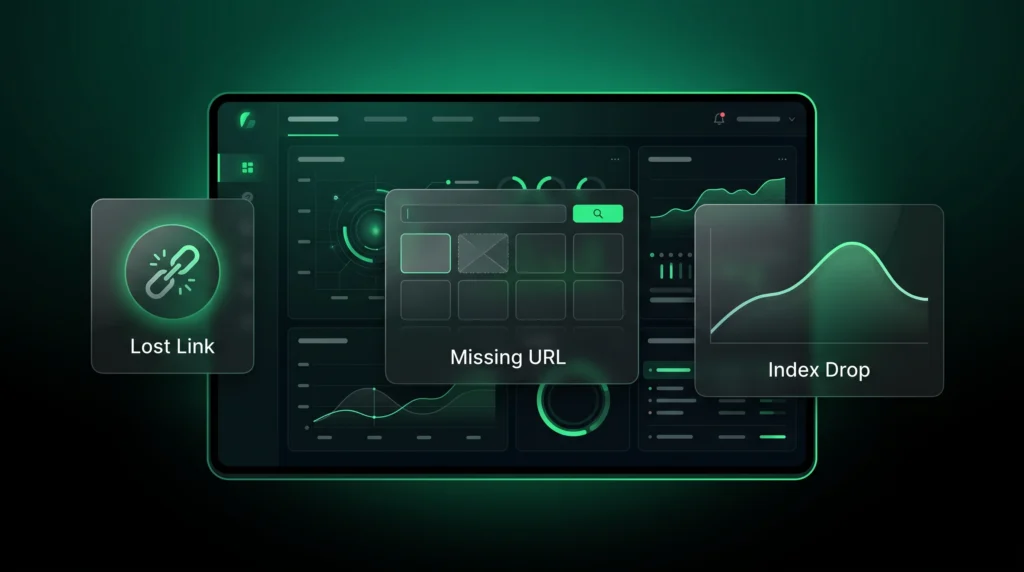
The main signs of PBN backlink deindexation are usually visible before a placement loses all value. Our monitoring process checks search results, crawling behavior, backlink tool data, and domain-level visibility instead of relying on one metric.
Warning signs include:
- placement page missing from Google index;
- sharp drop in indexed pages;
- domain missing for brand-style searches;
- lost link status in Ahrefs or Semrush;
- sudden crawl decline;
- unusual outbound link growth on the same site in your network.
Page Missing From Google Index
A page missing from Google index means the exact URL no longer appears for direct search checks. This can happen because of technical errors, crawl restrictions, low content quality, or broader domain visibility changes.
We first confirm the URL status manually before making a campaign decision. A temporary crawl fluctuation is different from repeated indexing instability, especially when the same issue appears across your PBN or across sites on the same server.
Domain Missing For Brand Search
A domain missing for brand search can signal lower trust, weak crawlability, or broader visibility problems. For PBN networks, we check whether the homepage, core pages, and recent posts still appear for domain-name or branded queries.
This check is practical because search engines often retain basic visibility for healthy real website structures. When the domain disappears completely, we review WHOIS data, content across your network, hosting signals, and backlink profile changes.
Cached Version Disappears From SERP
A cached version disappearing from SERP is not always a direct problem, but it can support a wider indexing diagnosis. Search results pages change often, so our agency never treats one missing cached version as a final conclusion.
We combine this signal with URL indexing, crawler access, backlink tool visibility, and content freshness. The stronger pattern matters more than a single search operator result.
Indexed Page Count Drops Suddenly
A sudden indexed page count drop can show crawling, quality, or technical instability. When many pages disappear at once, the issue may involve duplicate content, low editorial value, broken internal links, or footprint patterns.
Our team monitors page count trends after publication. If a PBN domain loses visibility, we pause additional placements and review technical configuration, content depth, outbound link ratio, and any recent algorithm turbulence affecting similar assets.
Backlink Tool Shows Lost Or Dead Link
A lost or dead link in Ahrefs, Semrush, or Majestic may indicate that the page changed, the link was removed, the URL stopped resolving, or the crawler could not access the placement. Backlink tool data is useful, but not final by itself.
We verify every link manually before taking action. A crawler delay is common, while repeated lost-link reports across multiple tools can justify replacing or revising the placement.
PBN Footprints Worth Checking
PBN footprints are patterns that make different websites appear connected. A professional PBN agency reduces visible footprint patterns by varying hosting, CMS configuration, design, authorship, publishing cadence, tracking scripts, and site structure.
Our PBN footprints review focuses on controllable signals:
- compare IP address, subnet, nameserver, and hosting provider;
- check WHOIS data, registrar pattern, and renewal behavior;
- review theme, plugin, layout, and author overlap;
- inspect outbound link destinations across your PBN;
- confirm that every PBN site has original content and realistic structure.
Shared Hosting Footprint
Shared hosting footprint appears when multiple network of websites use the same server, same IP range, or similar hosting setup. Different IPs do not automatically create quality, but hosting diversification supports a more natural infrastructure profile.
We avoid stacking too many sites on the same server. A safe PBN approach spreads assets across providers, account types, CMS setups, and server environments while keeping maintenance practical for long-term monitoring.
WHOIS And Registrar Pattern
WHOIS and registrar pattern checks help identify whether multiple domains appear managed by the same owner or process. Private registration, registrar diversity, renewal timing, and domain age can all influence the overall campaign risk profile.
Our acquisition process reviews WHOIS data alongside historical use, referring domains, anchor text, and prior search results. Aged domains are useful only when domain history supports the new content plan.
Nameserver And IP Range Similarity
Nameserver and IP range similarity can create visible connections across PBN networks. Search engines evaluate many signals, so a single shared feature is not always meaningful, but repeated similarities across every domain can reduce infrastructure quality.
We diversify nameservers and hosting patterns where practical. Our goal is not random variation; our goal is a real website footprint for each site in your network.
Same Analytics, AdSense, Or Tracking ID
Using the same Google Analytics, AdSense, or tracking ID across a private blog network creates an avoidable connection. PBN builders should never use one account for each site if the same account ties unrelated assets together.
We avoid shared tracking identifiers across client placement sites. When analytics are needed, tracking is configured with separation, minimal exposure, and a clear operational reason.
Content And Site Quality Signals For PBNs

Content quality is one of the strongest stability signals for PBN backlinks. A real website with original articles, topical structure, internal links, and limited outbound links is more durable than a thin site built only for commercial keyword placements.
Our editorial checks include:
- original writing with human review;
- content that is relevant to the site topic;
- internal links to supporting pages;
- varied formatting and page layouts;
- natural outbound link placement;
- no mass AI-generated content without editing.
Thin Or Reused Content Across Network
Thin or reused content across your network can reduce page value and create similarity signals. A page that exists only to link back to your money site rarely provides the context needed for stable authority transfer.
We write placement content around topical relevance, user intent, and natural mention flow. Every link should appear inside a useful paragraph, not in a random sentence attached to an unrelated topic.
AI Content Without Editorial Review
AI-generated content can support production, but AI-generated content without editorial review can create repetition, shallow explanations, and factual gaps. Content quality matters more than whether drafting begins with human writing or AI assistance.
Our agency reviews tone, facts, structure, topical depth, and link context before publication. The goal is content that reads like a real website article and supports the contextual link placement naturally.
Same Theme, Layout, Or Plugin Stack
Using the same WordPress theme, same plugins, and identical layout across every PBN site can create an unnecessary technical footprint. A well-built PBN should not look like copied infrastructure with changed logos.
We vary themes, page structure, plugin combinations, navigation, author presentation, and media style. These details help every PBN site operate as a separate content asset.
Expired Domain Rebuilt Without Topical Match
An expired domain rebuilt without topical match may lose relevance between historical backlinks and new content. For example, a former legal directory rebuilt as a fitness blog may create weak semantic alignment.
Before rebuilding a PBN domain, we review Wayback Machine history, referring domains, previous topics, anchor text, and organic traffic traces. Clients can also explore aged PBN domains for SEO when domain relevance and authority history are campaign priorities.
Spam Comments Or Low-Quality User-Generated Pages
Spam comments and low-quality user-generated pages can weaken the perceived quality of a PBN site. A site filled with irrelevant comments, auto-generated profile pages, or broken directory listings may create more harm than good.
We disable or moderate comment sections, remove junk pages, and check crawlable URLs before publication. Clean site architecture helps protect your site from weak supporting signals.
Missing Contact, Privacy, Or Real Site Signals
Missing contact, privacy, author, or editorial signals can make a PBN site look unfinished. Real website presentation matters because search engine systems evaluate quality, usefulness, and trust signals across pages.
We build basic trust elements into every PBN site where appropriate. Contact pages, about pages, privacy policies, author bios, and consistent navigation help support the site’s editorial identity.
Link Profile And Anchor Text Signals
A strong link profile supports PBN performance because link value depends on both the source domain and the target context. Our team checks referring domains, anchor distribution, toxic links, domain authority metrics, and link velocity before recommending placements.
Anchor strategy is reviewed against campaign intent:
| Signal | Stable Pattern | Review Trigger |
| Branded anchor | Natural brand mention | Too few brand anchors |
| Partial-match keyword | Controlled relevance | Repeated commercial keywords |
| Exact-match anchor | Limited use | Aggressive repetition |
| URL anchor | Natural citation | Overuse across campaign |
Referring Domain Quality
Referring domain quality shows whether backlinks pointing to a PBN domain come from relevant, indexed, and trustworthy sources. Ahrefs, Semrush, Moz, and Majestic can estimate authority, but manual review is still necessary.
We check the backlink profile before placement because high-authority metrics alone can be misleading. A domain authority score means less when referring domains are irrelevant, hacked, hidden, or dominated by toxic links.
Anchor Text Distribution
Anchor text distribution influences how natural every link back to your money site appears within the broader backlink profile. Exact-match anchors can be useful, but repeated exact-match use across PBN backlinks may create ranking volatility.
We balance branded, URL, partial-match, topical, and generic anchors. The right mix depends on the money site authority, existing backlink profile, keyword difficulty, and current search rankings.
Sudden Link Growth Patterns
Sudden link growth patterns can make a campaign look unnatural when too many links appear in a short period. PBN link velocity should match website age, competition level, backlink profile strength, and ranking timeline.
Our PBN link velocity planning controls publication timing, anchor variation, and target URL rotation. A conservative schedule often produces more stable results than aggressive link-building bursts.
Expired Domain Redirect History
Expired domain redirect history reveals whether a domain was previously used for SEO redirects, affiliate campaigns, hacked pages, or irrelevant commercial topics. Redirect abuse can weaken trust in a domain’s history.
We review Wayback Machine snapshots, historical anchors, prior URLs, and redirect traces before using a domain. Strong expired domains have coherent history, relevant backlinks, and no obvious pattern of churn.
Outbound Link Ratio
Outbound link ratio shows how many external links appear across a PBN site compared with useful content. Too many outbound links can reduce link equity and make the site look built mainly for link placement.
We limit outbound links per article and across each website. A contextual link to your money site should appear naturally, with supporting internal links and relevant editorial content around the placement.
Money Site Link Placement Context
Money site link placement context determines whether the backlink supports the target page topic. A link to your money site should appear in a paragraph that explains a related concept, service, product, or informational topic.
We place links where readers would expect a citation or recommendation. Contextual placement helps search engines connect the source topic, anchor text, target page, and keyword intent more clearly.
Technical Checks For PBN Link Building
Technical checks help confirm that PBN link building supports rankings without avoidable instability. Our review covers index status, crawl access, robots directives, canonical tags, internal links, HTTP status codes, hosting separation, and CMS configuration.
Our standard process includes:
- verify page indexation and domain visibility;
- check the backlink profile in Ahrefs or Semrush;
- review domain history and old content;
- inspect outbound link count;
- confirm anchor text and target URL;
- monitor placement after publication.
Manual SERP Check Before Link Placement
Manual SERP check before link placement confirms whether the PBN domain and relevant pages appear in search results. Tool metrics are helpful, but search results provide direct visibility evidence.
We search for the domain name, selected URLs, and article titles before approving placement. When a domain has no visible search footprint, the placement requires deeper review before any link-building decision.
Wayback Machine History Review
Wayback Machine history review shows what a PBN domain looked like before acquisition. Domain history can reveal previous business type, language, topical focus, spam pages, hacked content, or irrelevant redirects.
We use historical snapshots to rebuild content around authentic topical signals. A strong rebuild respects past relevance while adding fresh, useful content for the current site.
Toxicity Score Review
Toxicity score review helps identify toxic links, weak referring domains, and suspicious anchor patterns. Tools like Semrush, Ahrefs, and Majestic provide useful indicators, but a professional review should not depend on one automated score.
We combine tool data with manual backlink inspection. A domain with a few weak links can still be usable, while a domain with broad irrelevant patterns may be excluded from placement inventory.
Best Practice For Using PBN Links
Best practice for using PBN links starts with controlled execution. A safe PBN strategy focuses on domain quality, topical content, diversified infrastructure, limited outbound links, and transparent reporting rather than high-volume placement.
Practical standards include:
- check the backlink profile before approval;
- use original content across your network;
- avoid using the same WordPress theme everywhere;
- diversify hosting and IP address patterns;
- place links only inside relevant articles;
- review every link after publication;
- avoid unrealistic ranking guarantees.
Content Refresh Schedule
A content refresh schedule keeps PBN websites active and useful. Search engine crawlers respond better to sites that continue publishing, updating older articles, fixing broken links, and improving topical coverage.
We refresh supporting pages, update internal links, and add new content where it makes sense. Maintenance helps every PBN site operate like a long-term asset rather than a one-time link page.
WordPress And Plugin Updates
WordPress and plugin updates protect site functionality, crawlability, and user experience. Broken plugins, outdated themes, and security issues can affect indexing, page rendering, and link visibility.
Our maintenance team monitors CMS health across PBN networks. We update carefully because aggressive bulk updates across every domain can create timing patterns or technical conflicts.
Link Placement Review
Link placement review confirms that every link appears in the right article, paragraph, anchor, and destination. Every link should support the reader’s topic and connect naturally back to your money site.
We review the surrounding sentence, section topic, outbound links, and target page relevance. When placement context is weak, we revise content before publication instead of forcing the link.
Page Indexing Recheck
Page indexing recheck confirms whether the published placement remains discoverable after search engine crawling. Indexing can change after publication, especially when content quality, crawl depth, or technical signals shift.
We recheck the page after placement and during campaign reporting. If visibility weakens, we review content depth, internal links, crawl access, and domain-level indexation patterns.
Recovery Steps When PBN Backlink Looks Unstable
Recovery begins with diagnosis, not panic. A PBN backlink can look unstable because of crawler delays, temporary search results changes, content edits, hosting issues, or domain-level quality signals.
Our recovery workflow is practical:
- confirm whether the link still exists;
- check URL index status manually;
- review hosting, crawl, and HTTP response;
- inspect anchor and outbound link changes;
- compare backlink tool data;
- decide whether to refresh, replace, or remove the link.
Link Removal Request When Needed
A link removal request may be useful when a placement no longer meets quality standards. We use removal only when review shows weak domain quality, poor indexation stability, irrelevant content, or unsuitable outbound link patterns.
Professional PBN management includes knowing when to retire links. Keeping every link forever is not always the best decision for a campaign risk profile.
Disavow Review For Extreme Cases
Disavow review is reserved for extreme cases where backlinks create persistent quality concerns and cannot be removed. Google Search Console supports disavow file submission, but submitting a reconsideration request is a separate process tied to manual action situations.
We do not treat disavow as routine maintenance. Our first preference is domain vetting, placement control, link removal, or replacement before using advanced cleanup actions.
Guest Post Link Comparison During Audit
Guest post link comparison during audit helps evaluate how PBN backlinks fit into the full backlink profile. Some websites use editorial backlinks, guest post placements, niche edits, tiered link building, and PBN backlinks together.
We compare placement relevance, anchor text, domain quality, link equity, and traffic signals. The goal is to diversify your backlink profile without overusing any single link-building source.
FAQ
A PBN in SEO is a private blog network: a group of websites used to publish contextual backlinks to target pages. A professional network relies on aged domains, original content, controlled outbound links, and diversified infrastructure. PBNs work best when execution quality, topical relevance, and anchor planning are carefully managed.
You check whether a PBN site is deindexed by searching the domain, exact URLs, and recent article titles in Google search results. A professional review also checks crawl access, HTTP status, backlink tool data, and indexed page trends. One missing URL may be temporary, but repeated domain-wide loss needs deeper review.
Yes, a search engine can reduce or ignore link value when signals suggest weak relevance, poor content quality, or unnatural patterns. That does not mean every PBN placement creates a manual action. Strong domain vetting, contextual content, conservative anchors, and controlled link velocity help reduce avoidable ranking volatility.
PBN links are easier to evaluate and monitor when the placement page is indexed. An indexed page can pass clearer authority signals because search engines can crawl and assess the content. If the page is not indexed, the backlink may provide limited or inconsistent value depending on crawlability and domain signals.
A PBN link may have lost value if the placement page disappears from search results, the backlink tool reports a lost link, rankings soften after crawl updates, or the domain shows broader visibility decline. A full review should include index status, anchor context, outbound links, and referring domain quality.
When Google stops indexing a PBN page, the backlink on that page may pass less link equity or become harder to measure. The right response depends on the cause. A professional agency may refresh content, improve internal links, fix technical issues, replace the placement, or remove the link when quality standards are no longer met.