
PBN Link Indexing And Value Verification
PBN link indexing and value verification starts with one practical question: can Google crawl the page, index the placement, and evaluate the contextual backlink as a quality backlink? As a professional PBN agency, pbnbacklinksservice.com evaluates aged domains, domain history, backlink profile strength, topical relevance, outbound links, and indexation stability before placing links for client campaigns.
Controlled PBN backlinks are not random bulk links. A private blog network needs real websites, original PBN content, conservative anchor text distribution, diversified infrastructure, and regular monitoring. When these variables are managed correctly, contextual link placement can support search engine rankings while keeping the campaign risk profile realistic.
Backlink Indexing Meaning For PBN Links
Backlink indexing means the external site page containing your backlink appears in Google’s index and can be evaluated by search engine systems. For PBN backlinks, indexing is the first verification point before value analysis.
A link on a page that may never be indexed has limited practical value because Google does not need to consider pages outside search results. Our agency checks whether the page is indexed, crawlable, contextually relevant, and technically clean before treating the placement as active.
Backlink Indexing Definition
Backlink indexing means Google has discovered, crawled, and stored the page where the backlink appears. A backlink can support ranking signals only when the crawler can access the page, process the content, and evaluate the link relationship.
Key indexing checks include:
- Whether the page is indexed in Google’s index.
- Whether Google can crawl the page without technical blocks.
- Whether the backlink sits in visible main content, not only footer or sidebar areas.
- Whether the link is followed rather than hidden behind no-follow links.

Mon-Fri: 09:00 AM – 06:00 PM
Why Indexing Matters For PBN Value
Indexing matters because PBN backlinks provide value only after Google crawls the page and evaluates the content surrounding the link. A contextual backlink from an already indexed aged domain can send stronger relevance signals than a link buried deep in the site on a weak new page.
Indexation is also a quality control signal. If many pages across your PBN fail to index, the issue may involve content quality, outbound link patterns, weak internal links, or risky network footprints.
Indexed Links Versus Crawled Links
A crawled link is not always an indexed link. Google can crawl the page, process the HTML, and still decide that the page should not appear in search results.
An indexed link appears on a page that Google has accepted into Google’s index. For PBN posts, our team separates crawling and indexing because a crawler visit confirms access, while indexation confirms stronger eligibility for link value evaluation.
Google Indexing Process For PBN Backlinks

Google indexing works through discovery, crawling, rendering, and selection. PBN sites need clean crawl paths, original new content, internal links, and technical accessibility because backlinks get indexed more reliably when search engines can evaluate every page naturally.
At pbnbacklinksservice.com, contextual placements from PBN backlink packages are reviewed through this sequence before reporting. The goal is not to tell Google to value a link, but to create conditions where Google can see, crawl, and assess the placement properly.
Discovery Through Internal Links, Sitemaps, RSS, Mentions
Discovery happens when Google finds a URL through internal links, sitemap files, RSS feeds, external links, or mentions from another external site. New PBN posts should not be orphaned because pages deep in the site often receive weaker crawl attention.
A clean discovery workflow includes:
- Publish new content on an active PBN site.
- Add internal links from relevant existing posts.
- Include the page in a clean XML sitemap.
- Support discovery with natural external signals when appropriate.
Crawl Scheduling And Priority Signals
Crawl scheduling depends on demand, quality, authority, freshness, and technical performance. Google crawls your site more efficiently when the PBN site has useful content, healthy internal links, fast server response, and no crawl waste.
Low-quality pages, broken links, excessive outbound links, and duplicate templates can reduce crawl priority. A professional private blog network improves crawl demand by keeping PBN sites active, relevant, and technically stable.
Page Crawling And Rendering
Page crawling and rendering confirm whether Google can access visible content, anchor text, links, images, scripts, and canonical tags. A backlink placed inside content that Google can crawl is more useful than a link hidden behind scripts, widgets, or blocked assets.
Our technical review checks the robots.txt file, canonical settings, server status, page speed, mobile rendering, and whether the content is visible without user interaction. These details are easy to overlook but can decide whether the page is indexed.
Indexation Decision Signals
Google uses multiple signals to decide whether content deserves indexation. PBN posts with thin text, recycled paragraphs, irrelevant anchors, or excessive external links may struggle to index because the content appears weak or duplicative.
Strong indexation candidates have original writing, topical relevance, clean formatting, helpful context, limited outbound links, and consistent internal linking. Search engines evaluate page quality, not only domain metrics.
Indexing Statuses To Check Before Measuring Value
Indexing status shows where the PBN page sits in the discovery-to-indexation pipeline. The same backlink can be found by tools like Ahrefs, visible in a browser, and still absent from Google’s index.
We use status checks before judging link value because ranking movement takes time. A placement should be verified at URL level, page level, and link level before campaign performance is evaluated.
| Status | Meaning | Agency Response |
| Discovered | Google knows the URL | Strengthen internal links |
| Crawled | Google visited the page | Improve content quality |
| Indexed | Page appears in index | Monitor ranking impact |
| Dropped | Page lost indexation | Review deindexation signals |
Discovered – Currently Not Indexed
“Discovered – currently not indexed” means Google knows the URL but has not crawled or selected the page for indexation yet. This status is common for a new page, especially when the PBN site has low crawl demand.
Our response is practical. We improve internal links, refresh related content, check sitemap inclusion, and make sure the page is not buried deep in the site where Google may never prioritize crawling.
Crawled – Currently Not Indexed
“Crawled – currently not indexed” means Google crawled the page but did not keep the page in search results. For PBN content, this often points to weak uniqueness, low topical value, poor formatting, or excessive outbound links.
A page that fails to index after crawling needs quality review. We expand the content, tighten relevance, fix broken links, reduce link clutter, and improve internal link context before requesting another review cycle.
Indexed, Not Submitted In Sitemap
“Indexed, not submitted in sitemap” means Google found the page through another discovery path. This status is not automatically negative because Google can crawl and index pages through internal links or external references.
For PBN posts, this status confirms that Google has already processed the page. We still check whether the sitemap is clean because sitemap consistency helps maintain crawling and indexing across your network.
Deindexed Or Dropped From Index
A deindexed or dropped PBN page was previously indexed but no longer appears in Google’s index. This can happen after content changes, crawl disruptions, quality reassessment, technical changes, or weak page signals.
We review PBN deindexation signals by checking domain history, server logs, robots.txt file changes, canonical tags, thin content, outbound links, and footprint patterns across multiple sites.
Noindex, Robots.txt, Crawl Block Issues
Technical blocks can prevent backlinks from getting indexed even when the PBN domain looks healthy. A misplaced noindex tag, blocked directory, or bad canonical can make the link invisible to search engine systems.
Common technical checks include:
- Confirm no noindex tag appears on the PBN post.
- Confirm the robots.txt file allows Googlebot to crawl the page.
- Confirm the canonical tag points to the live URL.
- Confirm the server returns a 200 status code.
Signals Google Uses To Decide PBN Link Indexing And Value
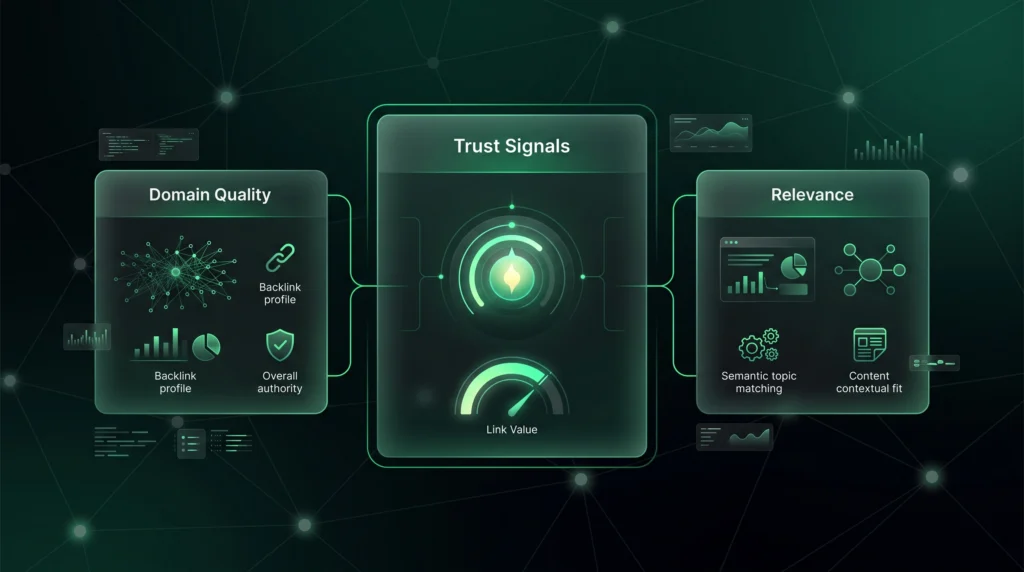
Signals Google uses to decide PBN link indexing and value include authority, relevance, content quality, crawl accessibility, link context, and user engagement patterns. No single factor in ranking explains every outcome.
Our agency evaluates these signals before placing links because controlled execution matters more than raw domain metrics. PBN backlinks work best when aged domains, original content, and contextual link placement support a natural backlink profile.
Signal groups we review include:
- Domain-level trust and clean history.
- Page-level topical relevance and originality.
- Link-level placement, anchor text, and surrounding copy.
- Network-level footprint protection across your PBN.
Site-Level Authority
Site-level authority comes from aged domains with clean history, relevant referring domains, organic traffic signals, and stable indexation. Tools like Ahrefs, Semrush, Majestic, and Moz can help evaluate domain strength, but manual review is still required.
A strong PBN site should not exist only to publish links. Sites that exist with topical structure, real content, and controlled outbound links create better conditions for value transfer.
Content Uniqueness
Content uniqueness helps Google decide whether the PBN post adds value beyond recycled SEO text. New content should match the aged domain’s topic, support the anchor naturally, and avoid thin keyword stuffing.
Our editors build PBN content around semantic relevance, entity-rich copy, natural subtopics, and clear context. Original content quality is one of the strongest operational safeguards for indexation stability.
Internal Link Structure
Internal link structure helps Google crawl the page and understand how PBN posts relate to other pages. A backlink placed on an orphan page may never receive enough crawl attention to produce value.
We connect new PBN posts to relevant category pages, older articles, and topical clusters. This structure helps Google crawl your site more efficiently and reduces indexing instability across your network.
External Signals
External signals include backlinks to the PBN post, mentions, citations, social discovery, and links from related pages. A page with no signals can still index, but pages that offer stronger discovery paths usually perform better.
External links should be natural and selective. Many links built too quickly to a weak post can look unnatural and may reduce value rather than improve indexation.
User Engagement Signals
User engagement signals are indirect but useful for operational review. Pages with organic traffic, real clicks, branded searches, and readable layouts often have stronger indexation stability than abandoned pages with no activity.
We do not treat engagement as a guaranteed ranking lever. We treat engagement as a quality clue that shows whether the website’s content, structure, and topical positioning look credible.
Page-Level Trust And Relevance
Page-level trust depends on whether the content, anchor text, outbound links, and target URL make sense together. A relevant contextual backlink from a niche-aligned page is more credible than a random sidebar link.
Our placement team reviews topical relevance in PBN backlinks before publishing. This process helps align PBN posts with money-site intent, keyword themes, and backlink profile goals.
Signs Showing PBN Backlinks May Pass Value
PBN backlinks may pass value when the linking page is indexed, the anchor text is relevant, the surrounding copy is original, and the target page shows gradual ranking or crawl improvements. These signs should be measured together.
A single metric can mislead. For example, tools like Ahrefs may discover new links before Google uses them, while Google Search Console may show delayed or incomplete link data.
Ranking Movement After Link Placement
Ranking movement after link placement is one of the clearest signals that a PBN backlink may be contributing value. Movement should be measured against baseline keyword positions, competitor changes, content updates, and other link-building activity.
A clean review process includes:
- Record target keyword positions before placing links.
- Track search engine rankings over several crawl cycles.
- Compare movement against new links, page updates, and SERP volatility.
Target Page Crawl Frequency Changes
Target page crawl frequency changes can suggest that Google is paying more attention to the money site. Google crawls important pages more often when new links, new content, or stronger internal signals increase discovery demand.
This signal is not proof by itself. Our agency compares crawl logs, Google Search Console data, and ranking trends before linking crawl frequency to PBN backlink impact.
Anchor Text Relevance And Context
Anchor text relevance helps search engines understand the relationship between the linking page and target page. A natural backlink profile includes branded anchors, URL anchors, partial-match anchors, topical anchors, and carefully limited exact-match anchors.
Aggressive anchor text can create ranking volatility. Our anchor planning focuses on relevance, distribution, and campaign maturity rather than repeating one keyword across multiple placements.
Link Placement Inside Main Content
Link placement inside main content usually carries stronger context than a footer, header, or sidebar link. A contextual link surrounded by relevant paragraphs helps Google see clear semantic alignment between the source page and destination page.
Our placement standard avoids cluttered templates and excessive outbound links. The link should feel editorial within the article, even when the campaign uses controlled PBN infrastructure.
Referral Traffic, Brand Queries, Engagement Clues
Referral traffic, brand queries, and engagement clues can support value analysis when the PBN site has real visibility. Not every quality backlink produces referral traffic, but complete absence of activity across many pages deserves review.
We use these clues carefully. Organic traffic, branded searches, and reader behavior help identify PBN sites that operate as real websites rather than inactive link containers.
Link Equity Signals Across Target Pages
Link equity signals across target pages include better crawl frequency, broader keyword visibility, improved positions, and stronger ranking stability. PageRank is no longer visible as a public metric, so modern SEO relies on observable outcomes and third-party indicators.
A backlink profile should grow naturally. Building links from PBN sites works best when combined with content improvements, internal links, and balanced acquisition from multiple source types.
PBN Factors That Limit Indexing And Link Equity
PBN factors that limit indexing and link equity usually come from execution quality. Weak aged domains, poor content quality, aggressive outbound links, visible footprints, and unnatural link velocity can reduce value.
Professional PBN management focuses on prevention. At pbnbacklinksservice.com, domain vetting, content standards, anchor review, and infrastructure variation are handled before client placements go live.
| Limiting Factor | Effect On Campaign | Control Method |
| Weak domain history | Lower trust | Archive and backlink review |
| Thin PBN content | Indexing instability | Original editorial content |
| Too many outbound links | Reduced link value | Outbound link limits |
| Shared footprints | Network exposure | Hosting and CMS variation |
Low Crawl Demand And Weak Site Activity
Low crawl demand happens when a PBN site has little new content, weak internal links, few relevant external signals, and many pages with no search visibility. Google may crawl fewer URLs when the site appears inactive.
We maintain PBN sites with fresh posts, updated content, category structure, and controlled publishing cadence. This helps backlinks get indexed without relying on spammy automation or mass pinging.
Thin, Repetitive, Or Unhelpful Content
Thin, repetitive, or unhelpful content makes PBN posts less likely to index and less likely to support value transfer. Search engines evaluate whether the content deserves inclusion, not only whether the backlink exists.
Our editorial process avoids reused templates and generic paragraphs. Every page is written to support the backlink context, topic, and user intent behind the target page.
Poor Internal Link Structure
Poor internal link structure keeps important PBN posts too deep in the site. If Google does not find efficient crawl paths, a new PBN page may never be indexed or may index slowly.
We fix broken links, connect related PBN posts, and ensure category pages point to pages you actually want crawled. Internal relevance matters across your PBN because crawl depth influences discovery.
Weak Trust Elements And Missing Credibility Signals
Weak trust elements can reduce perceived site quality. A PBN site should include coherent branding, author details where appropriate, contact information, privacy pages, category structure, and content that matches the domain history.
Trust signals do not need to be exaggerated. A simple, consistent, well-maintained website with original content often performs better than a heavily templated site trying to look larger than it is.
Tools And Checks For PBN Link Indexation
Tools and checks for PBN link indexation help separate visible placements from active SEO assets. A link shown in a report is not enough; the page should be crawlable, indexed, relevant, and technically healthy.
We combine manual checks with platforms such as Google Search Console, Ahrefs, Semrush, and Majestic. No single platform sees every page, every backlink, or every crawl event.
Useful verification checks include:
- Google search operator checks for indexed URLs.
- URL inspection tool review when access is available.
- Third-party backlink discovery comparison.
- Manual review of content, anchors, and outbound links.
Google Search Operators For Indexed URL Checks
Google search operators help verify whether the page is indexed. The simplest method is to check the URL with a site: search or exact URL search, then confirm whether the page appears in search results.
This check has limits. Search operator results can fluctuate, so our team uses operators as a first check, not the only proof of link value.
Google Search Console URL Inspection Limits
Google Search Console’s URL inspection tool can show whether the page is indexed, crawlable, and canonicalized, but access usually belongs to the website owner. For client money sites, URL inspection helps confirm whether Google has discovered new links indirectly.
The URL inspection tool is useful but not complete. Google does not show every link signal, and Google Search Console link reports can lag behind actual crawling.
Third-Party Backlink Index Checkers
Third-party backlink index checkers can identify whether a URL appears indexed, but results vary by data source. Some tools rely on scraped search results, while others combine crawler databases and status checks.
We treat these platforms as supporting evidence. If a tool says a page is indexed, manual verification still matters because false positives and stale data are common.
Ahrefs, Semrush, Majestic, And Link Discovery Gaps
Ahrefs, Semrush, and Majestic are useful for backlink profile analysis, referring domains, anchor text, and link discovery. Tools like Ahrefs can find many links quickly, but third-party crawlers do not match Google’s crawler exactly.
A link may appear in Ahrefs before Google has already indexed the page. A link may also pass value before third-party tools discover it.
Manual SERP Checks For PBN Pages
Manual SERP checks confirm what automated tools can miss. A reviewer should check the URL, cached snippets when available, title display, index presence, and whether the content appears as expected.
Manual review also catches quality issues. Excessive external links, unrelated anchor text, and thin paragraphs are easier to detect through human inspection than through automated metrics.
Troubleshooting PBN Links Not Indexed Or Not Passing Value
Troubleshooting PBN links requires a sequence: confirm crawl access, review content quality, strengthen internal links, evaluate external signals, and decide whether the page should be replaced. Random re-submission is rarely the best first step.
Our agency troubleshooting workflow avoids panic. Indexing instability usually comes from controllable variables: technical settings, content depth, crawl paths, link context, and footprint patterns.
A practical workflow includes:
- Check the URL and crawl accessibility.
- Review whether the content is original and relevant.
- Improve internal links and sitemap signals.
- Replace the placement when the page continues to fail.
Technical Fixes For Crawl Blocks
Technical fixes start with crawl access. Google can crawl a page only when the server responds properly, the robots.txt file allows access, and page-level tags do not block indexation.
Our technical checklist covers:
- Status codes and redirects.
- Noindex tags and robots directives.
- Canonical tags and sitemap inclusion.
- Broken links and rendering issues.
Content Refreshes And On-Page Improvements
Content refreshes help when the page is crawled but not indexed. We improve the article by adding unique details, clearer structure, better topical depth, and more natural anchor placement.
New content should answer a real search intent. A PBN post that looks like placeholder text with one link is less likely to keep stable indexation than content with useful context and relevant internal references.
Stronger Internal Links And Crawl Paths
Stronger internal links help Google find and prioritize PBN posts. A placement linked only from a weak archive page may struggle to index, especially on a large site with many pages.
We add contextual internal links from related posts, categories, and hub pages. This approach helps Google crawl your site more efficiently and supports crawling and indexing without unnatural pressure.
Tier 2 Backlinks, Social Mentions, Pings
Tier 2 backlinks, social mentions, and pings can help discovery when used conservatively. The purpose is to create crawl signals around the PBN post, not to flood the page with low-quality links.
Tiered link building should match the campaign risk profile. Our team uses selective signals, avoids spammy automation, and monitors whether backlinks get indexed after support is added.
Replace Links On Pages That Will Not Index
Some pages that offer little value may never be indexed even after improvements. When a PBN post continues to fail to index, replacing the placement is often more efficient than forcing repeated fixes.
Replacement decisions are based on evidence. We review domain quality, content quality, crawl history, and risky PBN network footprints before choosing a stronger page.
Recheck Indexation After Every Change
Rechecking indexation after every change keeps reporting accurate. A page can move from discovered to crawled, from crawled to indexed, or from indexed to dropped after technical or content updates.
Our reporting process tracks URL check results, index status, anchor text, link target, placement date, and ranking movement. This protects clients from assuming value before the link is actually active.
FAQ
Check whether the PBN post URL appears in Google’s index, then verify that the backlink is visible, crawlable, and placed inside main content. Use Google search operators, Google Search Console when available, and tools like Ahrefs or Semrush for supporting evidence. Indexation confirms page visibility, but link value still depends on relevance, authority, anchor text, and content quality.
PBN backlinks can index in days, weeks, or longer depending on domain authority, crawl demand, content quality, internal links, and technical setup. Aged domains with active publishing and clean internal links usually index faster than inactive sites. If a new page is still not indexed after several crawl cycles, review crawl blocks, content depth, and internal link structure.
Yes, PBN backlinks can be indexed but pass little value if the page is weak, irrelevant, overloaded with outbound links, or supported by a poor backlink profile. Indexation only means the page is eligible for evaluation. Link value depends on topical relevance, authority, placement context, anchor distribution, and whether the target page deserves stronger rankings.
Tier 2 backlinks can help PBN links get indexed by creating additional discovery paths for crawlers. This works best when Tier 2 links are relevant, moderate, and used to support crawlability rather than inflate signals aggressively. Poor Tier 2 links can reduce campaign quality, so selective placement and monitoring matter.
A PBN link may drop out of Google’s index because the page changed, crawl access failed, content quality was reassessed, internal links weakened, or the domain showed visible footprint patterns. The first step is to review technical settings, content uniqueness, outbound links, and crawl history. Some drops are temporary, while repeated drops usually require replacement or deeper quality fixes.
Backlink indexing tools can be useful for checks, but aggressive automation is not a substitute for quality control. A professional PBN agency focuses on crawlable pages, original content, internal linking, limited outbound links, and stable infrastructure. Tools are safest when used for verification and conservative discovery support, not mass artificial signal generation.